
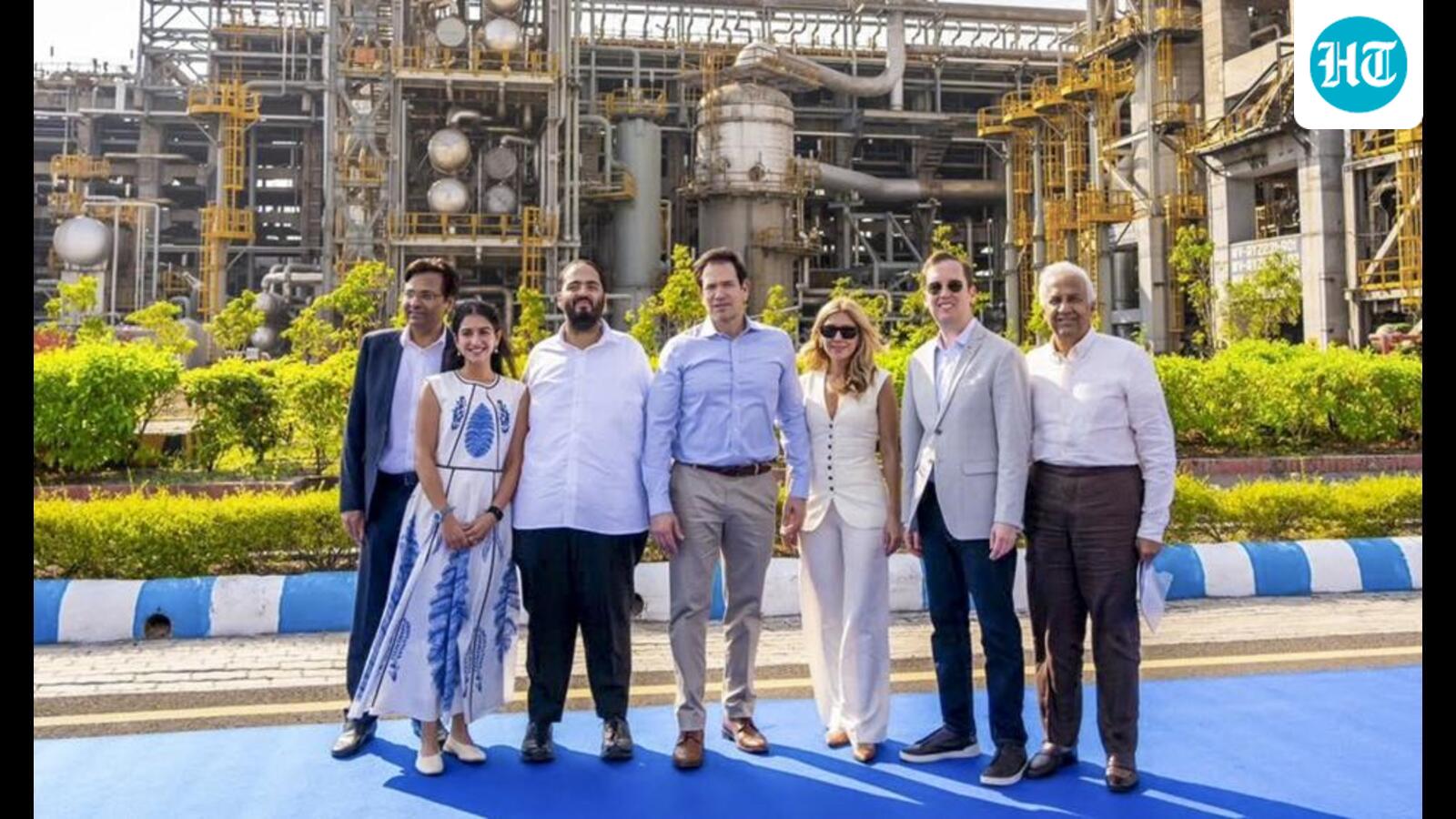
US Secretary of State Marco Rubio arrived in Mumbai for his second visit to India. An accompanying journalist said it was "remarkable" and wondered why Rubio would travel again so soon. The trip showed that the Trump administration sees India as a key partner for energy, technology, and economic interests.
When US secretary of State and national security advisor Marco Rubio arrived in Mumbai, an accompanying journalist said it was "remarkable" and wondered why Rubio would travel again to India within a few months. This is not a question that gets asked when senior American cabinet members visit European or West Asian countries multiple times. But, perhaps, the puzzlement reflects a gap that's long existed between the DC establishment's sense of India's utility and that of US administrations. And Rubio's trip made evident that, despite frictions, the Donald Trump administration does see India as useful to some of its interests -- even if its agenda and prioritisation is different from that of the Joe Biden era.
One of those interests was clearly energy and India's usefulness on both the demand and supply sides (as a consumer and a refined product producer). Former US officials have talked about the importance of engaging India because of the scale it brings in the technology domain. The Trump administration clearly sees that scale as important in the energy -- and especially hydrocarbon -- domain as well. It has highlighted in recent months that India is the third-largest energy consumer, the number one destination for US coal exports, and a growing buyer of US oil, natural gas, and liquefied petroleum gas.
This is not just an energy play but also a foreign policy, economic and even political play -- and Washington seeing if India can be part of the solution to problems the US is facing across multiple regions. While it continues to urge India to buy more American energy, the emphasis during Rubio's trip to the world's largest refinery seemed to be on the purchase of Venezuelan oil. This is a 180-degree turn given that US sanctions had previously resulted in India ceasing imports from there. But it is not unexpected given this administration's interests in Venezuela, the secretary's own interest in Western hemisphere affairs, and the desire to stabilise prices by getting more oil on the market.
The economic and political dimensions were also evident in the secretary's emphasis on India's role as a petroleum products exporter -- at a time, ahead of the midterms, that President Trump has sought increased diesel supplies. And they were implied in Rubio's comments about Reliance building a refinery in the US, and in his reported meetings with the Adani and Tata leaderships. The administration has recently touted Indian investment in the US and is seeking more of it. But this engagement might also reflect the perception of Indian business as a potential enabler or disruptor of economic cooperation, and thus a desire to engage it as a constituency.
There clearly also remains interest in getting a trade deal done. Rubio noted that the finish line was "incredibly close." It remains to be seen whether this time is different from previous assurances that a deal would soon happen. But certain factors might help: the granting of a waiver from Russia-related sanctions, potential Modi-Trump meetings (in Manila in November and Florida in December) that can serve as action-forcing events, and the prospect that Indian trade deals with others could benefit US competitors for market access in India. Some can be dismissive about the importance of India as a trading partner for the US, but it has moved up the ranks (as a goods trade partner, it's almost the same as the UK and it's a larger services trade partner than China).
US interest in continued Indian partnership on regional security, defence and technology was less front and centre during this visit but not absent. Ahead of Rubio's trip, it was visible in bilateral engagements on the Indian Ocean and space, in multiple military exercises, and in US Pacific Command's Admiral Samuel Paparo's second visit this year. During the secretary's visit, on the western flank, the India-US-UAE trilateral meeting placed special emphasis on, predictably, energy security. On the Indo-Pacific, Rubio expressed particular enthusiasm about Quad "really taking on a lot of energy." He acknowledged that a strong India-US relationship was a necessary basis for it. And perhaps the positive tone -- speaking of India as a "feature" of US foreign policy and of "extraordinary" alignment -- was to infuse some momentum and lay the ground for potential Quad and bilateral high-level engagements in the months ahead.
Despite the positive mood music, neither side denied differences. India's external affairs minister S Jaishankar stated India was "deeply invested" in ties with the U.S. But he also alluded to Indian concerns about the US approach to Pakistan and its immigration policy. On his part, on certain issues, Rubio engaged in damage control. He criticised those fueling anti-Indian sentiment in the US and asserted that those in power should not encourage hateful behaviour. On others, such as a US-China G2, he tried to mitigate Indian concerns. But on yet others, he defended the administration's position. For instance, comparing the US need to engage with Pakistan to India's engagement with US rival Iran.
The question that remains is whether these and other divergences can be managed or if they will prevent both sides from focussing on and expanding areas of convergence -- something the Indian foreign minister saidwas essential if India-US cooperation was to deepen. The answer to that will determine the ceiling of this relationship, and it will depend in part on whether the US president's view of India's utility is sufficient to navigateor dissipate the current headwinds or those that emerge in the future.