
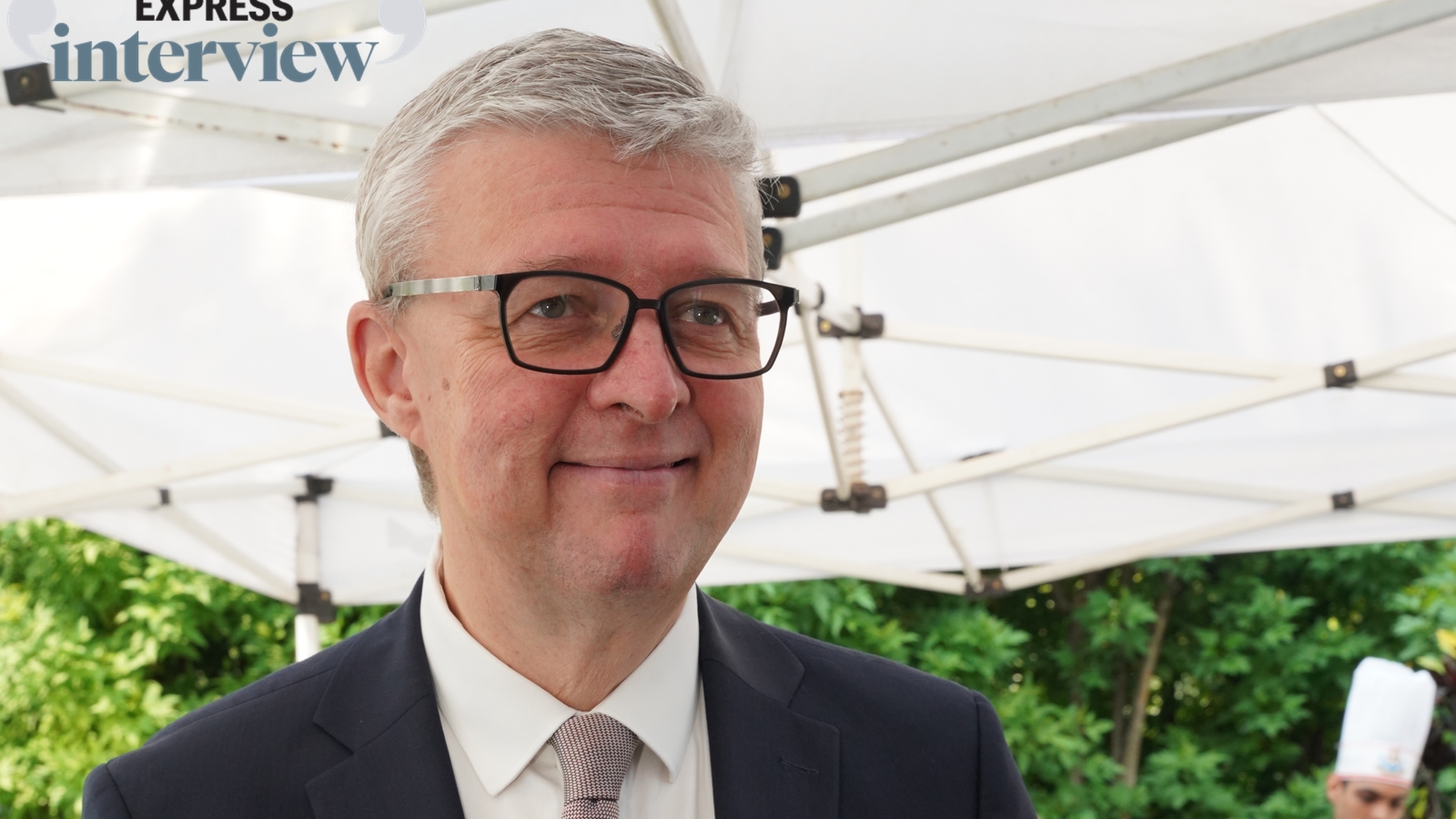
Czech Deputy Prime Minister Karel Havlicek said India’s ceasefire proposals for the Russia-Ukraine war are helpful. He noted the conflict has no military solution and drains resources. Havlicek, who finished a four-day visit to India, added that tariff barriers create uncertainty, while India remains a key strategic partner for trade.
It seems the conflict does not have a military solution and it significantly drains the resources of both sides, says Czech Republic's First Deputy Prime Minister Karel Havlicek.
The Russia-Ukraine war stalemate may not have a military solution and India's ceasefire proposals to stabilise the situation are helpful, says Czech Republic's First Deputy Prime Minister and Minister of Industry and Trade, Karel Havlicek, who just wrapped up a four-day visit to India. In an email interview from Prague, Havlicek talks about his multi-city visit to India aimed at strengthening trade, technology and defence cooperation. He also weighs in on US protectionism and why India-Middle East-Europe Economic Corridor (IMEC) is more critical than ever. Edited excerpts:
President Petr Pavel has said the war will not end soon. Does Prague expect New Delhi to use its leverage with Moscow to push for peace?
The war in Ukraine has gone on for more than four years, and it remains in a stalemate. It seems the conflict does not have a military solution and it significantly drains the resources of both sides. Therefore, the diplomatic solution is our preferred choice. Nevertheless, it must be consistent with international law, respect Ukraine's sovereignty and future security guarantees. Russia's aggression constitutes a violation of the UN Charter, and any sustainable peace should not in principle legitimise territorial changes achieved through force.
Keeping channels open can help create conditions for a negotiated and lasting peace without compromising these principles. We applaud India's recent ceasefire proposals to stabilise the situation in Ukraine before the winter season.
Where does the Czech Republic place India -- as a trade partner, a strategic partner, or as a bridge between the Global South and the EU?
We see India as a strategic partner and one of the key economic and political players in the world. Czech companies want to take part in India's economic growth and modernisation, while India is becoming an increasingly important partner for the diversification and resilience of European supply chains.
The greatest potential lies in sectors where Czech companies can offer advanced technologies and know-how to support India's economic modernisation agenda under the 'Make in India' initiative. These include transport infrastructure, railway industry, civil aviation, smart manufacturing, energy and clean technologies, water management, defence and security technologies, healthcare, and innovation-driven industries.
As an export-oriented economy, how does the Czech Republic see this new tariff war affecting EU-India trade convergence?
As an open and export-oriented economy, the Czech Republic benefits from predictable and rules-based international trade. Rising protectionism and tariff barriers create uncertainty for businesses and increase costs for consumers and industries. In this connection, closer economic cooperation between the EU and India becomes even more relevant.
Should the EU and India fast-track the FTA as a joint counter to US protectionism?
The EU-India Free Trade Agreement should primarily be pursued because it creates favourable opportunities for both sides; it should not stand as a reaction to any particular country's current attitude to international trade.
For the Czech Republic, the agreement represents a chance to strengthen our presence in one of the world's largest and most dynamic markets. While India can be a challenging market for Czech companies, the FTA could provide a strong incentive for our exporters and investors.
Will we see more Czech defence offers, be it the L-159 aircraft, small arms, or EV battery tech transfer?
We see substantial potential for further Czech engagement in India. Our approach is not limited to exporting individual products or platforms. We are increasingly focused on long-term industrial partnerships, joint production, technology transfer and cooperation in innovation. Czech companies can offer proven capabilities in areas ranging from aerospace and defence technologies to advanced manufacturing and dual-use innovation.
India and the Czech Republic signed a Migration and Mobility Agreement in 2024. How many Indian workers/students are you willing to take annually?
The Czech Republic continues to welcome Indian talent, students and highly qualified professionals. The number of applications for certain types of long-term residence permits is regulated by Czech legislation and reflects the processing capacity of the Czech Embassy in New Delhi. For 2026, the annual quota is set at 600 applications under the Qualified Employee Programme, rising to 1,600 from January 2027, while a further 960 applications are available under the Highly Qualified Employee and Key and Scientific Personnel programmes. The quota for long-term study visas in 2026 is 360 applications annually.
With West Asia instability, is IMEC still viable, or do you see it getting delayed?
The India-Middle East-Europe Economic Corridor (IMEC) remains an important initiative, but we must be realistic about the challenges posed by the current instability in the Middle East. The regional security situation could delay the implementation, particularly where progress depends on cross-border infrastructure, investment decisions and close cooperation among participating countries and companies.