
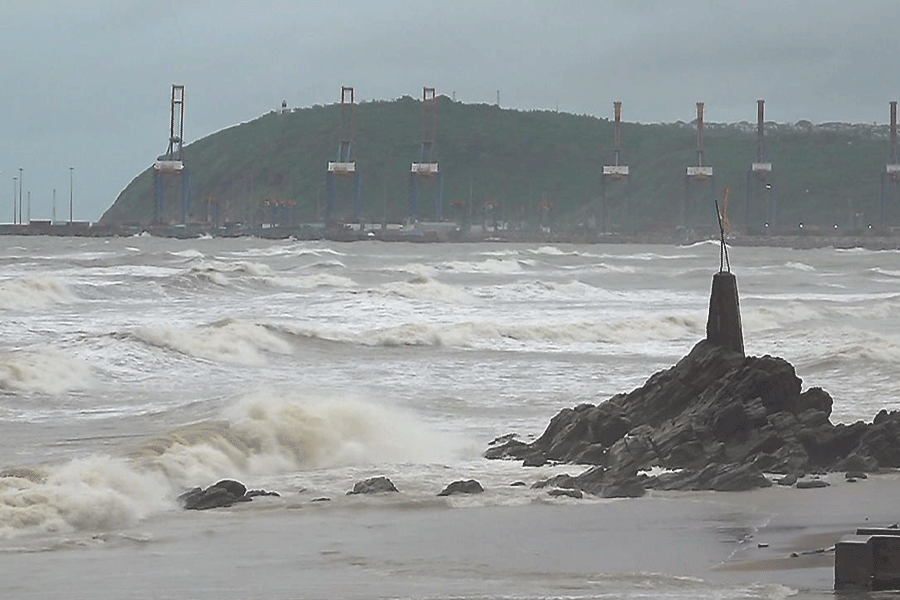
Cyclone Arnab crossed the Andhra Pradesh and Yanam coasts on Wednesday morning and weakened into a severe cyclonic storm. Chief Minister N Chandrababu Naidu said, "No loss of life has been reported so far due to Cyclone Arnab." Officials got to work clearing fallen trees and restoring power across regions.
Speaking during a teleconference with 32,000 personnel, including district collectors, Andhra CM directed officials to minimise property damage and restore normalcy in cyclone-affected areas at the earliest
Very severe cyclonic storm Arnab crossed the Andhra Pradesh and Yanam coasts on Wednesday morning and weakened into a severe cyclonic storm, uprooting hundreds of trees and electric poles, disrupting power supply and damaging roads. Andhra Pradesh chief minister N Chandrababu Naidu said no loss of life had been reported so far, crediting advance precautionary measures by the administration for preventing casualties.
The India Meteorological Department (IMD) said the landfall process was complete, with the weather system moving entirely over land. Peak wind speeds reached 135 kmph, with gusts of up to 150 kmph.
"The cyclone crossed the Andhra Pradesh & Yanam coasts to the Southwest of Yanam near latitude 16.450 N and 81.90 E, about 20 km east-northeast of Narsapur, 40 km southwest of Yanam and 60 km southwest of Kakinada," said the Met department in an official release.
Police personnel and government officials were clearing fallen trees, electric poles and other debris to restore essential services and reopen major roads.
Naidu directs swift restoration of essential services
Speaking during a teleconference with 32,000 personnel, including district collectors, Naidu directed officials to minimise property damage and restore normalcy in cyclone-hit areas at the earliest.
"No loss of life has been reported so far due to Cyclone Arnab. The advance precautionary measures taken by the administrative machinery helped prevent casualties," said Naidu in an official press release.
He instructed officials to clear roads blocked by fallen trees within two hours and remove obstructions from national highways immediately. Electricity supply should be restored once strong winds subside, he said.
Naidu also directed officials to ensure adequate food, drinking water and medical facilities at cyclone shelters. He asked them to prevent water from entering agricultural fields, protect horticultural crops and take measures to prevent breaches in tanks and canals.
Officials were asked to prepare preliminary estimates of crop damage and keep National Disaster Response Force (NDRF) and State Disaster Response Force (SDRF) personnel on standby.
The chief minister also directed officials to use the Manamitra system to address public grievances in affected areas and inform complainants about the action taken to resolve their issues.
Kakinada, Konaseema report fallen trees and power disruptions
Kakinada Superintendent of Police G Bindu Madhav said the cyclone had uprooted hundreds of trees and fewer than 100 electric poles in the district, although no major damage had been reported.
"Cyclone Arnab had significantly affected the district, uprooting a few hundred trees and fewer than 100 electric poles. However, no major damage has been reported and rainfall subsided after 1 am."
Madhav said residents had been evacuated to relief camps as a precaution and remained there during the strong winds and the roar of the storm between midnight and 1 am.
The Uppada coastal road had been completely washed away, he said, adding that rainfall in the district was relatively low and gusty winds had caused the main impact.
Konaseema district Superintendent of Police Rahul Meena said winds of up to 130 kmph had uprooted trees and electric poles late on Tuesday night, blocking roads and disrupting power supply. No casualties or property damage had been reported.
"Konaseema is among the worst-affected districts, with winds reaching up to 130 kmph uprooting trees and electric poles, blocking roads and disrupting power supply," the SP told PTI.
Meena said electricity connections were expected to be restored within a few hours and major highways cleared within two to three hours. Clearing interior roads could take until the evening.
More than 10,000 people had been evacuated from low-lying areas and shifted to shelters, according to his preliminary information. Around 495 cyclone shelters and temporary relief centres had been established.
No village inundation had been reported, and water accumulated due to the storm surge had drained, he said.
Two NDRF teams and two SDRF teams had been deployed a day before the cyclone to conduct road clearance and rescue operations in response to emergency calls. Additional Andhra Pradesh Special Police platoons and personnel from various departments were also engaged in restoration work, with efforts aimed at restoring normalcy by evening.
Limited impact reported in Alluri Sitaramaraju district
Alluri Sitaramaraju district Superintendent of Police Amit Bardar said the cyclone's impact had been limited in the district as of 9 am, although trees and electric poles had been uprooted and some roads inundated.
"No loss of life or major damage to infrastructure, houses or livestock has been reported so far. We are monitoring the situation closely as water levels may rise due to continued rainfall," Bardar told PTI.
An old bridge in Tadiguda village in Anantagiri mandal had been washed away, isolating a hamlet. Alternative arrangements were being made, and restoration work was underway, he said.
The preliminary assessment indicated limited overall damage in the district, though officials would continue monitoring the situation amid persistent rainfall.