
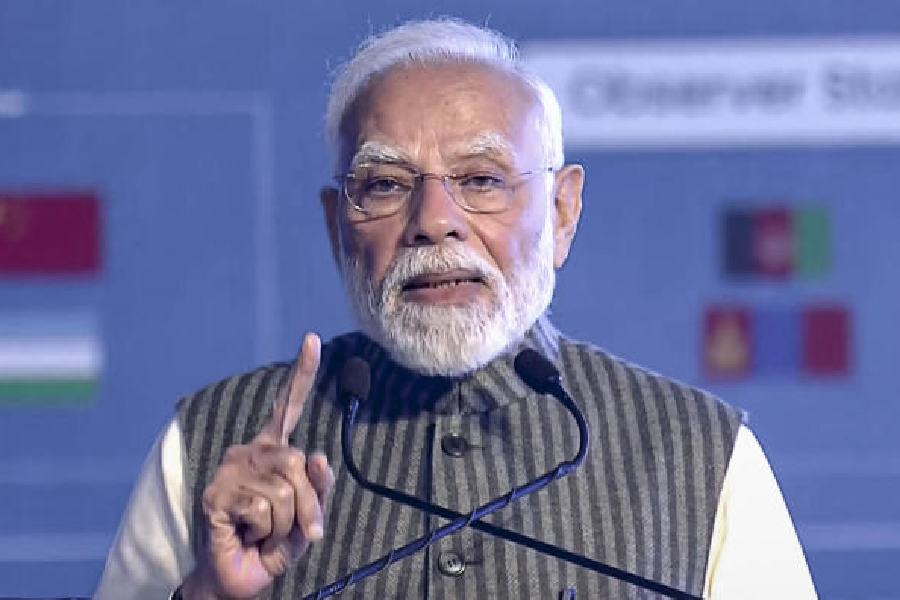
Prime Minister Narendra Modi pushed for digital ties among nations at Friday’s SCO Civilisational Dialogue Forum in New Delhi. He offered India’s expertise in digitising museums and libraries to preserve heritage. Modi said, "Civilisational connect is the best guarantee for world peace," urging countries to use technology for shared progress.
Narendra Modi at the SCO event at Purana Qila in New Delhi on Friday. (@NarendraModi/YT via PTI)
Prime Minister Narendra Modi offered India's expertise in digitising museums and libraries to other nations at Friday's inauguration of the three-day First Shanghai Cooperation Organisation (SCO) Civilisational Dialogue Forum.
Arguing that "civilisational connect" was the best guarantee for world peace, Modi pitched the CDF -- which he had proposed at last year's SCO meeting in Tianjin, China -- as "a platform to guide the world".
Musadik Masood Malik, the first Pakistani minister to visit India in three years, sidestepped a question on cross-border terrorism on the sidelines of the event but said it was "wonderful" that "we are having a dialogue across civilisations".
"At a time when the prevailing discussion in the world is of war and unrest, we are having a dialogue on the civilisational connect in India. This is important because it is the strongest guarantee for world peace," Modi said in his speech in the evening.
"...I understand that the empires have changed the world map. But the civilisation dialogues have changed the world's thinking. So, the SCO civilisational summit is not just a ceremonial platform. It can be a platform to guide the world."
Modi pushed for digital and technological cooperation among nations, stressing modern technology's ability to preserve heritage through the digitisation and translation of ancient texts.
"The legacy of thousands of years of our countries is safe in our museums, libraries and archives.... Today, with the help of technology, there are many opportunities to pass on this heritage to the next generation," he said.
"We can contribute to the digitisation and translation of ancient manuscripts. Through joint research projects, we can bring new aspects of our shared history to the forefront."
India has undertaken one of the biggest digitisation exercises in the world -- in the National Archives. Almost two-thirds of a target of some 300 million pages had been digitised by July this year.
"Today, we have more resources than before, so we should make full use of them. In addition, there are many opportunities for cultural exchange that we need to pay attention to," Modi said. "For example, museums and cultural institutions of our countries can host joint exhibitions."
Towards the end, the Prime Minister said: "That is why our desire for our own welfare is based on the desire for the welfare of the world. We consider mutual harmony to be the base of global well-being.
"Friends, mutual harmony is the most important thing for mutual faith. And mutual faith is born when we feel a shared sense of something. That is why we need to focus on what is shared between us. And I can say from the experience of India, when we are broad-minded, only our diversity becomes the basis ofour unity."
Modi inaugurated an exhibition named "Astitva -- The Essence of Our Existence" at the venue of the summit, the 16th-century Purana Qila, that showcases Delhi's history through archaeological artefacts dating from 1,200 BCE to 1,200 CE.
The exhibits include an 18th-century scroll depicting the Mahabharata.
Before Malik, the last Pakistani minister to visitIndia was Bilawal Bhutto, who did so to attend the SCO foreign ministers' meetingin 2023.
Bilateral diplomatic relations have been strained since the Pahalgam terror attack and the Operation Sindoor military conflict in April and May last year.
Asked by reporters about cross-border terrorism, Malik replied: "I think it's wonderful that we're speaking across, we are having a dialogue across civilisations, across cultures. I think we need more and more of these things.
"I think the entire region is in flux, geopolitics is in flux, and I think the easiest thing to do is to speak about things that affect us all. And that is to talk about cultures and talk about civilisations and talk about how these civilisations have affected all of us.
"So, it's a very welcome sign. I'm very grateful that SCO is holding these forums and they create an opportunity for all of the countries in the region to come together."
The Congress has condemned Malik's visit, especially after he was quoted in June threatening "to cut off" India's "hands" if it touched the Indus waters, the subject of an ongoing dispute.
Malik is Pakistan's minister for climate change and environmental coordination.