
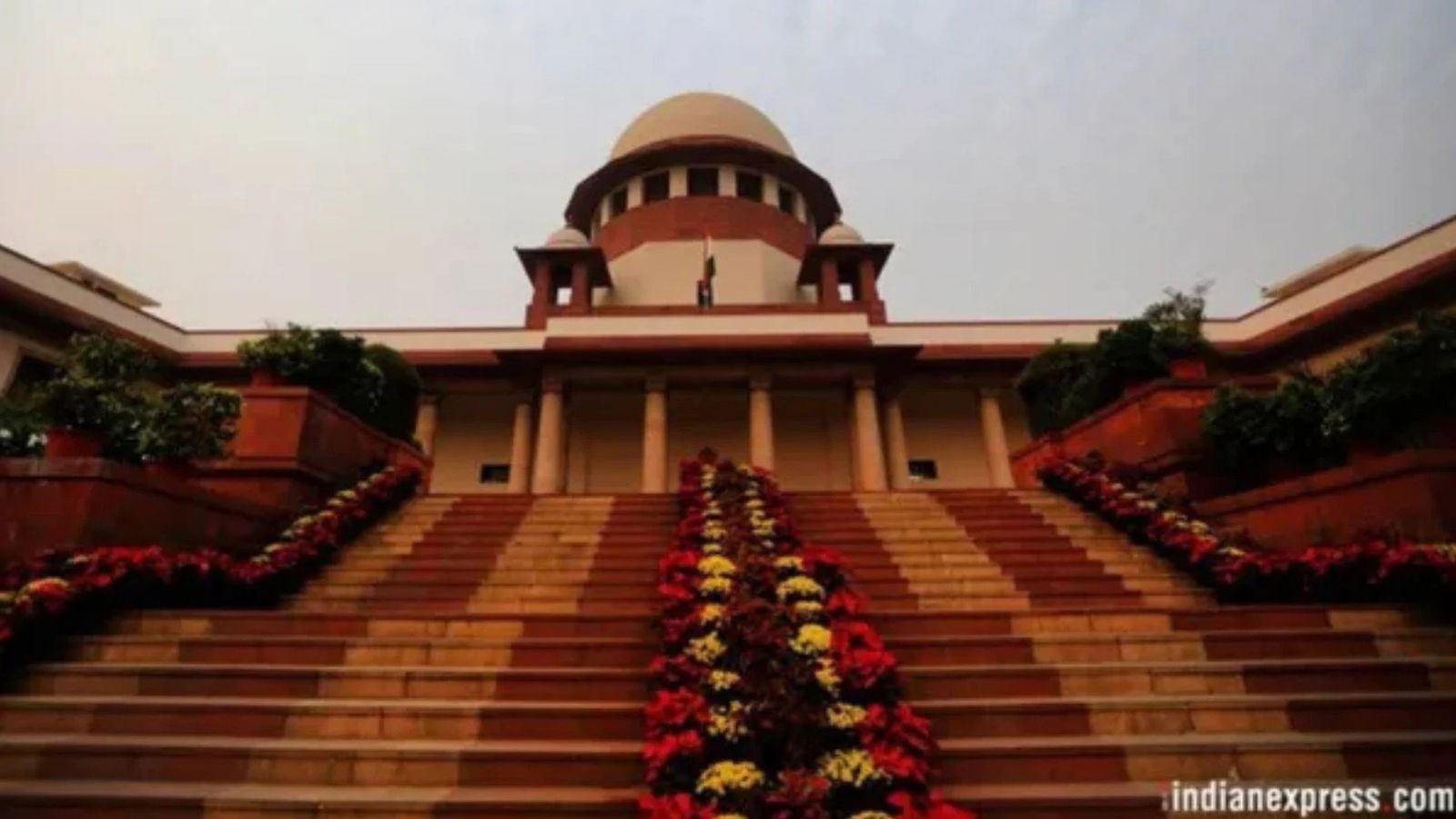
The Supreme Court directed the Ministry of Electronics and Information Technology to stop unauthorised recordings of court proceedings. A bench led by Chief Justice Surya Kant on Friday said the government must act against violators. Solicitor General Tushar Mehta said, "Within a week, will prepare kind of a formula for consideration."
The Supreme Court had earlier asked High Courts and other stakeholders to give suggestions so that the government can prepare a proposal to prevent commercial exploitation, misrepresentation, misquoting and dissemination of misleading content relating to court proceedings.
The Supreme Court has directed the Ministry of Electronics and Information Technology (MeitY) to ensure compliance with its order prohibiting the unauthorised recording, uploading and circulation of audio-video recordings of court proceedings.
A three-judge bench headed by Chief Justice Surya Kant on Friday said the government's proposed policy must include measures to act against those violating the directions.
"Necessary measures for taking action against those who fail to comply with the directions will also be incorporated in the policy decision," the bench, also comprising Justices Joymalya Bagchi and V Mohana, ordered after Solicitor General Tushar Mehta said that he had submitted suggestions received from various High Courts and others on dealing with the issue to the ministry and a formula will be prepared for the court's consideration.
The court also said it will "examine whether there is unfettered right of use of court proceedings without court's supervision."
The court had earlier asked High Courts and other stakeholders to give suggestions so that the government can prepare a proposal to prevent commercial exploitation, misrepresentation, misquoting and dissemination of misleading content relating to court proceedings and their live streaming and place the same before it.
The Solicitor General said he "received suggestions from High Courts and others, and I have given it to MeitY. Within a week, will prepare kind of a formula for Your Lordship's consideration".
He added that "there were breaches" of the court's earlier orders and added, "I don't want to escalate."
He urged the bench to direct MeitY to take it down if there is a breach of the order.
"Yes, that is what we are directing. Authorities under the concerned intermediary rules shall immediately act and implement this order," said Justice Bagchi.
In its order, the court said, "MeitY is directed to ensure compliance with the interim directions contained in para 9 of the July 24 order and as explained via subsequent order of October 9, 2026.
What the July 24 order says
Paragraph 11 of the July 24 order directed that, as an interim measure, "there shall be no extraction, dissemination, monetisation, posting, re-posting, uploading, transmitting, modification, storing, or hosting of the audio-video recording(s) of the judicial proceedings on social media or any other digital platforms without prior permission of the Secretary General of the Supreme Court of India or the Registrar Generals of the jurisdictional High Courts."
Subsequently, the Supreme Court clarified that "the said paragraph makes it clear that the order is not to be construed as imposing a blanket prohibition on
the reporting of court proceedings by recognised news outlets. Such outlets may, therefore, continue to report on the proceedings and inform the general public of legal developments and judicial pronouncements, save that audio or video clips of the court proceedings shall not be utilised in the course of such reportage."
He added that this "So, all the proceedings of the court should be actually placed on a website, which is the court's website, which is fully watermarked and authenticated, so that anybody should be able to extract."
The CJI said, "that we are doing separately on administrative side."
Cannot extract from official channel
Justice Bagchi added, "We are also contemplating and, in fact, have placed some High Courts in order where you cannot make an extraction from the feed on the channel set up in YouTube for the court concerned. The difficulty is that a person can easily make a duplication of that and then make an extraction. This proceeding would be uploaded in the official channel. You cannot extract from it. But you can contemporaneously make a photograph of the entire proceeding and then extract from it...".
The judge said that though the court had passed orders barring the recording and circulation of courtroom proceedings without prior permission, the "difficulty is the implementation, which we are requesting the MeitY and concerned intermediary under the Intermediary Rules."
Bhushan suggested, "Actually, this is very easily solved by having an official website of the court where all the proceedings are stored, and that should be authenticated by digital watermarking and cryptographic signing... "
Tushar Mehta said, "Even authenticated cannot be commercialised; that's the problem."
Bhushan said that anybody who wants the clip of proceedings should only use it from that and not from any other source.
CJI Kant said, "That's why in para 9, we have already imposed the rider of commercial exploitation.
Bhushan pointed out that what constitutes commercial exploitation was a very vague thing. "Let's say, there is a YouTuber who is doing his YouTube and he is doing a report about what has happened in this particular case and he wants to use a part of the official clip from the official court website."
Justice Bagchi added, "That YouTuber will be duty-bound to take permission from the Secretary General of the Supreme Court."
'Will examine UK guidelines'
Bhushan said that will not only be contrary to the judgement of this court in Swapnil Srivastava, but also contrary to UK guidelines."
Justice Bagchi said the court will examine the UK guidelines and whether there is an unfettered right of use of court proceedings without the court's supervision. "The court's supervision is to the extent of how much you have extracted and for what purpose."
When Bhushan said that it would lead to a problem, Justice Bagchi said the court would examine the problem "when we cross it".