
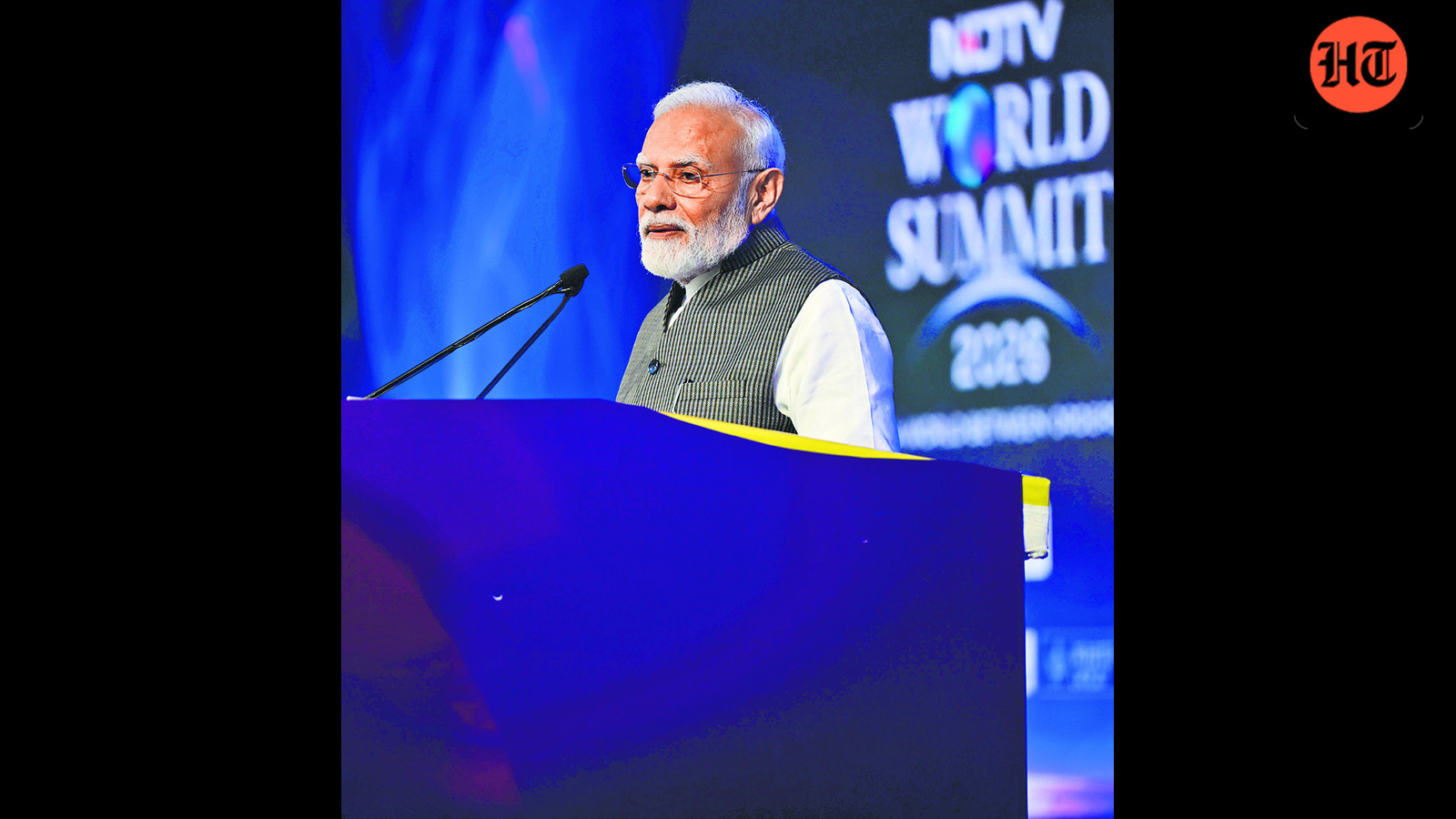
Prime Minister Narendra Modi attacked the Congress on Thursday, calling the party a parasite. He said, "The Congress has become that parasite that does not want to let anyone succeed." Modi accused the opposition of defaming India abroad and ruining the country's reputation to save one family from political failure.
Prime Minister Narendra Modi launched a frontal attack on the Congress on Thursday, calling the opposition party a parasite and accusing it of damaging India's international standing by criticising the country on foreign platforms.
"When the entire world is in search of a new order, some people are dreaming of disorder in India. Today, when there is so much disorder in the world, a strong picture of India should be presented to the world, but these people are interested only in ruining the reputation of the country. These people go abroad and defame India. They ask foreigners to intervene," he said.
"I don't know how long the Congress will continue to put the country at stake for the launch of its failed product. Sriharikota does not see as many launches as the Congress tries, unsuccessfully, to launch its leader in a year. The party can do what it wants to ruin itself; we have no issue with that. But to save one family from the stain of failure, the Congress is now putting India's achievements, India's greatness and its development at stake," he added.
He also questioned the Congress's leadership and electoral prospects, arguing that the party's approach was undermining legitimate criticism of the government by allowing political rhetoric to overshadow substantive policy debates.
"The Congress has become that parasite that does not want to let anyone succeed. The dimagi Naxals (intellectual Naxals) have taken over the Congress's brain and hence it has lost the ability to think. The people who used to wreak havoc in the jungles have entered the Congress and are trying to destroy the country," he added.
He said the Congress was hurting even other opponents of the government. "The voices of those who want to oppose the government in a democratic manner are being suppressed... We have seen in Parliament how talented young MPs in the Opposition want to speak and criticise the government, but the Congress does not let the House run so that others do not get a chance. Because the Congress wants to keep only one person in the limelight," he said.
The remarks came amid protests by the Cockroach Janta Party and the Opposition seeking the removal of Kumar and scrapping the controversial special intensive revision. The Bharatiya Janata Party has alleged the protesters are trying to destabilise constitutional bodies to deflect attention from their own political and electoral failures.
In his speech, Modi also spoke about the changing world order. "The challenge is how to make such an order in the changing world in which new personalities get a place, global institutions are more influential, and there is a strong sense of unity among the nations," he said.
Modi argued that emerging economies and new centres of power needed a greater role in international institutions, warning that outdated arrangements risked weakening their ability to address contemporary challenges.
The PM said global interconnectedness through trade, technology, maritime routes and cultural exchanges had also created new avenues for geopolitical competition. "Trade is becoming a means of weaponisation. Technology is becoming a new area of competition and conflict. Sea routes are becoming the centre of geopolitical tensions," he said.
Referring to the Covid-19 pandemic, Modi said the crisis exposed the limitations of international cooperation. Countries prioritised their own interests, undermining global trust, he said.
Recalling his 2020 call for "a new world order for the collective well-being of humankind", Modi said international arrangements must put humanity at their centre rather than allow narrow national interests to dominate.
"India is a guarantee of stability," Modi said, linking the country's approach to international affairs with its historical experience and civilisational values.
Modi cited India's response to the Covid-19 pandemic, including the supply of vaccines and medicines to countries in need, as an example of international cooperation during a crisis.
He also pointed to India's presidencies of the G20 and Brics, saying the country had helped secure consensus among members despite differences over key issues and expectations of disagreements over summit declarations.
The PM highlighted advances in green energy, artificial intelligence, digital payments and entrepreneurship, alongside developments in nuclear energy, hydrogen-powered transport and preparations for a digital census. He also referred to India's non-fossil fuel electricity capacity as evidence of progress in the energy transition.
Turning to sporting achievements, Modi mentioned India's 85 medals at the Asian Games and progress in women's cricket and boxing.