
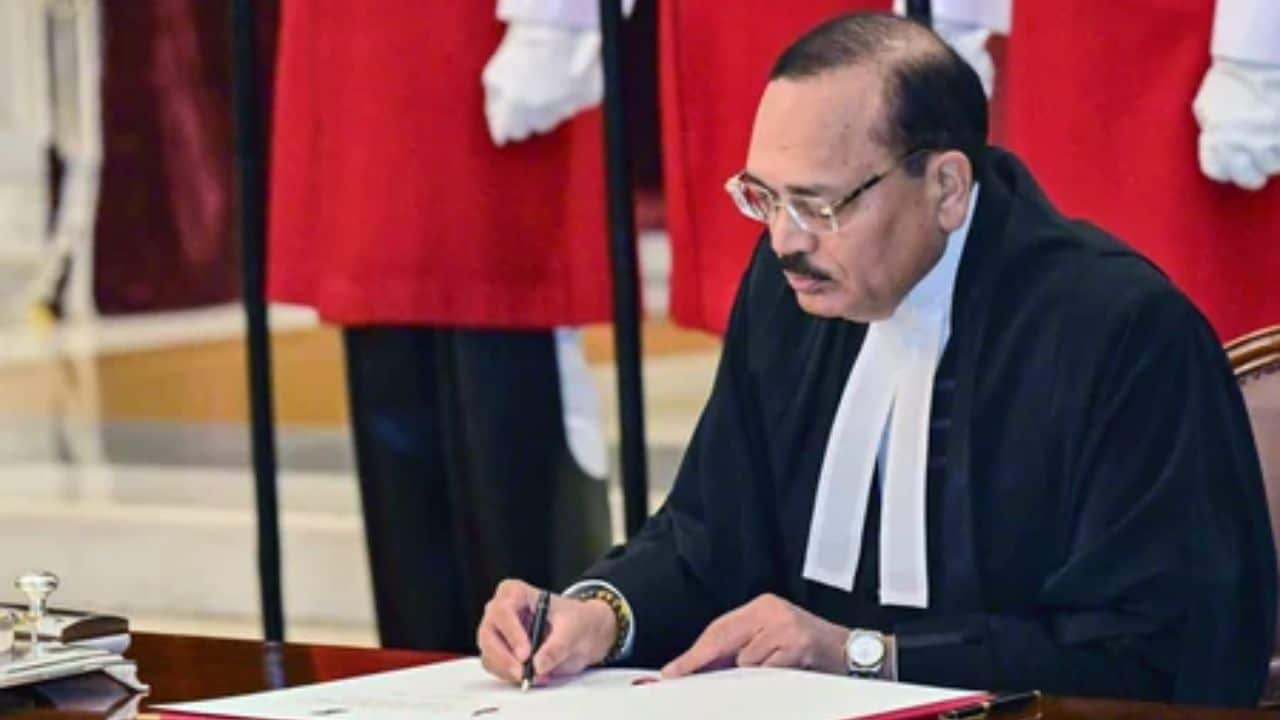
A bench led by CJI Surya Kant will hear bail pleas from Umar Khalid and Sharjeel Imam on November 25. The activists challenged a Delhi High Court order that rejected their applications regarding the 2020 northeast Delhi riots case. The Supreme Court will now review these petitions for regular bail.
The Supreme Court is scheduled to hear on Wednesday the separate petitions filed by jailed student activists Umar Khalid and Sharjeel Imam challenging the Delhi High Court's decision to reject their fresh bail applications in the 2020 northeast Delhi riots larger conspiracy case.
According to the cause list published on the apex court's official website, a Bench comprising Chief Justice of India (CJI) Surya Kant and Justices Joymalya Bagchi and V. Mohana will take up both petitions on November 25. Khalid's plea has been registered as SLP (Crl.) No. 22342/2026, while Imam's petition bears the number SLP (Crl.) No. 22241/2026.
Both petitions challenge a common judgment passed on September 30 by a Division Bench of the Delhi High Court comprising Justices Prathiba M. Singh and Dinesh Bhatt. The High Court had dismissed their appeals against the trial court's July 4, 2026, orders rejecting their applications for regular bail.
The High Court had observed that it lacked the authority to modify the specific conditions imposed by the Supreme Court while rejecting their earlier bail pleas in January 2026. In its January 5 order, the apex court had denied bail to Khalid and Imam but granted them the liberty to renew their applications either after the examination of the protected witnesses cited by the prosecution or upon the completion of one year from the date of the order, whichever occurred earlier.
However, the two activists had approached the trial court in June 2026, citing subsequent developments to seek reconsideration of their bail pleas. These included the Supreme Court's observations in a separate UAPA case regarding prolonged incarceration and delays in trial, the grant of interim bail to co-accused Tasleem Ahmed and Khalid Saifi, and the additional period of imprisonment they had undergone.
After the trial court rejected their applications, Khalid and Imam moved the Delhi High Court. They argued that the trial was unlikely to conclude in the near future and that their continued incarceration, despite the lack of substantial progress in the proceedings, justified a fresh consideration of their bail pleas.
The High Court, however, held that a subordinate court could neither extend nor modify the specific liberty granted by the Supreme Court. It also noted that the apex court had clearly distinguished between the alleged roles of Khalid and Imam and those of the co-accused who had been granted bail.
The High Court further observed that the cases of Tasleem Ahmed and Khalid Saifi could not be equated with those of Khalid and Imam, whose alleged roles had been described as those of "masterminds" and "core conspirators" in the Supreme Court's earlier judgment.
The case pertains to the alleged larger conspiracy behind the communal violence that erupted in northeast Delhi in February 2020, leaving 53 people dead and several others injured.
Khalid and Imam are among several accused booked under the Unlawful Activities (Prevention) Act (UAPA) and other penal provisions in connection with the case. Both have remained behind bars for several years.
More recently, the apex court granted six months' interim bail to co-accused Tasleem Ahmed and Khalid Saifi. It also referred to a larger Bench the question of whether prolonged incarceration and delays in trial could constitute grounds for granting bail despite the restrictions imposed under Section 43D(5) of the UAPA.