
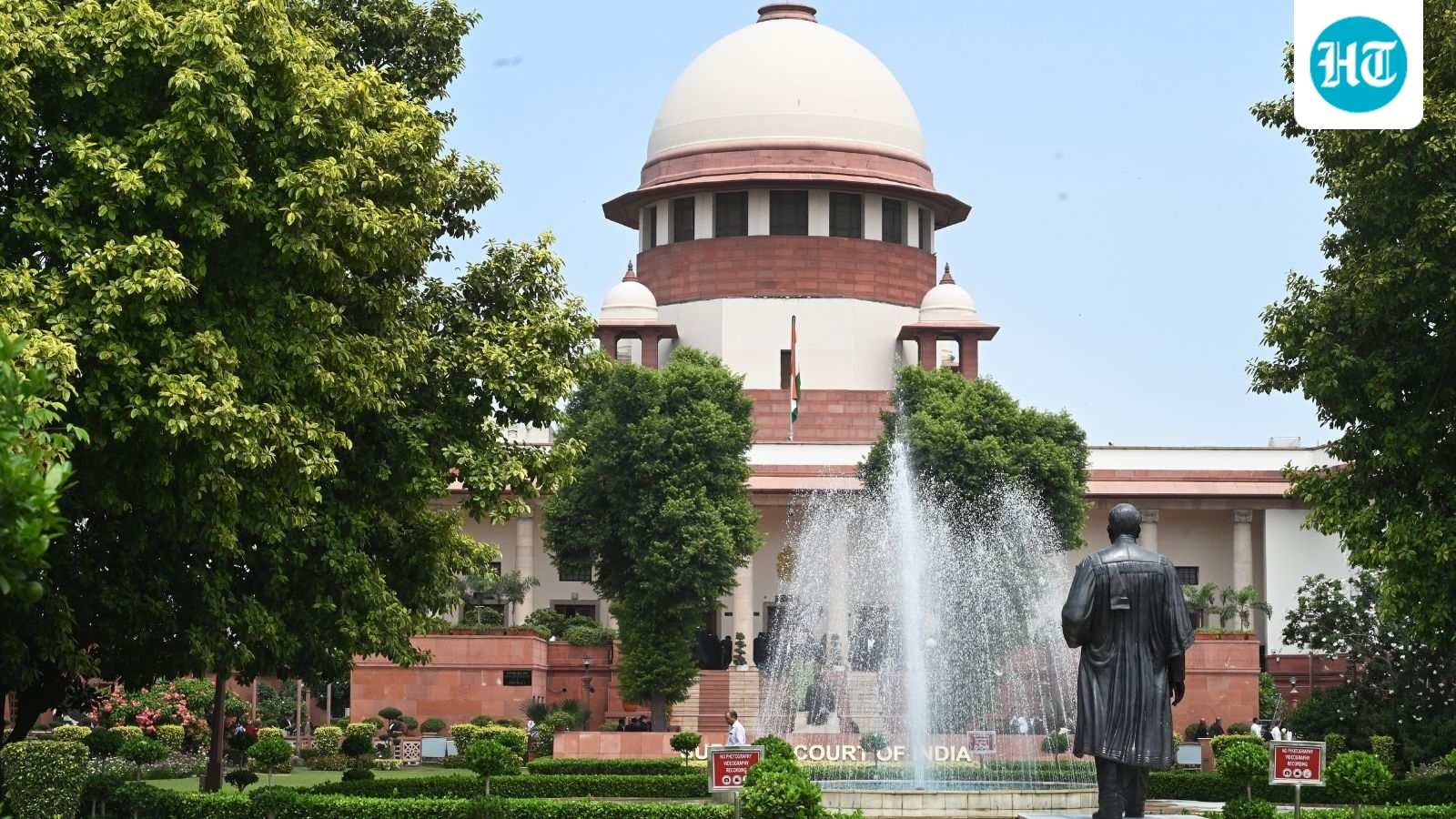
The Supreme Court ruled on October 16 that citizens can challenge false poll affidavits without Election Commission sanction. The bench said, “Magistrates are empowered to deal with frivolous allegations in accordance with the law.” This decision allows private complaints against elected representatives, ensuring voters get accurate information about candidates' backgrounds.
The Supreme Court has ruled that any private person can approach a magistrate with a criminal complaint against an elected representative for allegedly filing a false affidavit in an election, holding that such complaints do not require prior sanction or a complaint by the Election Commission of India (ECI) or any other public servant.
Underscoring that the interpretation of laws is the exclusive domain of courts, a bench of justices Dipankar Datta and Sheel Nagu said that ECI cannot dictate how statutory provisions should be interpreted through its press notes or guidelines, even though it is the constitutional authority responsible for conducting elections.
“We hold that a private complaint alleging offence committed under Section 125-A, RoP Act need not pass muster of the rigours of Section 195, Cr. PC, as held by the High Court,” the bench said in a judgment delivered on October 16.
Magistrates equipped to deal with false complaints
The court pointed out that the possibility of such complaints being used to harass elected representatives can be duly dealt with under the existing regime, emphasising that magistrates are empowered to deal with frivolous allegations in accordance with the law.
“If at all a complaint is lodged to harass an elected candidate or frivolous allegations are levelled therein, the laws of the country duly equip and empower the competent magistrates to pass such order(s) as they deem fit and proper commensurate with the facts and circumstances of each case,” it said.
The court’s ruling is significant because the disclosure of candidates’ assets, educational qualifications and criminal antecedents are intended to help voters make informed electoral choices. Section 125A was introduced following the Supreme Court’s 2002 decision in Union of India Vs Association for Democratic Reforms which underscored the importance of voters having access to relevant information about candidates.
The ruling came in an appeal filed by Rajkumar Madki against a Karnataka high court decision quashing his criminal complaint against Bidar MLA Shailendra Beldale, who was elected to the Karnataka legislative assembly in 2023. Madki had alleged that Beldale furnished a false residential address in the affidavit accompanying his nomination papers.
While settling the legal question in favour of private complainants, the Supreme Court declined to revive the proceedings against Beldale, holding that the documents on record had effectively rebutted the allegation and that the possibility of conviction was remote. It said allowing the proceedings to continue would consume precious judicial time.
The legal question arose from Section 125A of the Representation of the People (RoP) Act, 1951, which penalises a candidate who, with the intention of getting elected, fails to furnish prescribed information, knowingly provides false information or conceals information required in the nomination paper or accompanying affidavit. The offence is punishable with imprisonment of up to six months, a fine, or both.
Court rejects ECI's role in initiating proceedings
The high court had held that a complaint alleging an offence under this provision had to satisfy Section 195(1) of the Code of Criminal Procedure (CrPC), which bars courts from taking cognisance of specified offences unless a written complaint is made by the public servant concerned or another public servant to whom that official is administratively subordinate. On this reasoning, it concluded that the ECI, rather than an individual voter, had to initiate the criminal proceedings.
Rejecting this interpretation, the Supreme Court pointed out that Section 195 expressly covers offences punishable under Sections 172 to 188 of the Indian Penal Code, 1860, but does not include Section 125A of the election law.
The bench said that Parliament introduced Section 125A in 2002 and subsequently amended Section 195 in 2006, yet did not include the election-law offence within the provision’s restrictions. This omission, it held, has to be treated as deliberate rather than remedied by judicial interpretation.
“If indeed it were the intention of the legislature that cognisance of any offence relating to furnishing of false information by a candidate in an affidavit with intent of being elected in an election (referred to in Section 125-A of the RoP Act) could only be taken if the complainant were a public servant, the same could have been provided by an amendment of Section 195 CrPC,” the judgment said.
The court also rejected the argument that permitting private complaints would encourage frivolous litigation against elected candidates. It said the possibility of harassment could not justify reading into the statute a restriction that Parliament had not enacted, particularly when magistrates possessed the authority to assess complaints and pass appropriate orders.
The judgment also addressed ECI’s June 16, 2020 press note, through which the poll panel said it would take cognisance of complaints indicating serious omissions in candidates’ affidavits and refer them to the relevant investigating authorities on a case by case basis.
The bench said it did not need to rely on ECI’s clarifications to decide the question of law. “Even though the ECI is supreme in its own sphere and has, indeed, issued guidelines/press notes based on its understanding of the statutory provisions, interpretation of statutes is primarily the task of the courts and such guidelines/press notes do not bind us,” it noted.
The judgment interpreted the CrPC provisions applicable to the complaint, which was filed in 2023. The corresponding provisions under the Bharatiya Nagarik Suraksha Sanhita (BNSS), which came into force on July 1, 2024, are Section 215, replacing Section 195 of CrPC, and Section 223, replacing Section 200, which deals with the examination of a complainant by a magistrate.