
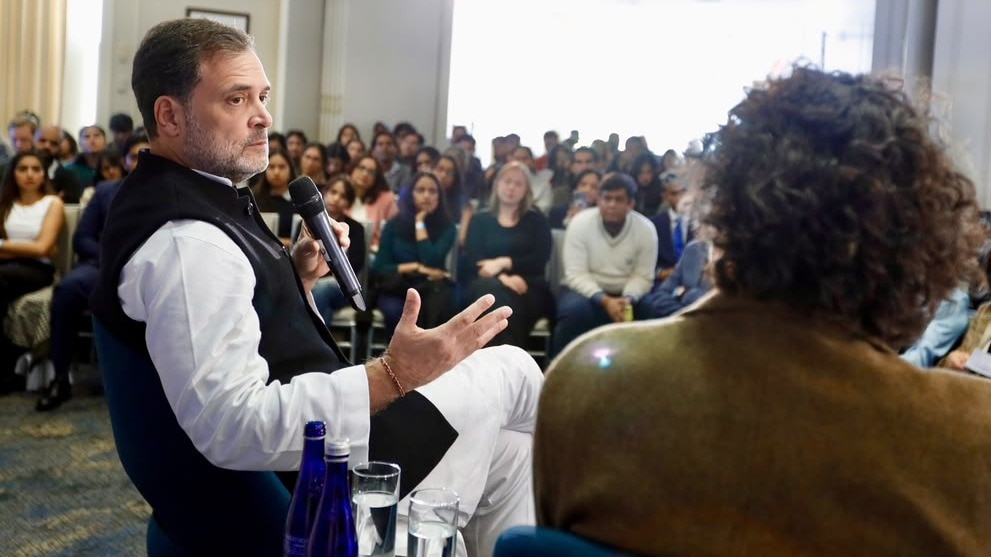
Rahul Gandhi spoke at Columbia University on November 17 about India’s political and economic future. He argued that democracy is more than just voting and requires a voice for everyone. Gandhi said, "T massive concentration of wealth taking place in India and huge disenfranchisement of people," during his visit.
From democracy and unemployment to China's manufacturing model and the lessons from the Bharat Jodo Yatra, Rahul Gandhi covered a wide range of topics at his Columbia University address. Here are five key points from his New York speech and what they reveal about his political and economic vision for India.
Rahul Gandhi's speech was delivered thousands of kilometres away from India, but its political message was firmly directed at home. The Leader of the Opposition (LoP) in the Lok Sabha spoke on a wide range of topics -- from questioning the state of democracy and the country's jobs crisis to challenging Western political frameworks and examining China's manufacturing dominance, Rahul Gandhi used his Columbia University address to lay out his vision of India's political and economic future.
The Congress leader, who arrived in New York on Tuesday morning (November 17), was speaking at a fireside chat with New York Times columnist Lydia Polgreen at Columbia University. Gandhi was addressing hundreds of students and faculty members, and he touched upon everything, from the growing concentration of political and economic power in India to the changing global order, and his own political transformation following the Bharat Jodo Yatra.
The conversation, which was uploaded on the public platform a day after (Wednesday evening), also featured questions from students. Based on videos of the address available on public platforms, here are five themes that stood out in Gandhi's address.
1. DEMOCRACY IS NOT JUST CASTING A VOTE, BUT HAVING A VOICE: RAHUL GANDHI
Rahul Gandhi revealed that for him, India's democratic crisis goes beyond elections. He argued that the concentration of political and economic power has gradually weakened the ability of different sections of society to make themselves heard.
Pointing to the protests by Adivasis, Dalits and farmers over the years, Gandhi said resistance against the concentration of power had been taking place for nearly a decade.
"There is a massive concentration of wealth taking place in India and huge disenfranchisement of people," Gandhi said while speaking to students and Columbia University staff in New York on Tuesday.
Gandhi also linked the state of democracy to the functioning of democratic institutions. He argued that democratic participation becomes difficult when these institutions are unable to function independently.
Responding to a question on the student protests in India, the Congress leader said the biggest change was that people were no longer afraid of expressing themselves.
"For years, students, farmers, bloggers and others had been reluctant to challenge the government because they feared action from investigative agencies or the police," he said. "The student movement helped break that fear," Gandhi added.
The LoP in the Lok Sabha also reiterated his demand for the removal of Chief Election Commissioner (CEC) Gyanesh Kumar.
"Restoring the electoral system was essential to reviving democratic participation," he said.
2. RAHUL GANDHI'S TAKE ON DEGREE, JOBS AND PROMISES MADE TO YOUTH
If there was one issue that repeatedly surfaced during the hour-long conversation at Columbia University, it was undoubtedly about unemployment. Gandhi argued that India's economic model had stopped delivering results, leaving a generation of educated young people uncertain about their future.
He said the problem was not that students were unable to find opportunities abroad, but that the domestic economy was failing to create enough jobs.
"The crux of it is that they do not see a future for themselves," he said, referring to young Indians questioning the choices and achievements of their parents.
The LoP described unemployment and the education system as two of India's biggest challenges, arguing that educational qualifications were increasingly failing to translate into employment.
"You can get as educated as you want. You can go to IIT, IIM or wherever you want. But if, at the end, you don't have a job, it doesn't mean much," he said.
The Congress leader recalled meeting an engineer working as a coolie at Delhi railway station to illustrate the disconnect between education and employment.
Gandhi also questioned the BJP-led Centre's Make in India and Startup India initiatives, asking where the promised jobs and manufacturing growth had materialised.
He also pointed to demonetisation, the implementation of GST and the economic disruption during Covid-19 as factors that hurt small businesses.
3. INDIA CANNOT BE UNDERSTOOD WITH WEST'S LEFT-RIGHT POLITICAL LENS: RAHUL GANDHI
Gandhi's address was not reserved for pure political remarks. It also had philosophical takes. The LoP rejected the conventional Western understanding of political ideologies.
He argued that India's political and social realities cannot be neatly classified using the familiar left-right framework.
"There is no left and right in India. Left and right is a Western concept," Gandhi said.
He explained that India's political contest, in his understanding, was between two competing visions of the country rather than a conventional ideological battle between the Left and the Right.
He described the Congress party's core philosophy as protecting the expression of every Indian, irrespective of their social, economic or political background.
"Every individual's expression was equally valuable," Gandhi said, citing Mohandas Karamchand Gandhi's idea of protecting the last person in the queue.
"We're fighting the BJP because it has a particular vision of our country. That vision has existed in India for thousands of years," the LoP said adding, those of us who oppose the BJP have a different vision, which has also existed for thousands of years.
He also connected this understanding to his experience during the Bharat Jodo Yatra, which he called an "exploration of his Indianness".
Gandhi recalled studying at Harvard and Cambridge, believing that these institutions offered frameworks that could help him understand politics better. He said he eventually realised that the ideas he had learnt did not necessarily work when applied to Indian politics.
"The tools that work here don't necessarily work there. The frameworks that work here don't necessarily work there," he said.
4. RAHUL'S TAKE ON CHINA MODEL, HIS SUGGESTION FOR A DEMOCRATIC PLAN FOR INDIA
Gandhi also discussed China during the conversation. But it was not an endorsement of its political system. Instead, he used the communist country's manufacturing dominance to highlight what he believes India is getting wrong economically.
He said that China had emerged as the world's manufacturing powerhouse, controlling large parts of global production and moving rapidly towards new technologies, particularly electric mobility. He was equally critical of China's political structure.
"The China model has huge problems. It isn't democratic. It's brutal towards its people," the Congress leader said.
Gandhi also added that he was not interested in replicating the Chinese model but wanted India to learn from its emphasis on production while retaining a democratic environment.
"Energy transitions often determined which countries emerged as superpowers," he argued, drawing comparisons with the rise of Britain through coal and the steam engine and the United States through petrol and the internal combustion engine.
Gandhi's central argument was that economic growth and social equality could not be separated.
"If you want pluralism, you have to give your people jobs," he said, adding that employment gives people the economic power to participate in society and demand their rights.
5. BHARAT JODO YATRA CHANGED HOW RAHUL GANDHI SAW POLITICS, PEOPLE
Rahul Gandhi's New York conversation also touched upon his Bharat Jodo Yatra. He spoke about how the 4,000-kilometre walk transformed his understanding of Indian politics.
He said the decision to undertake the Yatra came after the Congress began questioning the functioning of India's electoral system and the growing challenges faced by the Opposition.
With political institutions seemingly becoming less accessible, Gandhi said the party decided to take its concerns directly to the people.
"If we can do nothing, let's go to the people's houses and walk from south to north and see what happens," he recalled.
He called the Yatra the most beautiful experience of his life, saying it fundamentally changed his understanding of the relationship between politicians and ordinary citizens.
According to Gandhi, conventional politics often operates on the assumption that leaders know what is best for people and that their role is to communicate those ideas to voters.
The Yatra challenged that approach be believed. "The only real political model is listening to people," he said.
Gandhi also spoke about the need for politicians to set aside their own assumptions and be willing to question themselves.
He connected this philosophy to Mohandas Gandhi's transformation, arguing that the diminishing of one's sense of self makes it possible to listen more deeply to others.
Towards the end of the conversation, Gandhi returned to the larger question of India's future, arguing that the country needed to restore democratic participation while building an economy capable of providing opportunities to its people.
Taken together, Gandhi's Columbia address offered a picture of the political and economic changes he believes India needs. Rahul Gandhi's whole conversation revolved around one argument. It is that India's future depends on giving ordinary people a greater say in how the country is governed and how its wealth and opportunities are created.