
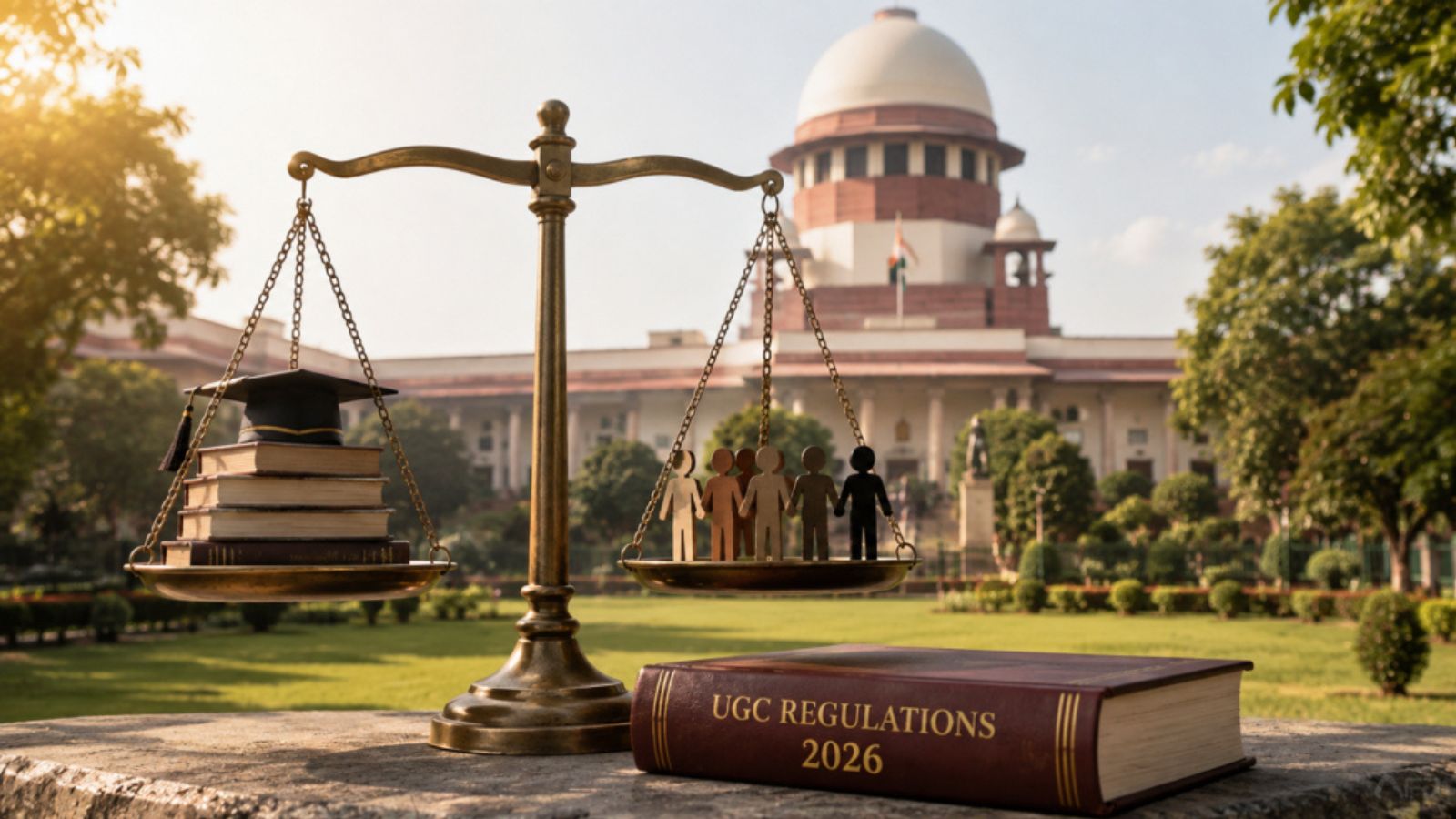
The Centre told the Supreme Court on Thursday that it may set up a committee to review the UGC equity regulations. These rules faced many objections from various groups after they started in January. Chief Justice Surya Kant said, "Why don't you revisit these regulations so that the next generation is taken care of?"
The UGC (Promotion of Equity in Higher Education Institutions) Regulations, 2026, drew objections from general category groups and sections of Dalit and OBC communities.
The Centre on Thursday told the Supreme Court that it is planning to put in place a committee to reconsider the University Grants Commission (Promotion of Equity in Higher Education Institutions) Regulations, 2026, which were stayed by the court earlier this year after petitions questioned their neutrality.
"The government is contemplating appointing a committee," Solicitor General Tushar Mehta told a three-judge bench presided by Chief Justice of India Surya Kant.
The solicitor general said this after the bench also comprising Justices Joymalya Bagchi and V Mohana told the government to consider taking a relook at the provisions. "Why don't you revisit these regulations so that the next generation is taken care of? They should protect the interest of every student," the CJI said.
Row over definition of caste-based discrimination
Notified on January 13 this year, the UGC (Promotion of Equity in Higher Education Institutions) Regulations, 2026, snowballed into a political issue after drawing objections from both general category groups and sections of Dalit and OBC communities.
In the eye of the storm is regulation 3(1)(c), which defines caste-based discrimination as discrimination on the basis of caste or tribe against members of the Scheduled Castes, Scheduled Tribes and Other Backward Classes.
Petitioners who challenged it argued that this excludes general category students and faculty from specific protection against caste-based discrimination. At the same time, the regulations' broader definition of "discrimination" covers unfair or differential treatment on the ground of caste against any stakeholder.
Supreme Court puts forward questions
The regulations stem from a 2019 petition filed in the Supreme Court by the mothers of Payal Tadvi and Rohith Vemula, who died by suicide over alleged caste-based discrimination in 2019 and 2016, respectively. They had sought the enforcement of robust anti-discrimination mechanisms across higher education institutions.
Staying the notified regulations on January 29, the court put forward a set of questions:
* Whether Clause 3 (1) (c) "bears a reasonable and rational nexus to subserve the object and purpose of the 2026 UGC Regulations, particularly in light of the fact that no distinct or special procedural mechanism has been prescribed to address caste-based discrimination, as opposed to the exhaustive and inclusive definition of "Discrimination" provided under Clause 3(e)".
* Would the introduction of the term "caste-based discrimination... have any bearing on the existing constitutional and statutory sub-classification of the Most Backward Castes within the Scheduled Castes, Scheduled Tribes, and Other Backward Classes, and whether the (new rules) provide adequate and effective protection and safeguards to such Extremely Backward Castes against discrimination and structural disadvantage".
* Whether the inclusion of the expression "segregation... in the context of allocation of hostels, classrooms, mentorship groups, or similar academic or residential arrangements, albeit on transparent and non-discriminatory criteria, would amount to a "separate yet equal" classification, thereby infringing the constitutional guarantees of equality and fraternity under Articles 14, 15 as well as the Preamble to the Constitution".
* Whether the omission of the term "Ragging" as a specific form of discrimination constitutes "a regressive and exclusionary legislative omission? If so, whether such omission is violative of unequal treatment of victims of discrimination by creating an asymmetry in access to justice and thus falls foul of Articles 14 and 21 of the Constitution".