
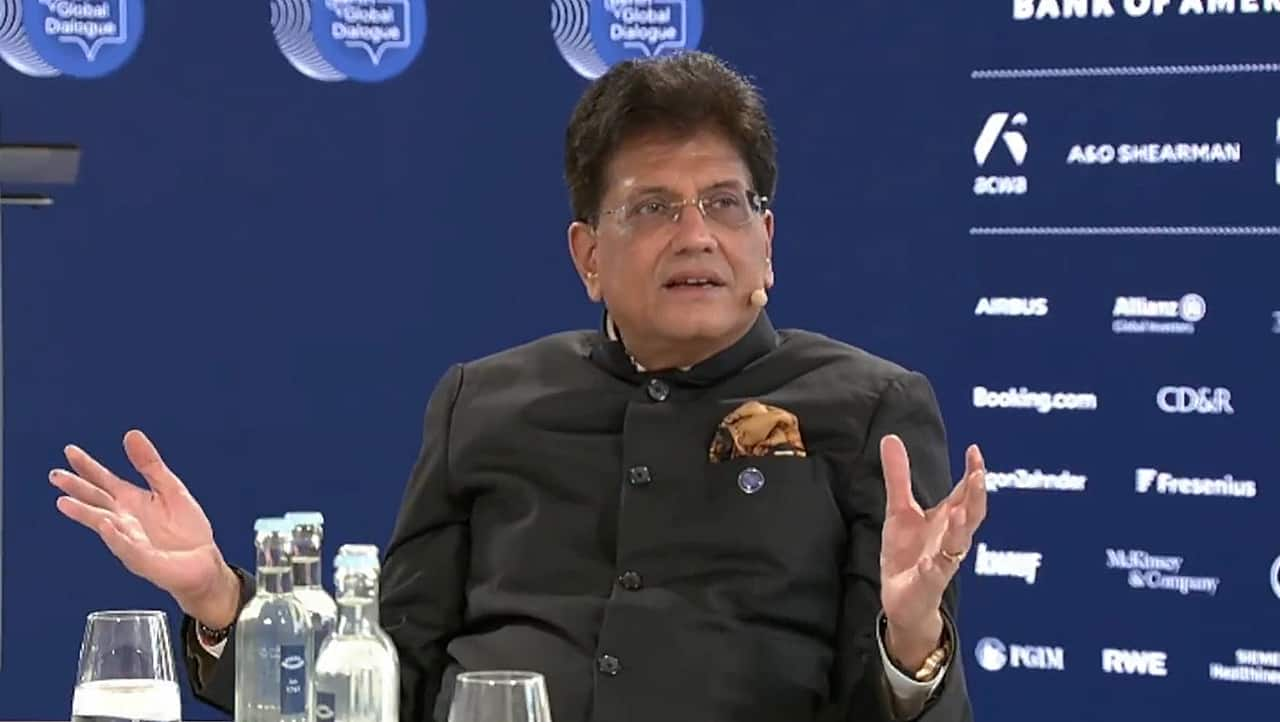
Commerce and Industry Minister Piyush Goyal warned on Thursday that Europe’s Carbon Border Adjustment Mechanism could cause a disaster. He said, “Your cost of living will go up. Your people will be unhappy.” Goyal is visiting Germany and the Netherlands until October 27, 2026, to boost trade and industrial cooperation.
Market Mastery
Webinar by Vishal Malkan
Find the weak links
in your portfolio by Vishal Malkan
Commerce and Industry Minister Piyush Goyal on Thursday warned European countries that the Carbon Border Adjustment Mechanism (CBAM) and high import duties on steel could raise the cost of living, make industries uncompetitive and hurt consumers. During a question answer session at the Berlin Global Dialogue 2026, Goyal said, “If You have put a CBAM on yourself, you put a 50% import duty to bring steel into your country, you are inviting disaster. Your cost of living will go up. Your people will be unhappy. Your industry will be out priced.”
Union Minister of Commerce and Industry Piyush Goyal is on an official visit to Germany and the Netherlands from October 22 to October 27, 2026, accompanied by a delegation of about 100 Indian businesses and startups.
In an another program in Berlin Goyal also said India-Germany bilateral trade could rise to €310 billion from around €31 billion at present if the two countries focus on complementary strengths and jointly create products and technologies. However, he did not specify a timeline for achieving the target, leaving it to businesses to draw up a roadmap.
German Federal Minister for Economic Affairs and Energy Katherina Reiche called for reducing red tape on both sides and undertaking joint projects, saying bilateral trade could be doubled.
“Germany’s precision engineering, nuclear science, commitment to quality with Indian infrastructure, our desire to upgrade Indian infrastructure, our digital capabilities, our youthful, skilled, and talented people can together shape the outstanding future in this evolving global order,” Goyal said, outlining areas that could drive bilateral cooperation.
Germany is India’s largest trading partner in Europe, with more than 2,000 German companies operating in India.
Goyal said Germany could serve as a role model for India in manufacturing, precision engineering, apprenticeships and skill development. He added that the two countries could strengthen supply chain resilience and have a transformational impact on each other’s economies.
“We can even help you grow faster than the 1.9% you are expecting this year,” he said.
The minister also called for cooperation to strengthen economic security without compromising openness, create industrial opportunities through the green transition and leverage emerging technologies to drive growth while maintaining trust.
“Trust is the hardest currency in commerce today,” he said, calling on India and Germany to move beyond products merely being “Made in India” or “Made in Germany” towards goods and technologies “co-created” by both countries. He emphasised closer links between trade, investment, manufacturing, research and academia.
Goyal said the newly inaugurated India Centre at DGAP could strengthen bilateral understanding and shape the future of the partnership by providing a platform for Indian perspectives in Berlin and helping Indian stakeholders better understand Germany and Europe.
The two ministers held a bilateral meeting earlier in the day and discussed cooperation in artificial intelligence, semiconductors, energy and other sectors.
“Discussed opportunities in AI, semiconductors, advanced manufacturing, critical minerals, green hydrogen, renewable energy, energy storage, and resilient supply chains, as well as increased investment in India’s industrial and digital ecosystems,” Goyal said in a social media post.
“We also exchanged views on how the India-EU FTA will prove to be a game-changer that would help businesses in both India and Germany realise their full potential,” he said.
FTA progress
Reiche said it had taken 20 years to finalise the India-EU FTA, which has been described as the “mother of all deals”. She said the agreement was based on rules and mutual gains, adding that the European Union expected €4 billion.
“Our businesses can actually use this FTA…With the FTA, we have a strong foundation,” she said, adding that Indian entrepreneurs were “more than welcome”.
Goyal said the agreement had been finalised after years of negotiations, with the final points concluded in January this year. He expressed confidence that it would move towards signing rapidly after the necessary parliamentary processes and could become operational within the next four to five months.
“We have the confidence of walking through the future at speed and with greater degree of comfort as two trusted partners,” he said.
He urged businesses to begin preparing for the agreement’s implementation by identifying customers, investors and collaborators, exchanging information on quality requirements and pricing, and getting ready to expand trade and investment.
“The agreement really got finalized in the last 13 months. It has been an on-off situation. It has been on for 25 years ago… There were no hot, no cold,” Goyal said.
Replying to Reiche’s comment that he had been sceptical about the negotiations last October, Goyal said: “Now that the agreement is over, I can tell you, no trade minister will ever be very optimistic or be very forthcoming. It will be seen as a sign of weakness by the other side. I’m not. I’m not trying to teach the art of deal making. We leave that to somebody else”.
He said there was no dissent from any EU member country or India over the agreement.
“Everybody accepted also the language, which would otherwise be quite a constraint to get so many different language translations and the legal benefits. But the sense of urgency, the mutual commitment to make this happen, was remarkable,” he said.
With the agreement moving towards signing, Goyal urged businesses to begin preparations, including sampling, exchanging notes on quality requirements and pricing, and putting everything in order to maximise the benefits of the pact.