
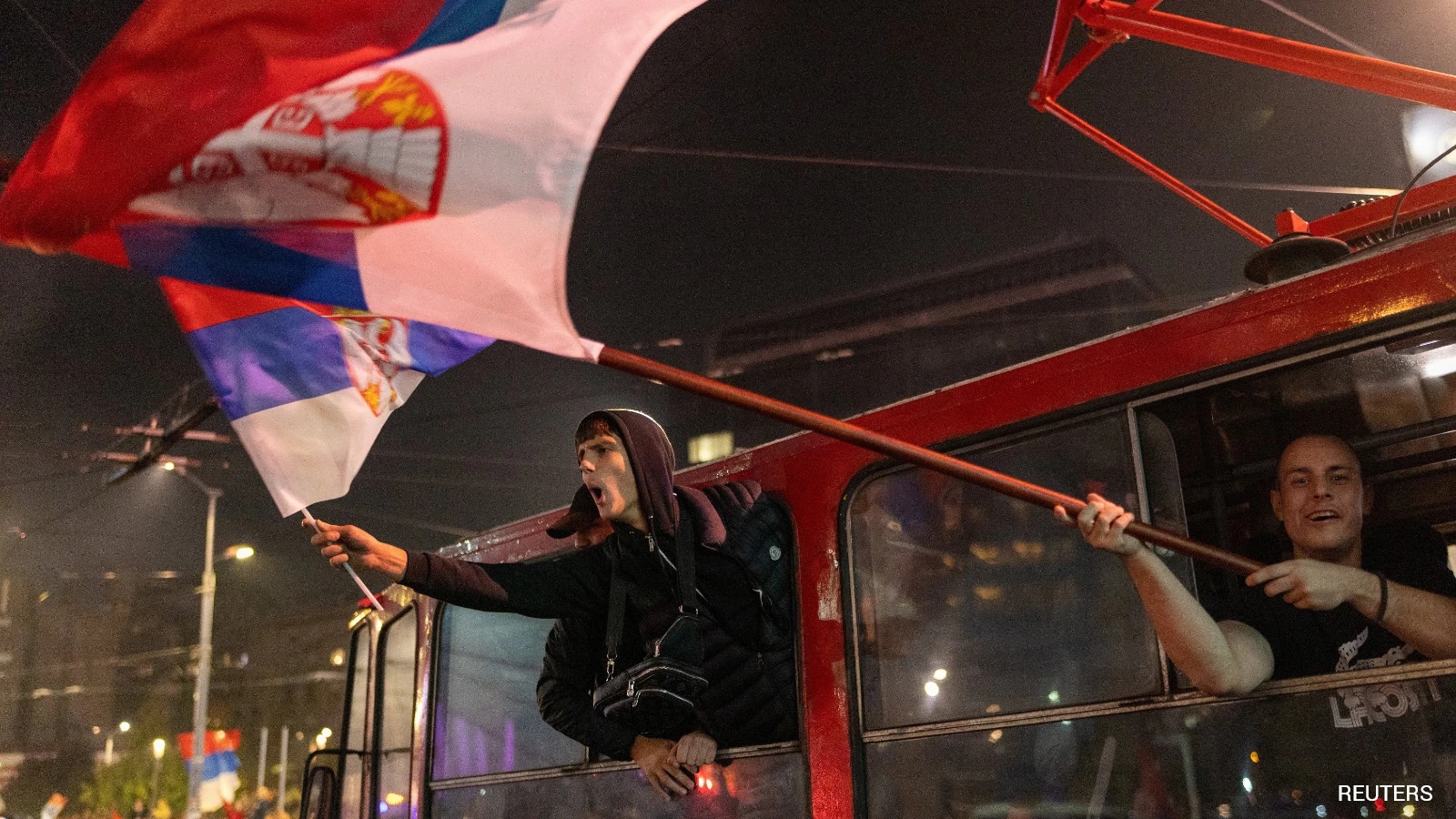
Serbia’s Student List won 141 seats in the 250-member parliament, ending Aleksandar Vucic’s 14-year dominance. The movement secured 53 per cent of the vote, bringing in professionals like a cardiologist and a former central bank governor. Over 160 candidates hold PhDs, as the group seeks to replace traditional politicians with experts.
Supporters of Student List celebrate its election win in Serbia.
A cardiologist, a former central bank governor, a chemistry professor and a celebrated basketball star are among the figures who could enter Serbia's parliament after a student-backed movement won a landmark election, ending Aleksandar Vucic's 14-year dominance on the country's politics. The movement, known as the Student List, has secured a projected 53 per cent of the vote, translating into 141 seats in Serbia's 250-member parliament, according to the Centre for Free Elections and Democracy. Vucic's Serbian Progressive Party won about 39 per cent, according to a report in The Guardian.
But beyond the scale of its victory, the movement's candidate list stands out for another reason: Its emphasis on academic qualifications, professional expertise and public standing rather than conventional political experience.
More than 160 of its 250 candidates hold PhDs, according to The Guardian. And in a striking twist, none of the candidates are actually students. They were selected by students who led a nationwide movement demanding accountability, transparency and an end to corruption.
Who Are The People Behind Serbia's Student List?
The political movement brings together professionals from fields rarely represented so prominently on a single electoral list.
Ilija Srdanovic, a cardiologist and professor at the University of Novi Sad, heads the political movement. Dejan Soskic, an economist, served as governor of Serbia's central bank between 2010 and 2012. Radomir Saicic is a chemistry professor at the University of Belgrade and a member of the Serbian Academy of Sciences and Arts.
The list also features Dejan Bodiroga, the former Serbian basketball star who is now president of EuroLeague Basketball, as well as sociologist Jovo Bakic, known for his criticism of the outgoing administration.
Its candidates include university academics, lawyers, doctors, artists, farmers and activists. The range reflects an attempt to build a political alternative that extends beyond traditional party structures.
Yet the movement has deliberately avoided putting a single leader at its centre. It has no publicly declared candidate for prime minister, leaving open the question of who will lead the government and how its members will share power.
How Is It Different From Conventional Parliaments?
In most parliamentary democracies, political parties select candidates through established party structures. Senior politicians, party leaders and experienced lawmakers usually occupy prominent positions, while election campaigns revolve around leadership, party ideology and policy promises.
Serbia's Student List has taken a different route. Students who organised the protests selected a slate dominated by established professionals and public figures, many of whom have little experience of electoral politics.
Its non-hierarchical structure is also unusual. Rather than rallying around a single political personality, the movement has emphasised collective decision-making and a common agenda focused on fighting corruption and rebuilding public institutions.
This is not to suggest that other countries lack highly qualified lawmakers or expert-led political movements. Nor does Serbia's approach guarantee better governance. The distinction lies in the way the candidates were assembled, the movement's limited reliance on conventional party leadership and the prominence of academics and professionals on its electoral slate.
The result could make the incoming parliamentary group one of Europe's most highly educated, although its final composition and the qualifications of those elected will need to be confirmed.
From A Railway Tragedy To A Political Earthquake
The movement emerged from protests following the collapse of a concrete canopy at a railway station in Novi Sad in November 2024, which killed 16 people.
The tragedy triggered anger over alleged corruption, construction standards and the accountability of public officials. Students began organising demonstrations and university blockades, demanding a transparent investigation and greater responsibility from those in power.
The protests expanded into a broader challenge to Vucic's administration, which had dominated Serbian politics since 2014. The government denied accusations of corruption and repression, while the movement argued that public institutions needed to become more independent and accountable.
The Challenge
The Student List's success also raises a difficult question: Can a movement built around protest and professional expertise become an effective government?
The answers will determine the political stability of Serbia, the largest economy in the Western Balkans, and its relations with China, Russia, and its largest trading partner, the European Union.
The students' victory "is likely to trigger broad institutional and policy changes centred on anti-corruption, the rule of law, and better public services. However, bureaucratic resistance to reforms and the movement's limited governing experience could make the transition challenging," Teneo Global Research said in a report on Monday.
Got a follow‑up question on this article? Go on
How may i help you today
Show full article
Track Latest News Live on NDTV.com and get news updates from India and around the world