
India has officially set aside the 2018 report on Nepal-India relations. Foreign secretary Vikram Misri said, "I would say that (EPG) is in the past." The government now prefers a forward-looking approach. Prime Minister Narendra Modi and Balen Shah instead started a new vision document to guide their future ties.
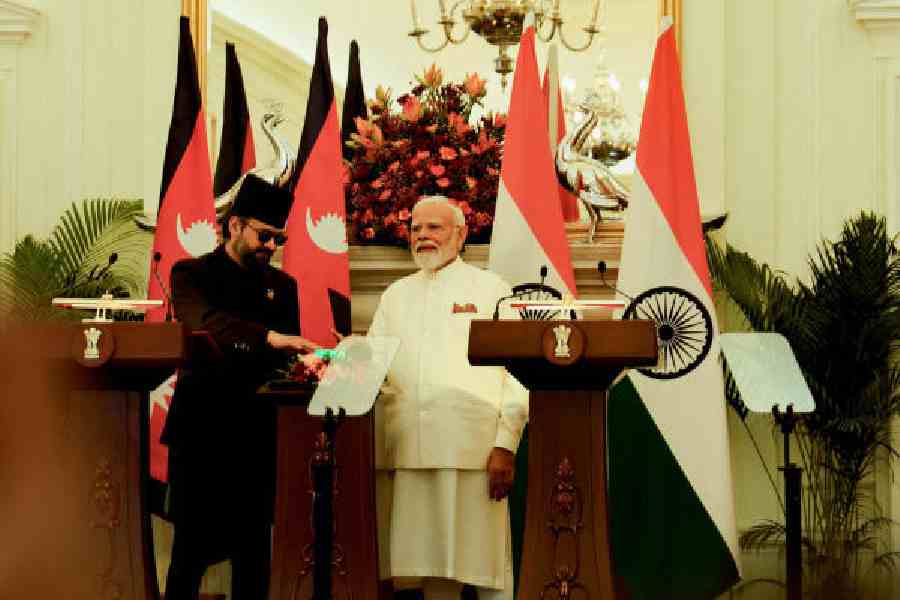
Balen Shah and Narendra Modi in New Delhi on Monday. (Reuters)
A report prepared over two years by a high-powered committee constituted by India and Nepal at the initiative of the two countries' prime ministers has finally been rendered irrelevant by New Delhi, without Narendra Modi even accepting it.
The fate of the report, prepared by the Eminent Persons Group for Nepal-India Relations (EPG-NIR) in 2018, became clear on Monday during Nepal Prime Minister Balen Shah's visit to India.
"I would say that (EPG) is in the past. We are looking at a forward-looking approach to this particular issue. We are not looking backwards, and to me, therefore, the report that you have mentioned is not relevant; it pertains to the past," foreign secretary Vikram Misri said when asked about the report.
The eight-member EPG, constituted in 2016, was jointly headed by former Uttarakhand chief minister Bhagat Singh Koshyari and former Nepal foreign minister Bhekh Bahadur Thapa.
Mahendra Lama, the founding vice-chancellor of Sikkim University, former Indian ambassador to Nepal Jayant Prasad and academic B.C. Upreti were also in the Indian contingent. Nepal's representatives, apart from Thapa, were former law minister Nilambar Acharya, politician Rajan Bhattarai and former anti-corruption commission chief Surya Nath Upadhyay.
The group held nine meetings -- six in Nepal and three in India -- between 2016 and 2018 before arriving at a consensus on its recommendations.
The group had been mandated to examine the entire gamut of bilateral relations between the two countries, including the 1950 India-Nepal Treaty of Peace and Friendship.
"The government of India should have at least accepted the report. It is for the government to decide whether it wants to implement the recommendations or not," said Mahendra P. Lama.
He added that given the lapse of time, many issues could not be relevant in the present context.
Since the group has never got an appointment with Modi to formally submit the document to him, the report hasn't been presented to the Nepal Prime Minister either.
When the committee was constituted, K.P. Sharma Oli was Nepal's Prime Minister.
Shah and Modi have adopted a new joint vision document to guide bilateral relations.
The vision document states that existing bilateral agreements, including the 1950 treaty, could be reviewed on the basis of mutual consent to reflect contemporary political, economic and technological realities.
The development has significance for the politics of the Darjeeling hills, where the demand to review the 1950 treaty has been intrinsically linked to the assertion of the Indian identity of Gorkhas.
On July 27, 1986, 13 people were killed in police firing in Kalimpong during a programme to burn copies of the treaty at the height of the Gorkhaland agitation. The day has since been observed as Gorkhaland Martyrs' Day.
Hill political parties have long demanded the scrapping of Article VII of the treaty, which provides reciprocal privileges to citizens of the two countries on matters of residence, ownership of property, trade, commerce and movement.
Many in the hills believe those provisions contribute to the blurring of the distinction between Indian Gorkhas and citizens of Nepal, undermining the former's quest for a distinct political identity within India.
The constitution of the EPG had raised hopes in the hills that those concerns would be addressed through a comprehensive review of the treaty.
"While the new joint vision document keeps the possibility of reviewing the treaty alive, the recommendations of a committee that spent two years examining bilateral relations appear to have been consigned to history without being formally received by the Indian Prime Minister," said an observer.