
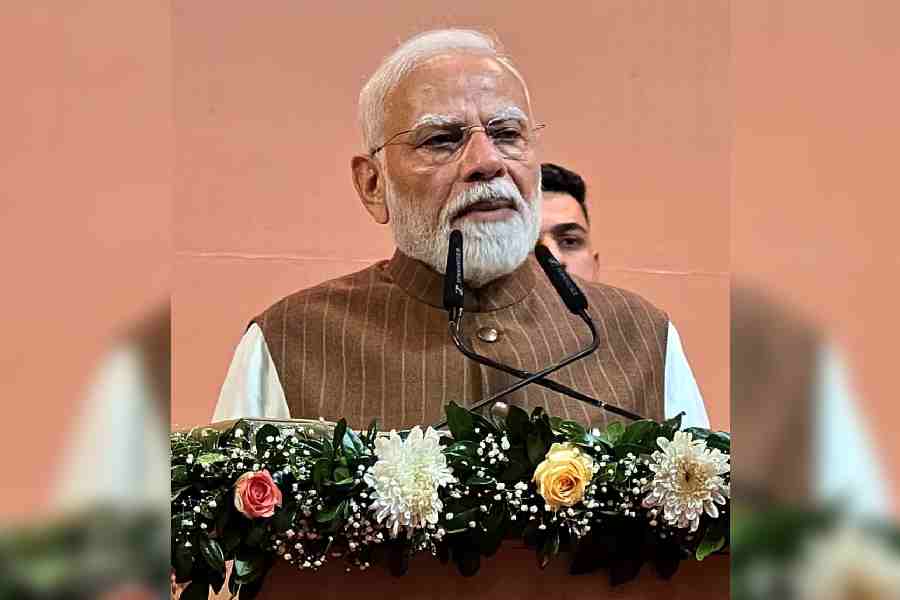
Prime Minister Narendra Modi on Saturday said "red flags" drove a semiconductor factory away from India 50 years ago. Speaking at IIT Kharagpur, he claimed his government started the semiconductor mission despite many questions. He said multiple facilities got established in four years, helping the country start exporting chips today.
Narendra Modi atIIT Kharagpur on Saturday. Picture by Saikat Santra
Prime Minister Narendra Modi on Saturday accused "red flags" of driving a semiconductor factory away from the country "50 years ago", a development a historian attributed to the Congress's "restrictive industrial policies" rather than Left protests.
Modi also accused the Congress, without naming it, of failing to eradicate poverty despite Indira Gandhi's vaunted "Garibi hatao" slogan.
The Prime Minister said at IIT Kharagpur's platinum jubilee celebrations that he had taken up these challenges and paved the way for semiconductor manufacturing and poverty removal.
"When I started the semiconductor mission, many questions were raised. 'Why is this mission needed now? This country is making those; that country is making those. Semiconductors have been in production for the past 50 years. What will we achieve by making semiconductors now?'" Modi said.
The CPM and the Congress hit back, accusing the Prime Minister of not speaking the truth.
"Friends, you will be surprised to know that 50 years ago, a company came to India. It came to make semiconductors here. But it was shown the red flag and sent back.... This was the work of the red flag," Modi said.
"And that is why, when I spoke about the (India) Semiconductor Mission, it was then said that it was too late now. Friends, I was determined. I said, even if we were late before, will India still just sit idle? We made a start."
Modi said multiple semiconductor facilities had been established in just four years and the country had begun exporting chips.
While Modi did not identify the foreign company, sources referred to a post last year by Union information and broadcasting minister Ashwini Vaishnaw.
It spoke of a development in 1964, rather than "50 years ago", and blamed the Congress rather than "red flags", identified with the Left.
"Fairchild founder Robert Noyce came to Bharat in 1964. Licence permit raj of Congress did not allow setting up a semiconductor plant. Went to Hong Kong. Then founded Intel. Rest is history," Vaishnaw posted on X on August 15, 2025. "Intel once again tried to set up a semiconductor unit in Bharat in 2005-06. Once again it was not allowed because of the policy paralysis of UPA regime."
Dinesh C. Sharma, a New Delhi-based historian of technology, too, said it was not exactly the Left but "the restrictive industrial policies" of the Congress-led government in the 1960s that "prevented large-scale semiconductor and electronics manufacturing in India".
"Fairchild Semiconductors, which was exploring an operation in India, was told to keep its equity below 50 per cent and limit production to much below the 10 million devices it had proposed," Sharma told The Telegraph. "This was not acceptable to the firm and it went to Hong Kong. Incidentally, Fairchild founder Robert Noyce later co-founded Intel."
Sharma, however, suggested that Modi had a point, emphasising that members of bank and insurance trade unions -- a province of the Left -- had violently opposed the introduction of computers.
"In the late 1960s, members of bank and insurance trade unions hurled stones at computer crates, fearing the technology would take away jobs," he said.
The CPM ridiculed Modi's claim, saying the party had no idea that the red flag was that powerful in 1976 (since Modi had said "50 years ago").
"As he is the Prime Minister, I can't say that he lied, but I can say that whatever he said was untrue," CPM central committee member Sujan Chakraborty said.
Modi claimed that poverty had not been eradicated because of the Congress system of governance.
"Until 20 years ago, poverty was considered a permanent problem in our country. Five decades ago, the 'Garibi hatao' slogan was raised from the Red Fort," he said.
"But after that, whenever something had to be done at the policy level, the whole system would just make a file and sit on it."
He claimed this was because no one believed that poverty could be eliminated.
"In 12 years, we have changed this thinking. We empowered the poor. Power to empower is the guiding principle I live by. We empowered them and started schemes for their ease of living," Modi said.
"And the country is seeing the result today. You must have read or heard the news about the latest World Bank report. (It) said that in just 12 to 13 years, 50 crore people in India have come out of poverty."
Congress leaders underlined that IIT Kharagpur, where Modi lauded his government's achievements, had been established during Congress rule.
"It's unfortunate to have to say the Prime Minister is lying," state Congress president Subhankar Sarkar said. He accused Modi of failure on multiple counts.
"Our country stands at 100 out of 120 in the hunger index. In practice of democracy, our rank is 106 out of 180," he said.
ITI focus
At a Lucknow event in the evening, Modi put IITs on a par with Industrial Training Institutes, whose trainees he said were more important for the country thanuniversity graduates.
He said "youths of the ITIs" would turn India into the "skill capital of the world" and added that a "world skill convention" would be held in Greater Noida next year.
Modi said parents tended to hide the fact that their children studied in the ITIs instead of a university.
"I decided to change this perception and ensure that ITI students are respected on a par with IIT students," he said.
"Times are changing. Those who have skill will get more respect than those donning coat-pants. There is a need for those who have passed from the ITI and not those who have come out of the universities."