
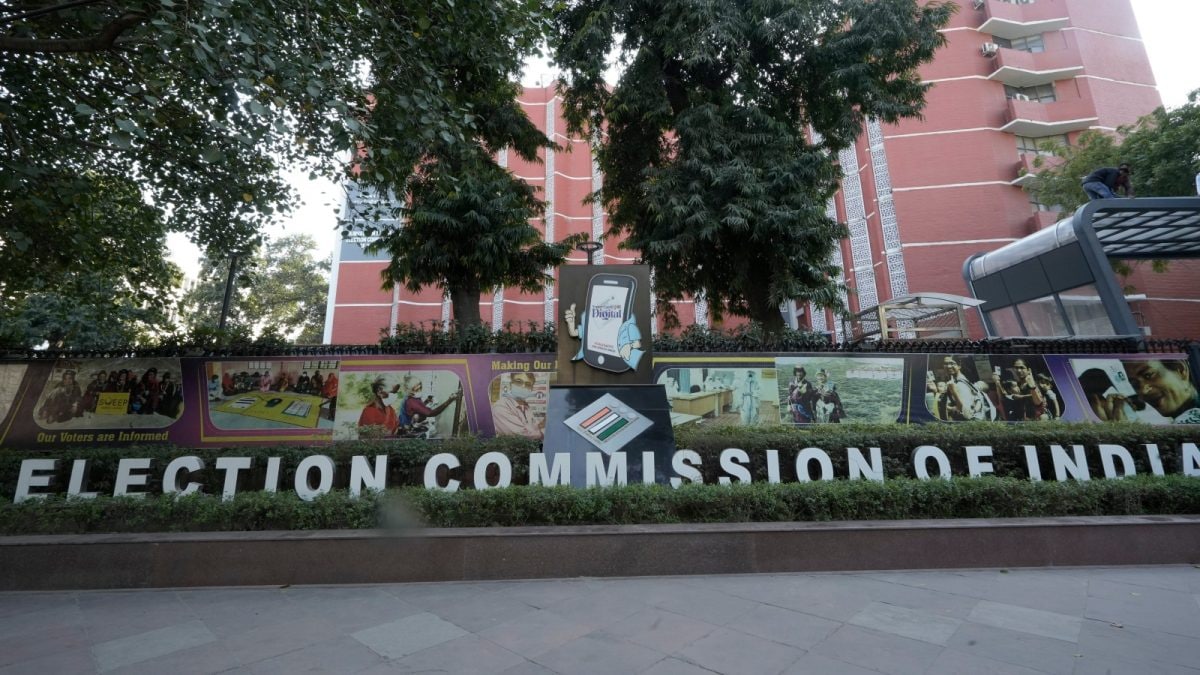
The Election Commission of India told the Supreme Court on Monday that all Special Intensive Revision orders were unanimous. The poll body rejected claims that it modified Form 6. “The attempt to make aspersions against the Election Commission is unfortunate,” the affidavit said, defending its legal process and internal decisions.
The Commission also rejected allegations that it had modified the statutory Form 6, used by eligible applicants to seek inclusion in electoral rolls.
The Election Commission of India (ECI) on Monday told the Supreme Court that its orders for the Special Intensive Revision (SIR) of electoral rolls were approved unanimously by all three members, asserting that the exercise was conducted within the framework of the law.
In a 248-page counter affidavit seeking dismissal of petitions challenging Chief Election Commissioner Gyanesh Kumar and decisions taken by the poll panel, the ECI said the SIR orders issued on June 24, 2025, October 27, 2025, and May 14, 2026, were based on unanimous decisions in accordance with Article 324 of the Constitution and Section 18 of the 2023 law governing the appointment and service conditions of election commissioners.
The Commission also said the affidavit itself had received unanimous approval from all three members before being filed. It maintained that comments or queries raised by an individual commissioner during the processing of a file do not amount to a formal decision by the Commission.
“The attempt to make aspersions against the Election Commission is unfortunate," the affidavit, filed by Deputy Election Commissioner Bhanu Prakash Yeturu on behalf of the poll body, said.
The ECI explained that files are circulated sequentially among the two election commissioners and the Chief Election Commissioner, with approved decisions bearing all three members’ signatures. In urgent cases where members cannot meet in person, approvals may be obtained electronically and subsequently recorded on the file.
‘Form 6 Not Modified’
The Commission also rejected allegations that it had modified the statutory Form 6, used by eligible applicants to seek inclusion in electoral rolls. It said the declaration required during the SIR was a separate document prescribed under the revision orders and was not part of Form 6.
However, the poll body acknowledged that the presentation of the declaration on its online platform “could be construed as though an amendment of Form 6 had been made".
It said the declaration had been integrated into the online Form 6 page to allow applicants to complete the process using a single OTP and e-signature.
Following a review on October 21, the Electoral Rolls Division decided that online applications would also be divided into two parts, in line with the procedure for physical forms.
BLOs To Visit Homes Of SIR Notice Recipients
The ECI further said a unanimous decision was taken on September 26 to have booth-level officers visit the homes of people who received notices during the ongoing SIR and collect their documents.
This would spare them from attending hearings in person, with hearings to be held only in exceptional cases and preferably online.
The affidavit also addressed questions about the ECINet portal, internal communications involving election commissioners and the Cabinet Secretary, and appeals filed in West Bengal concerning electoral roll entries. The Commission said no entry on the portal can be added, deleted or changed without an order from the electoral registration officer.
A bench headed by Chief Justice of India Surya Kant is scheduled to hear the petitions on Tuesday.
‘Newspaper Report Not Evidence’
The pleas followed a September 25 report by The Indian Express alleging that Election Commissioners Sukhbir Singh Sandhu and Vivek Joshi had objected on record at least 14 times over 10 months to SIR-related decisions they said were issued without their knowledge or recommendation.
Questioning the legal basis of the petitions, the ECI said, “In the eyes of law, a newspaper report is not treated as evidence of the facts it narrates."
The Commission also said it had “neither released nor authorised the release of any internal note/ file to any news agency". It challenged the maintainability of the pleas, including the request to restrain the CEC from functioning, citing constitutional protection under Article 324(5).