
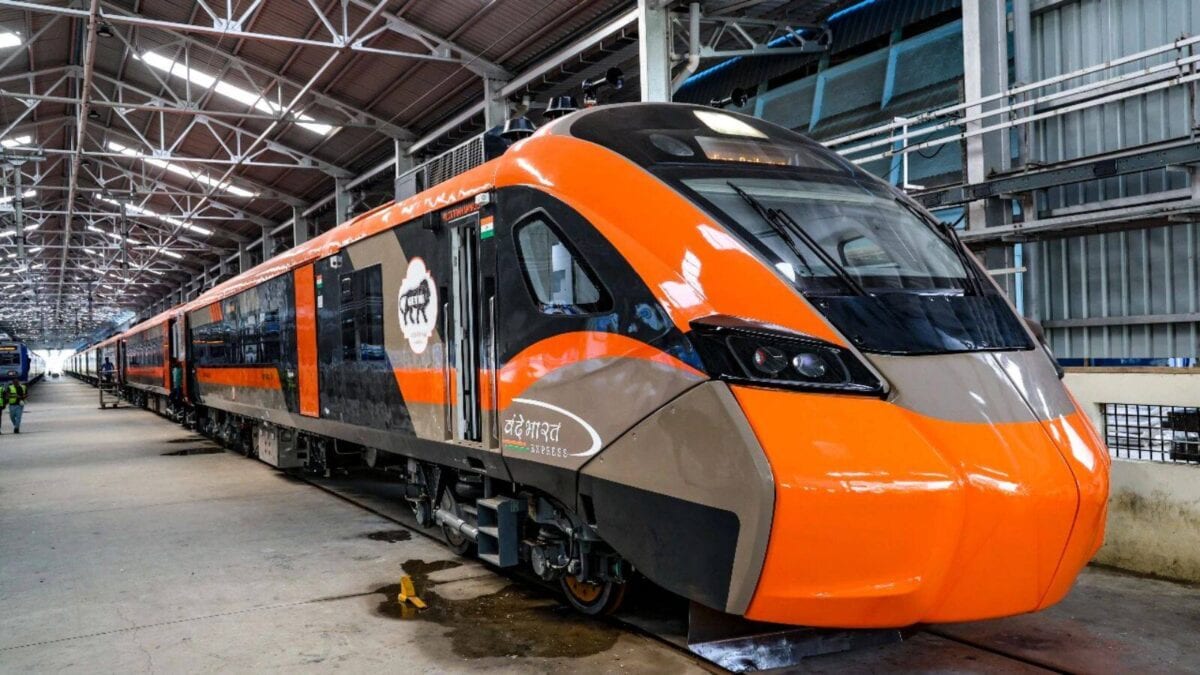
South Western Railway proposed the Bengaluru-Mumbai Vande Bharat Sleeper Express for November 1. This new train will cut travel time by eight hours, covering the distance in 16 hours. It features 16 coaches with 823 berths. Experts said, "Karnataka’s growing passenger traffic demands a wider rail connectivity push" for better travel.
Bengaluru-Mumbai Vande Bharat will have 16 coaches — 11 AC three-tier, four AC two-tier and one AC first-class coach. The fare is expected to range between ₹2,600 and ₹4,250
For years, passengers travelling between Bengaluru and Mumbai have had very few fast rail options, with the Udyan Express taking nearly 24 hours to cover the distance. That could change this Karnataka Rajyotsava, with South Western Railway proposing to run the inaugural special of the Bengaluru-Mumbai Vande Bharat Sleeper Express on November 1.
The proposed service is expected to cut travel time between the two cities from 24 hours to around 16 hours. But experts say Karnataka’s growing passenger traffic demands a wider rail connectivity push, with faster trains linking Bengaluru to Mumbai, Hyderabad and Chennai.
For Karnataka, the November 1 proposal could mark a welcome beginning just it did when it was declared a new state. But the larger question remains whether the Railways will move beyond individual train announcements and deliver a sustained expansion of services that connects Bengaluru more efficiently with the rest of the country.
If the plan goes ahead, it will be a significant addition to the rail network connecting two of India’s biggest economic centres. The proposed service is expected to cover the 1,118-km journey in around 16 hours, cutting travel time by nearly eight hours. However, the date for the commencement of regular commercial services is yet to be announced.
Union Railway Minister Ashwini Vaishnaw is expected to flag off the inaugural special. The train will be the first Vande Bharat Sleeper service in southern India.
The proposed train, according to railway sources, could not be launched in October because the model code of conduct was in force for the Karnataka Legislative Council elections. It will have 16 coaches — 11 AC three-tier, four AC two-tier and one AC first-class coach — with a total capacity of 823 berths. The fare for the journey is expected to range between ₹2,600 and ₹4,250, depending on the class, although the final fare structure is yet to be announced.
The proposed route will pass through Anantapur, Guntakal, Raichur, Kalaburagi, Solapur and Kalyan before reaching Mumbai.
For passengers, the biggest draw is the prospect of a faster overnight journey between the two cities. But transport experts say the proposed service also brings into focus a larger issue — Karnataka’s demand for better rail connectivity has grown with Bengaluru, yet the expansion of services has struggled to keep pace with passenger demand.
‘WE NEED MORE TRAINS, NOT JUST ONE’
An urban transport expert, who spoke to News18 on condition of anonymity, said the proposed service was welcome but argued that Karnataka needed a much larger expansion of its rail network.
The expert pointed to the enormous movement of passengers out of Bengaluru, particularly during holidays, and said the demand for connectivity was a reflection of the city’s unique position as a destination for people from across the country.
Karnataka, the expert argued, had been shortchanged by the Railways over the decades and needed multiple services across different routes, rather than a few isolated additions.
The concern is particularly relevant during festival seasons, when demand for travel rises sharply and passengers often struggle to find affordable tickets. A faster train between Bengaluru and Mumbai could offer relief, but the larger requirement is for more services connecting the city with other major destinations.
Rail and mobility expert Sanjeev Dyamannavar told News18 that the existing rail connectivity between Bengaluru and Mumbai was inadequate for the volume of passengers travelling between the two cities.
“We do not have a superfast train connecting Bengaluru and Mumbai. At present, we have the Udyan Express, but that is simply not enough to cater to the volume of passengers travelling between the two cities," he said.
Dyamannavar said a faster service would particularly benefit ordinary travellers, who are often forced to pay steep fares for buses and flights during peak travel periods.
“During Dasara, bus fares can soar to ₹5,000-₹6,000, while flight tickets are often prohibitively expensive. For many people, the train remains the most affordable and accessible mode of transport," he said.
He also called for the Railways to examine two possible routes — via Raichur and via Hubballi — keeping in mind the large volume of travel between Bengaluru, Hyderabad and Mumbai for education, employment, investment, industry and business.
“The demand for better Bengaluru-Mumbai rail connectivity has persisted for more than 30 years, and it is time the Railways addressed this long-standing need," he added.
BENGALURU’S CONNECTIVITY CHALLENGE GOES BEYOND MUMBAI
The demand for a faster Bengaluru-Mumbai connection comes at a time when the Centre has announced plans to develop seven high-speed rail corridors as growth connectors across the country.
The proposed corridors include links between Bengaluru and Chennai, and Bengaluru and Hyderabad. Union minister Vaishnaw has described the proposed connections as part of a “south high-speed diamond", linking major technology and economic centres in southern India.
Under the proposal, the journey between Bengaluru and Chennai could take just 1 hour and 13 minutes, while Bengaluru-Hyderabad travel could be reduced to around two hours.
But rail transport experts caution that these are proposed travel times and that the actual benefits will depend on the routes, infrastructure, design and implementation of the projects.
Another urban expert pointed out that feasibility studies for a Chennai-Bengaluru-Mysuru high-speed corridor had been conducted nearly five years ago, but the project had failed to make the expected progress.
He also questioned the utility of developing a standalone Chennai-Bengaluru corridor without adequately addressing terminal access and last-mile connectivity, which could eat into the time saved on the high-speed journey.
“High-speed rail corridors must be fully segregated, with no level crossings or public access," he said, drawing a comparison with access-controlled highways.
“Ideally, the Chennai corridor should have been extended up to Mysuru, and the Hyderabad corridor planned as part of a larger Bengaluru-Delhi link," he added.
The proposed Vande Bharat Sleeper could provide a much-needed improvement on the Bengaluru-Mumbai route. A reduction of nearly eight hours would make a substantial difference to passengers who currently spend almost an entire day travelling by the Udyan Express.
However, a single premium train cannot address all the connectivity requirements of a city that attracts people from across India for employment, education and business.
The Railways will also need to consider the frequency of services, the availability of affordable travel options, route alignments and the capacity to accommodate growing passenger demand.