
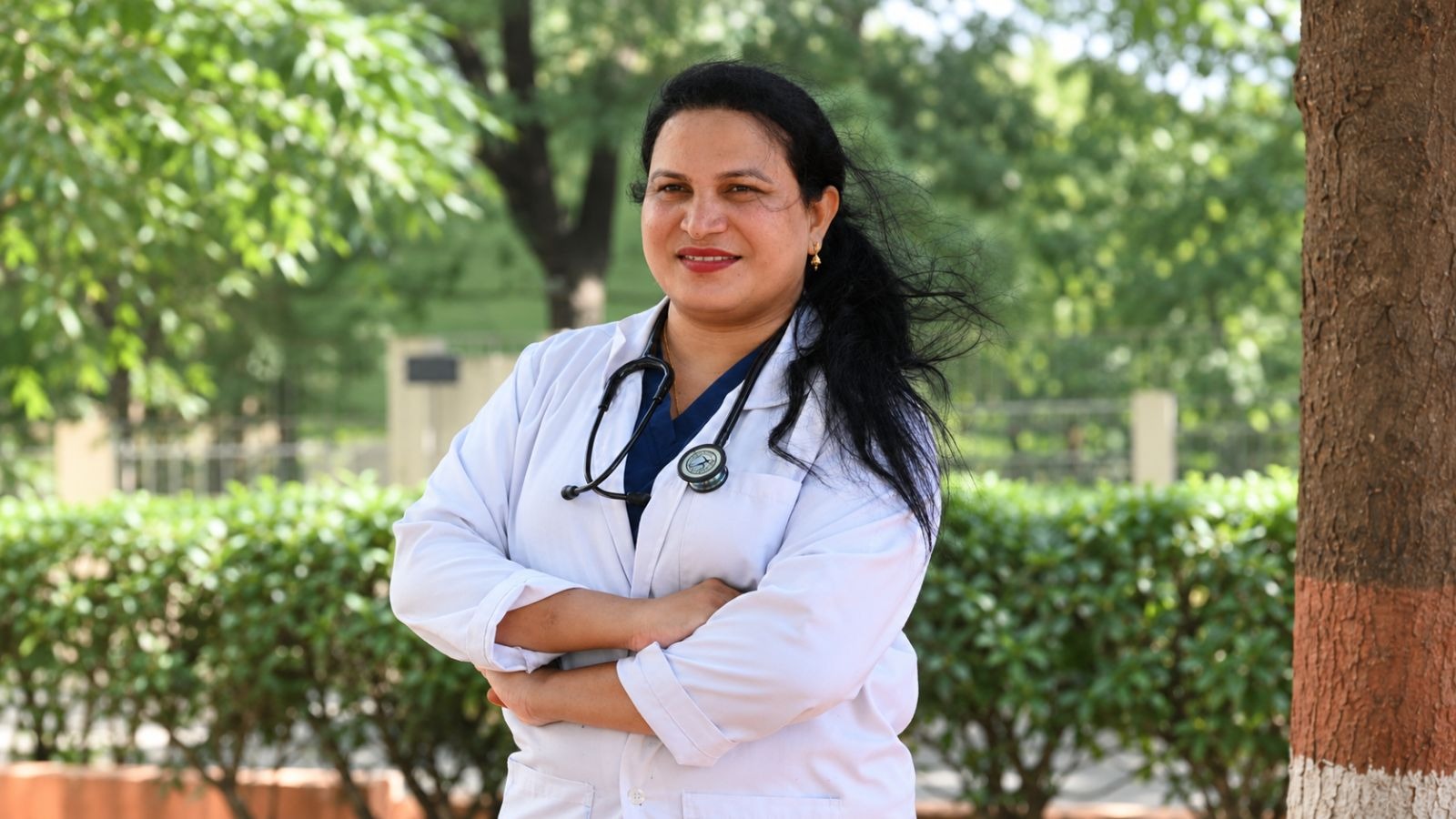
Dr Koyyala Ruth John Paul recently cleared her MD in Emergency Medicine, becoming one of the first Dalit trans women in India to do so. She said, "I'm still waiting to get my gender fixed on records." Despite facing family rejection, she now works at Hyderabad's ESIC Hospital helping patients.
After being driven out of her home for coming out as a trans woman, Dr Koyyala Ruth John Paul found support in her community and drew inspiration from Ambedkar. Even after clearing her MD in Emergency Medicine, she continues to fight for official recognition of her gender
In one corner of the triage centre in Hyderabad's ESIC Hospital, Dr Koyyala Ruth John Paul sits looking through a patient's records. Outside, a queue of patients snakes towards her consultation room.
The 31-year-old Dr Ruth recently cleared her MD in Emergency Medicine -- one of the first Dalit trans women to do so in India. That's a distinction she holds with both great honour and great trepidation.
Because for Ruth, this was only half the battle won. "I'm still waiting to get my gender fixed on records. The next step would be to work in a government hospital, not just for members of my community, but also for all those people who need medical care and do not have enough money to go to private hospitals."
According to the ESIC Hospital records, Dr Ruth hails from Khammam in Telangana. She is the youngest of three siblings. After her father died of a cardiac arrest in 2006, her mother, a daily wage labourer, raised her three children against all odds. Through it all, books were her constant companions.
"I was inspired by the life and struggles of Dr BR Ambedkar," she said. Ambedkar, she said, always spoke of "basic human dignity", not dignity for men or women. "As a Dalit trans woman, I was attracted by Dr Ambedkar's struggle against caste oppression and also his fight for human dignity. I was also attracted to Dr Ambedkar's quest for knowledge and formal education."
Dr Ruth's struggle for recognition of her gender dates back to her childhood, she said. Although she cleared her SSC (Class 10) and Intermediate (Class 12) with flying colours, she was still identified by the gender assigned to her at birth, which she describes as her dead gender.
"I enrolled under my given gender for medicine. But by third year, I came out to my family," she said. It was too much for her family to come to terms with. "They beat me and threw me out of the house," she said. She had two options -- begging and sex work, considered traditional practices of trans women. "But then I got in touch with educated members of our community. They were rare, but they were there," she said.
Hyderabad-based trans activists Rachana Mudraboyina and Vyjayanthi Vasantha Mogli helped her. "When my family beat me, saying that I could be possessed by demons, the members of my community saw the gift that I had. They nurtured my curious mind," Dr Ruth said. She completed her MBBS in 2019 from a college in Hyderabad. The family is now reconciled and supports her greatly, she said.
But the next stage was a struggle too. "I wrote and cleared NEET-PG thrice between 2021 and 2023. While I was allowed to register as an SC Transwoman in the application form, in the counselling, I was clubbed with women candidates. I approached the Telangana High Court to be enrolled as an SC trans woman in 2021," she told The Indian Express.
In 2022, the NMC wrote to her saying she cannot be included in the transgender category in counselling because there is no precedent for such an inclusion, making her case unique.
Three years on, that fight continues. The case in Telangana HC is still sub judice. In 2023, the court passed an interim order saying she could be admitted to the programme, but in the women's category.
"As a Dalit transwoman, I have the constitutional right to get reservation under two categories -- SC and Transgender. But the National Medical Council (NMC) does not approve of this and clubs me with women candidates," Dr Ruth said. "I was thrilled when the results of the examination came out on October 9."
Her older brother's name, John Paul, is now her chosen surname.
"My brother wanted to be a doctor. But my mother did not have the financial wherewithal to fund his education. So being a doctor remained a dream for him. I wanted to fulfil his dreams," she said. But what attracted her to medicine was the plight of trans women in her neighbourhood. "There were some trans women who had contracted HIV AIDS and were not getting the proper medical attention because they were trans women. I couldn't bear their plight," Dr Ruth said.
But finding work as a doctor proved difficult. "I did not get a job as a doctor because I was a trans woman and a Dalit to boot," she said. She then got a temporary job at Mitr Transgender Clinic, India's first specialised healthcare network for the transgender community, which was initially funded by USAID. The clinic shut down after US President Donald Trump cut funding in 2025 following his return to office. In May 2025, the Hyderabad clinic reopened as the Sabrang Clinic in Narayanguda, supported by Tata Trusts and YRG Care.
"When Mitr closed down, I did not have the support which I needed. But I got a job as a doctor in ESIC Hospital, Hyderabad soon after," she said, thanking her stars.
For Dr Ruth, the biggest dream is to work in a government hospital, she said. "The next step would be to work in a government hospital, not just for members of my community, but also for all those people who need medical care and do not have enough money to go to private hospitals," she said