
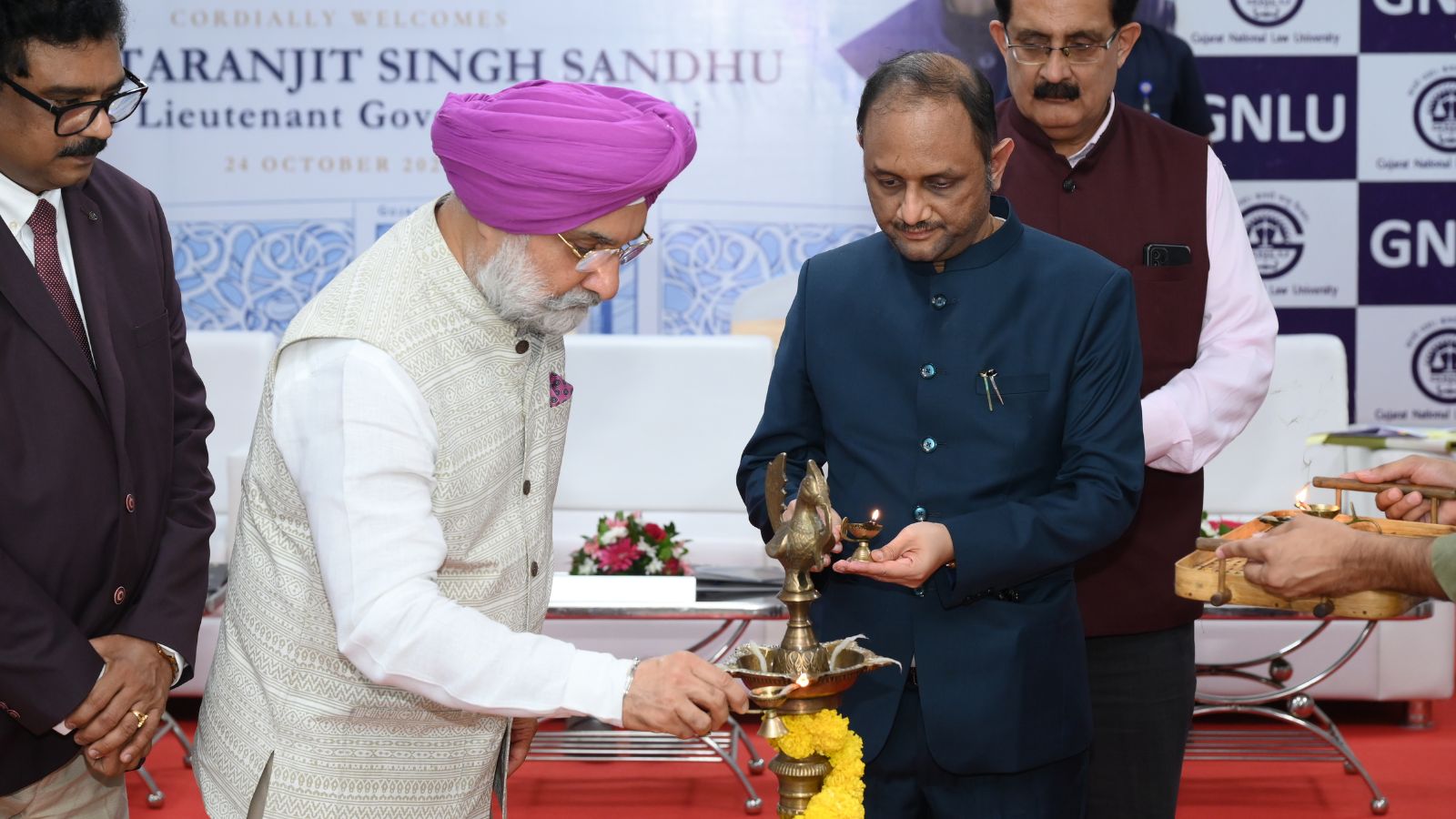
Bombay High Court judge Justice Advait M Sethna said 76% of India’s 5.73 lakh prisoners are undertrials, with 11,000 in Gujarat alone. At a GNLU event, he said, "Systematic case management is crucial." He urged students to help inmates who often do not know their rights or lack family support.
Every case must be tracked by its number, with follow-up the very next day: Justice Sethna at GNLU event
Calling for a system to track every undertrial prisoner's case with frequent follow-ups, Justice Advait M Sethna of the Bombay High Court on Saturday said systematic case management was crucial to preventing delays in the delivery of justice. Citing figures attributed to the National Crime Records Bureau (NCRB), he said 76% of India's 5.73 lakh prisoners were undertrials.
Speaking at the valedictory function of the Gujarat National Law University's (GNLU) Nyay Abhigam initiative, launched with the support of the Azim Premji Foundation to enhance access to justice for undertrial prisoners, Justice Sethna said: "Systematic case management is crucial. Every case must be tracked by its number, with follow-up the very next day, so that no case is overlooked, no judgment is delayed, and cases are disposed of in a timely manner."
Lieutenant Governor of Delhi Taranjit Singh Sandhu was the chief guest.
Emphasising the need to reach prisoners who are often unable to navigate the legal system on their own, Justice Sethna said, "One of the issues here is that the inmates are genuinely not aware of their rights." He said the initiative must pay particular attention to vulnerable prisoners, including women, those without family support and people struggling with addiction.
He added that the country had approximately 5.73 lakh prisoners, of whom 76% were undertrials, adding that there are 11,000 undertrial prisoners in Gujarat and 89,003 in Maharashtra, who accounted for 80% of Maharashtra's prison population.
"Martin Luther King Jr. said, 'Injustice anywhere is a threat to justice everywhere.' Probably this should shape your narrative of this initiative," he said, stressing that legal aid must extend beyond providing representation in court to ensure that applications are properly prepared and pursued. Recalling his experience as a lawyer handling matters involving prisoners in Solapur and Nagpur, he referred to the difficulties faced by inmates who were far from their families and lacked support.
"What needs to be ensured... is that the matters are properly prepared and the petitions appropriately drafted. This is very important," he said, adding that applications should be handled with due care so that courts could decide them at the earliest possible opportunity.
Urging students to participate in the effort, he said practical engagement with prisoners could impart lessons about justice that academic instruction alone could not provide.
"Imagine the privilege of being able to help an inmate, or someone who has no knowledge of the legal system, prepare an application that could change the course of their family's life. No classroom can teach this lesson as profoundly as the experience of working with prisoners," he said.
He also urged the government and institutional leadership to build legal awareness among students, cautioning against treating the administration of justice and respect for the law lightly.
Explaining the constitutional basis for access to justice, Sethna referred to Articles 14, 21 and 39A, dealing with equality before the law, protection of life and personal liberty, and equal justice and free legal aid.
"In Sanskrit and in our philosophy, 'nyaya' means justice, rules or logic, and also means approach or access. Therefore, the expression 'nyaya' becomes 'access to justice', which is a promise guaranteed under Article 39A of the Constitution of India," he said.
Referring to the Supreme Court's judgment in Anita Kushwaha v. State of Bihar, he said, "The process of adjudication must be speedy and fair. Last but not least, the process of adjudication must be affordable and economical," he said.
He cited the constitutional promise of access to justice as a responsibility that institutions must translate into practice, particularly for people who lack the resources or awareness to assert their rights. "The Magna Carta, human rights, national conventions and the evolution of jurisprudence have long contributed to the acceptance of access to justice as a basic and inalienable human right," he said.
Pointing to emerging challenges posed by artificial intelligence, data protection, cybersecurity, digital commerce and intellectual property, Sandhu said future legal professionals would need technological awareness, independent thinking and ethical judgment alongside sound legal knowledge.
"How do we encourage innovation while protecting citizens' rights? How do we ensure that technology remains accountable? How do we make justice more accessible, timely and affordable? These are questions that your generation will increasingly be called upon to address," he said.
Urging students to view law as an instrument of public service and nation-building, he said universities must go beyond preparing students for examinations and employment to foster curiosity, critical thinking, research, innovation and entrepreneurship.
The GNLU, with the support of the Azim Premji Foundation, launched Nyay Abhigam, a programme to improve legal assistance and case management for undertrial prisoners. The initiative is focussed on identifying barriers to justice, facilitating timely legal interventions, and helping prisoners understand and exercise their rights. It combines legal assistance, systematic case tracking, legal awareness, and rights-based education.