
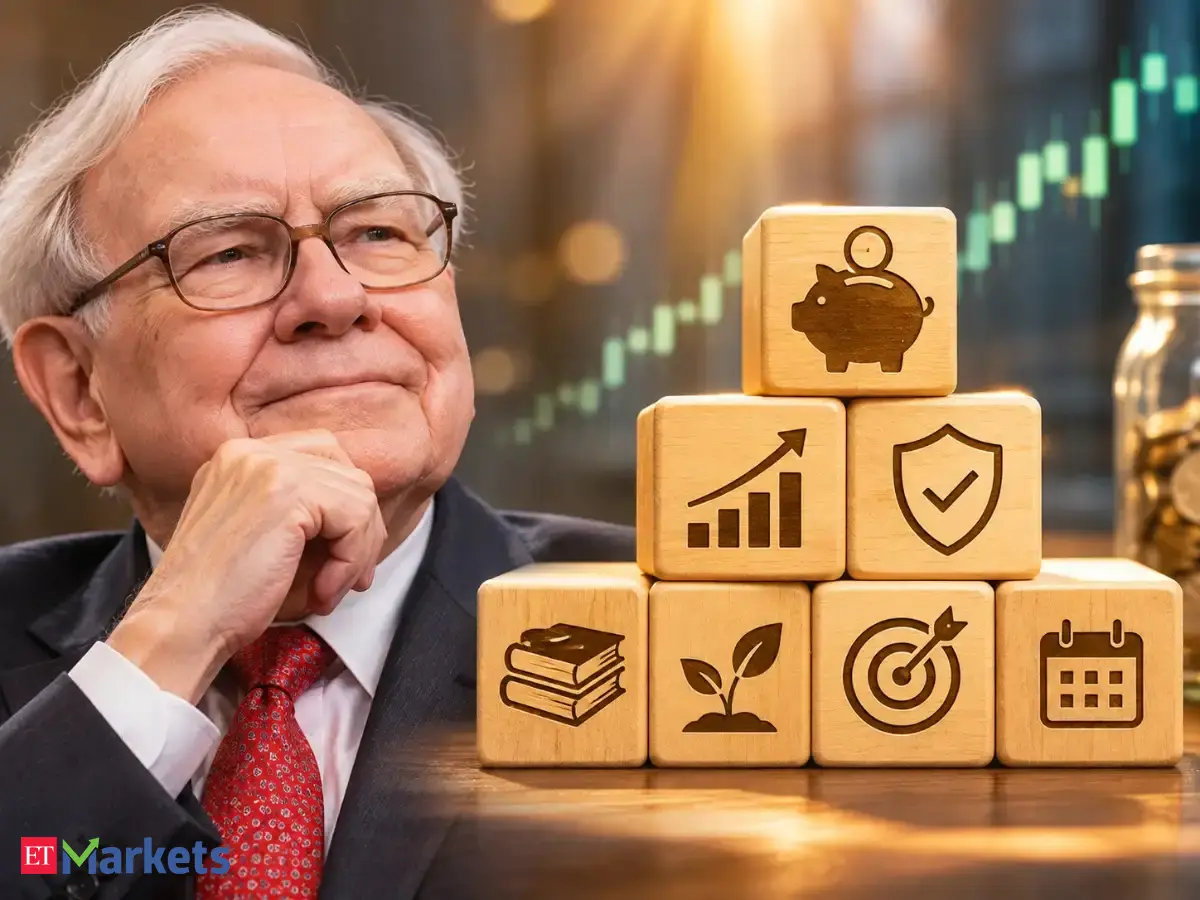
Warren Buffett shared seven financial lessons for young investors, focusing on frugal living and long-term growth. He said, "I do not think that standard of living equates with cost of living beyond a certain point." The 96-year-old veteran also advised people to pay off high-interest debt as soon as possible.
Warren Buffett shares seven essential financial lessons for young investors, emphasising frugal living, eliminating high-interest debt, long-term investing, understanding businesses, maintaining cash reserves and portfolio diversification through his 90/10 rule. He also reminds investors that financial wealth matters less than happiness, relationships and unconditional love.
Young investors often find it difficult to manage their finances as rising number of responsibilities and expenses take a toll on savings. But billionaire and market veteran Warren Buffett has some advice for them.
Buffett took control of a struggling textile company at the age of 35 in 1965 and transformed it into Berkshire Hathaway, now valued at more than $1 trillion, with annual after-tax operating earnings of about $45 billion. Buffett handed over the CEO role to longtime deputy Greg Abel this year, and recently passed on the Chairman role to his son, Howard Buffett.
The 96-year-old Warren Buffett, even after retirement, continues to inspire generations to come. Here are pieces of his advice that can help young investors.
1) Live below your meansWarren Buffett once famously treated fellow billionaire and Microsoft co-founder Bill Gates not at a fancy restaurant, but at his favourite McDonald's, and that too using coupons. This famously simple act speaks volumes about the market veteran's frugal lifestyle.
He lives in the Omaha house he bought for $31,500 in 1958. The five-bedroom home is now worth about $1.3 million, but Buffett says he would never trade it because it holds memories of raising his three children. He also avoids splurging on expensive cars. The legendary investor drives a 2014 Cadillac XTS, complete with hail damage, because, in his words, giving up half a day to shop for a new car isn't worth it. He even once had a license plate that read "THRIFTY," a fitting symbol for one of the world's richest individuals who chooses to live simply.
"I do not think that standard of living equates with cost of living beyond a certain point," Buffett said at a Berkshire Hathaway shareholders meeting in 2014. "My life would not be happier: it would be worse if I had six or eight houses or a whole bunch of different things I could have. It just doesn't correlate." Whether it's mansions or sports cars, Buffett avoids major purchases that reflect his wealth, believing they may ultimately detract from his happiness.
2) Pay off high-interest debt as soon as possibleWarren Buffett also strongly advised people to pay off any
high-interest debt they may have, like credit card debt. In fact, the ace investor believes that paying off your credit card debt is one of the best guaranteed ways to get a return on your money.
If you are drowning in debt, work out a payment plan to pay back your creditors as soon as possible, or the interest will keep piling up. After you're debt-free, make it a point to set aside funds for investments from your income regularly.
3) Think long-term while investingThe legendary investor advocated for long-term investing and not short-term quick trades. Buffett has famously said, "Our favourite holding period is forever." His long-term holdings have included Coca-Cola, American Express and Wells Fargo.
By emphasising low costs, diversification, and long-term growth, Buffett's rule continues to gain attention as a reliable strategy for everyday Americans seeking financial security.
4) Invest in what you knowWarren Buffett has repeatedly stressed the importance of staying within one's "circle of competence." "You only have to be able to evaluate companies within your circle of competence. The size of that circle is not very important; knowing its boundaries, however, is vital."
Buffett famously avoided technology stocks during the dot-com boom of the late 1990s because he believed forecasting the long-term survival of young technology companies was outside his expertise.
5) Always have a cash reserveWhile Warren Buffett is a bullish stock market investor, he did encourage people to hold some amount of cash reserves. "You do need oxygen, and if you are ever without it for four or five minutes, you will learn. And cash is that way. So you always need to have it available, because you do not know what will happen," Buffett told CNBC during an interview earlier this year. He, however, added that while holding cash at certain levels is necessary, it is not a good asset.
The legendary investor likes to keep some level of cash to pay obligations and as "dry powder" for any attractive acquisitions.
6) The 90/10 investment ruleIn his 2013 letter to Berkshire Hathaway shareholders, Warren Buffett introduced his 90/10 investment rule by sharing what he wrote in part of his will. With reference to a cash inheritance going to his wife, he advised his will's trustee to keep 90% of the cash inheritance in an S&P 500 index fund and 10% in short-term government bonds. Buffett believed this mix offers the best balance of growth and stability for non-professional investors. The S&P 500 provides exposure to America's largest and most profitable companies, while Treasury bonds act as a cushion during market downturns.
7) Remember that money isn't everythingBuffett is among the richest people in the world, but he does not use this metric as a measure of success. "Being given unconditional love is the greatest benefit you can ever get," he told MBA students in a 2008 talk.
"The incredible thing about love is that you can't get rid of it. If you try to give it away, you end up with twice as much, but if you try to hold onto it, it disappears. It is an extraordinary situation, where the people who just absolutely push it out, get it back tenfold."