
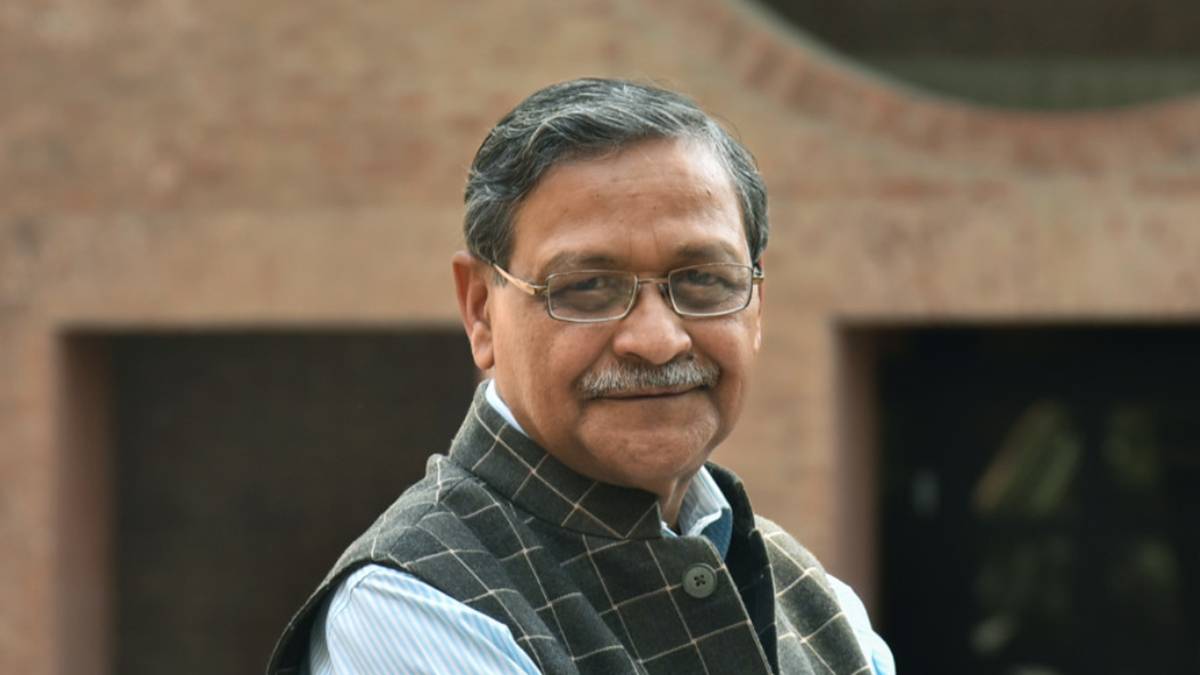
IIM Ahmedabad director Bharat Bhasker said placement prospects at top management schools remain strong despite global economic uncertainty. He noted that demand for graduates stays high regardless of market conditions. Bhasker said, "I can speak for the top five or six institutes in the country, where the impact is limited."
Placement prospects at leading management schools remain strong despite economic uncertainty, IIM Ahmedabad director Bharat Bhasker told FE's Manu Kaushik. He also discussed plans to expand funding for AI start-ups, the impact of the West Asia conflict on the institute's Dubai campus and how management education must evolve as businesses increasingly adopt AI.
With high crude oil prices, rising inflation and global trade uncertainties weighing on the economic outlook, how do you see these factors affecting final placements at IIM Ahmedabad?
We saw some impact last year. However, I can speak for the top five or six institutes in the country, where the impact is likely to be limited. The economy is large, and the pool of high-quality management graduates available for immediate managerial roles remains limited. There are perhaps 25 management schools producing graduates who are ready to take on such roles.
We produce around 400 graduates, and demand for them remains strong, regardless of whether the economy is performing well or poorly. We are unlikely to face a significant negative impact, although lower-ranked management schools could be affected much more.
Oil prices are the biggest crisis facing the economy. Uncertainty around import-export barriers is another concern, although companies have developed alternative export routes and may be able to adjust. However, a severe market crash would affect everyone.
IIMA's Dubai campus was inaugurated in September 2025. How has the West Asia conflict, which began within months of its launch, affected the campus, its students and its operations?
We initially felt the impact. There was considerable uncertainty about how the conflict would develop, and our students were worried. We prioritised their safety and brought them to India, where they stayed for around two to two-and-a-half months. The UAE is now in a stable position, and we are back on track.
The institute plans to support AI-related entrepreneurship through a fund. What kind of funding are you planning for AI start-ups, and how will it differ from the existing funding model?
Our blended MBA programme in Business Analytics & AI (BPGP: BA & AI) is not intended to fund students to start companies. It gives working professionals a space to experiment with AI and explore business ideas while learning. Funding becomes relevant when an idea is ready to move towards launching a company.
Alongside our educational programmes, we have IIMA Ventures, our incubation arm, which typically invests Rs 75 lakh to Rs 1 crore in each start-up at present. We recognise that Rs 1 crore may not provide a sufficiently long runway for some AI ventures. We have been discussing with Chandrika Krishnamurthy Tandon, who provided the endowment to launch the School of AI, our alumni and others how large a funding pool we should create. It could potentially support entrepreneurs from IIM Ahmedabad and other IIMs and IITs. The amount, however, will depend on the idea.
How would the proposed funding model work beyond the initial incubation stage?
IIMA Ventures has helped create around 70 consequential companies, alongside many smaller successful businesses. When IIMA Ventures invests '1 crore, co-investors may join, taking the initial funding available to around three times that amount. Follow-on investment can be substantially larger, depending on the start-up. We want to adopt a similar approach for AI ventures, backed by a wider investor network.
You are about to start the second batch of BPGP: BA & AI. What changes are you considering for the programme as the first batch progresses?
The first batch has completed only about six months, so it is too early to make major changes. We take feedback from the market and industry seriously, but significant changes require more time and evidence.
Will the AI-focused programme attract more engineers in the coming years, and could that change the composition of IIMA's traditional MBA cohorts?
The traditional MBA programmes already have more than 40% non-engineers, and some batches have come close to 50%. There is no question of freeing up seats for non-engineers. We are background-agnostic in admissions because we train managers and critical thinkers, not engineers.
The AI-focused programme currently has 23% non-engineers. AI is not only about engineering. A finance professional, for instance, needs to understand how to use AI tools and build agents for investment decisions without necessarily understanding the underlying mathematics and algorithms.
Are companies hiring fewer generalist MBAs as they increasingly seek specialised skills and AI proficiency?
That is not happening to any significant extent yet, although some industries will naturally prefer candidates with knowledge of their sectors. Over time, however, managers will have to be AI-enabled, just as they are expected to be digitally proficient today. Companies do not want managers who are digitally blind. The same expectation will develop around AI.
We need to prepare managers to work in an AI-enabled environment. Twenty years ago, the requirement was to prepare managers for an internet-enabled industry. The principle is similar, but the technology has changed.