
Vijay Sankeshwar built VRL Logistics into a ₹5,565 crore empire by November 9, 2026. Starting with a small printing press at 16, he later faced many business challenges. He said, "Luckily, I never missed paying the rent." Today, his company employs 21,511 staff and reported significant revenue from operations.
In 1978, a 28-year-old man from Gadag rented a house in Hubballi for ₹600 a month. He had a wife, small children and a transport business that was losing money. He also had a father who didn't trust any of it.
Then the father came to Hubballi and did something that the son would remember for the rest of his life. He gave the landlord a postcard with his own address written on it. If the boy failed to pay rent for two months, the landlord was to post it. The family would come and settle the dues.
The son was Vijay Sankeshwar. "Luckily, I never missed paying the rent," he said nearly four decades later.
That postcard was never posted. And the business it was meant to protect against grew into VRL Logistics, a company that reported ₹3,221.11 crore in revenue from operations for the year ended March 2026, employed 21,511 permanent staff and had a stock market value of about ₹5,565 crore on November 9, 2026.
But that's the ending. The middle is action-packed. It has a printing press, a newspaper sold to the Times Group, three terms in Parliament, an airline that never flew, a bus business sold to the family's own company, and a year in which profit fell from ₹323 crore to ₹89 crore. Start at the beginning.
The fourth of seven, running a press at 16
Vijay Sankeshwar was born on August 2, 1950, in Betageri, Gadag, in what was then Mysore State. He was the fourth of seven children. His father, Basavanneppa Sankeshwar, had founded BG Sankeshwar and Co., a book printing and publishing house in Gadag. His mother was Chandrawwa.
The family wasn't poor. It wasn't rich in the way the word is used today either. The press printed the D K Bhardwaj Kannada dictionary, which still sells 5 to 6 lakh copies a year and which Vijay's brothers continue to handle.
His father had a plan for him. College wasn't in it. So when Vijay finished school, he was handed a printing unit of his own, Vijay Printing Press, with one machine and two workers. He was 16.
He didn't treat it as a hobby. He printed the dictionary, answer sheets for Karnataka University, school textbooks and, oddly enough, the Indian edition of Span, the magazine published by the US Embassy in India.
At 19 he spent ₹1 lakh on modern machinery. He worked 12 to 14 hours a day, and in between he completed a commerce degree from Karnataka University, Dharwad, as an external student.
Two other things from these years matter later. Politics caught him at 12 and he was active with the RSS. And at 22 he married Lalitha, on December 14, 1972. Politics and family would both pull at him for the next fifty years.
Here's the thing about the press years. They taught him machines, deadlines and money. They also taught him that he didn't want to stay. While running the press he quietly studied what he could do with ₹2 to 3 lakh. He picked transport.
The truck nobody wanted him to buy
The trade he chose in the mid-1970s wasn't a respectable one. Trucking in Karnataka was a world of small owners, cash deals and middlemen. There was no way to talk to a driver once he left town. Organised players, even decades later, held only about 10% of India's logistics market.
Sankeshwar knew what people thought of truckers. "Back in 1976 having a truck business meant getting lured into the illegal domains like smuggling etc.," he said in 2017. "But I was very clear that I did not want to go on that path and stuck to my guts."
In 1976 he started Vijay Transport in Gadag with one truck. He borrowed ₹1.2 lakh from friends to buy it.
Respected local people advised him against it, he later said. His parents and his wife wanted him back at the family press.
He didn't go back. He was 26.
Losses, accidents and a founder behind the wheel
The first years were bad. Honestly, they were worse than bad.
Trucks met with accidents. Nobody knew where a load was until the truck came back, because there was no way to reach a driver on the road. He made losses. Relatives and acquaintances, he later said, insulted and humiliated him, and well-wishers turned into enemies. "I realised that if I didn't take risks, I would never succeed," he said.
There's one detail from these years that tells you more than any balance sheet could. On long routes, Sankeshwar drove the truck himself so his driver could sleep. The owner of the company. At the wheel at night on the Gadag and Hubballi roads, so the man he was paying could rest.
Accounts differ on how quickly the fleet grew. One version says he added a second truck only after three years; another says he moved to Hubballi in 1978 and added three trucks. What matters is the move itself, and that it was the first real gamble.
Hubballi sat at a crossroads of routes to Bengaluru, Belagavi, Goa and Maharashtra. Gadag didn't. So in 1978 he took his wife and children, rented that ₹600 house and left his father worrying. Big companies in Hubballi and FMCG firms in Bengaluru first brushed him off. Later, after hearing that his trucks arrived when he said they would, they came to him.
"I had really tough days but kept focus, had confidence and kept practicing what I believe in," he said. "I've tried meditation and all but doesn't work for me. I prefer just continuing to deal with the problem than run away from it."
Eight trucks, then 117, then a parcel network
On March 31, 1983, the business became Vijayanand Roadlines Private Limited. It had eight owned trucks.
This was the first breakthrough, and the reason is simple. Most truck owners of that time rented out a full vehicle to one customer. Sankeshwar was moving towards carrying many small loads from many customers on the same truck, through his own branches.
Parcels. Part loads. What the industry now calls less-than-truckload, or LTL. It's harder to run because you need branches, hubs and discipline. But once it works, nobody can easily copy it.
By 1990 the company had 117 vehicles and a turnover of about ₹4 crore. In 1992 it started a courier service in Karnataka. By 1994, when it became a deemed public limited company, it had more than 150 trucks. Two years later, in 1996, he bought four buses for the Bengaluru to Hubballi route.
That same year, 1996, he won the Dharwad North Lok Sabha seat on a BJP ticket. He won again in 1998 and in 1999.
The newspaper that ate money
In 1999 Sankeshwar did something nobody expected from a transporter. He launched a Kannada daily, Vijaya Karnataka.
It copied The Times of India's playbook in marketing, circulation and editorial style, and it became the largest circulated paper in the state. An English daily, Vijay Times, followed in 2002, and then, in 2005, a second Kannada paper, Usha Kirana.
The papers were a success with readers and a problem for the books. In May 2006, people close to Sankeshwar put his investment at ₹60 crore, while media watchers said it was over ₹100 crore. His own camp admitted the publishing company was losing about ₹1 crore a month. Critics said he had "bit off more than he could chew."
In June 2006, the Times Group signed an agreement to buy 100% of Vijayanand Printers. The price was never disclosed. Sankeshwar's explanation was short. He wanted to "focus on the major expansion and diversification plans for its logistics business."
He had to sit out a five-year non-compete. In 2012 he came back with another Kannada daily, Vijayavani, and made himself its editor.
The one decision that defined VRL
Every truck company in India faces the same choice. Own the vehicles or hire them. Hiring is lighter on the balance sheet. Owning is heavier, riskier and slower.
Sankeshwar chose to own. Almost everything.
VRL bought its own trucks, built its own truck bodies, ran its own garages and parking yards. It became one of the largest customers of Ashok Leyland and Volvo. He even refused to hire people from the transport industry, saying they "come with a set mindset."
"Owning vehicles gives us significant cost advantages over our peers," he said in September 2022. "Using one's own vehicles gives us 10 per cent cost advantages." He added a line any banker would like. "Today, of our total fleet strength, 50 per cent of our vehicles are fully depreciated and almost 90 per cent are debt-free."
In 2022, at 72, he doubled down. VRL ordered 1,600 trucks worth ₹560 crore, mostly from Tata Motors. To pay for it, the company sold things it had spent decades building. The 42 MW wind power asset went to Ratna Cement for ₹48 crore. The luxury bus business, 277 buses that had once made up 18% of revenue, was put up for sale for ₹230 crore.
The buyer of the buses was Vijayanand Travels, a promoter entity. That made it a related-party deal, and the company had to seek approval from non-promoter shareholders. The bus and wind sales closed in the January to March 2023 quarter.
VRL's filing said the bus business had a "drag-down impact on consolidated results" and that the aim was to become "a pure-play player in the goods transportation industry." Fuel had gone from 37% to 47% of bus revenue in two years. The logic was sound. But it's worth saying plainly that a family-owned bus brand moved from the listed company to the family's own hands.
And the risk was plain enough. A ₹560 crore truck order sits on the books whether the freight shows up or not.
For one year, it looked fine. FY23 net profit was ₹323 crore. Then the bill came.
From ₹323 Crore to ₹89 crore
Look at the FY23 number more closely and the warning is already there. It included a one-time profit of ₹187 crore from selling the bus and wind businesses, booked as an exceptional item, the CFO said in May 2023. Earnings per share from continuing operations were ₹18.80, against ₹36.58 for the year as a whole. Strip that out, and the core business was earning far less than the headline said.
In FY24 the headline caught up with reality. Revenue rose about 9% to ₹2,888.62 crore. Net profit collapsed to ₹88.85 crore. Profit as a share of revenue fell from 12.2% to 3.1%. Borrowings, which had been ₹537 crore in FY22, crossed ₹1,000 crore. The company's credit rating outlook moved from Positive to Stable.
The reasons were unglamorous. VRL ties its freight rates to diesel prices, and diesel didn't move, so rates stayed flat while salaries, tolls and rents rose. The company had leased big new transshipment hubs that were running well below capacity. A weak monsoon slowed demand in the southern states.
On the earnings call in February 2024, chief financial officer Sunil Nalavadi didn't dress it up. "The PAT for the current quarter is around 14 Crores which has been reduced from around 38 Crores," he said. Prices couldn't go up because rivals weren't moving theirs. "We do not want to take risk by increasing the rate," he told analysts. Trucks on hub-to-branch routes were running at only "60-65%" utilisation, he said.
That was the bottom. A company that had made ₹323 crore was now making ₹14 crore in a quarter, with more debt than ever and hubs it couldn't fill. The model Sankeshwar had defended for 48 years, own everything, carry everyone, looked heavy for the first time.
No debt default, regulatory penalty or court order against the company turns up in public reporting from this period. This was a margin crisis, not a scandal. For a founder who had always measured himself by trucks owned and dues paid on time, it was one of the sharpest falls in profit since the company listed.
The price hike that nobody wanted to make first
The recovery wasn't one big move. It was the slow, boring work that Sankeshwar had always liked.
VRL finally raised freight rates in mid-2024, by 5 to 10% depending on the product and region. It pushed its own vehicles harder, cutting lorry hire charges from 7.71% of revenue in FY24 to 5.54% in FY25. It kept opening branches, 25 to 30 a quarter, mostly in markets it hadn't touched.
FY25 profit doubled to ₹182.92 crore. FY26 profit rose again, to ₹236.83 crore. In July 2025 the board announced the company's first ever bonus issue, one share for every share held.
And then came FY27. Rates went up again, about 5% on April 1 and another 4% in mid-May 2026, CFO Sunil Nalavadi said on the November 5 earnings call. The quarter that ended September 2026 showed what that did.
Revenue from operations rose 21% to ₹961.9 crore. EBITDA margin climbed to 23.34%. Net profit more than doubled to ₹103 crore, from ₹49.9 crore a year earlier. The stock jumped over 14% to a 52-week high of ₹319 on November 3. Days earlier, the company had run a ₹280 crore buyback at ₹320 a share.
From the bottom to that quarter took nearly three years. No new founder. No outside investor. No fire sale. Just price hikes, fuller trucks and patience.
The Company Today, by the Numbers
As of September 2026, VRL ran 1,337 branches and moved 1.079 million tonnes of goods in a single quarter, at an average of ₹8,840 per tonne. The fleet stood at 5,941 vehicles at the end of September 2026, Nalavadi said on the earnings call, down from 6,158 owned vehicles in September 2024. About 76% of it is now debt-free.
Goods transport is effectively the whole business now. The hub-and-spoke LTL service made up about 91% of revenue in FY24. South India, where it began, is still its home ground.
Net debt was down to ₹337 crore on September 30, 2026, the company said, against gross borrowings of about ₹1,313 crore. The bigger risk is cost. The model needs constant spending on trucks and hubs, and diesel, tolls and wages can rise faster than rates.
The competition that matters most is still the unorganised operator with one truck and no overheads. The man who started as exactly that now competes against his own past.
Father, Son and a Reappointment at 76
Vijay Sankeshwar continues to be the Chairman and Managing Director. His son, Dr Anand Sankeshwar, is Managing Director and runs marketing and day-to-day work. Between them they held 59.76% of the company on March 31, 2026, with Anand at 31.43% and Vijay at 28.33%.
Total promoter holding was 60.24%. The promoters stayed out of the 2026 buyback, which closed in November, so their share of the company rose as the bought-back shares are cancelled. The second generation already owns more than the first.
There has been no public family fight. Succession here looks planned rather than sudden. In 2022, Anand produced Vijayanand, a film about his father's life, released in five languages on December 9 that year.
Even so, the board's latest step is telling. The board proposed to reappoint Vijay Sankeshwar as CMD for five more years from January 1, 2027, and shareholders approved it at the August 4, 2026 annual general meeting. He'll be 76 when the new term begins and 81 when it ends.
What One Truck Changed
In the 1970s, sending a carton of goods from Hubballi to a small town a few hundred kilometres away usually meant finding a truck owner, waiting for a full load and hoping. The parcel business in South India was mostly informal, mostly cash and mostly unreliable.
Sankeshwar didn't invent the parcel. What he built was a company that could promise a small trader in Gadag or Bellary the same service a big FMCG company got, through a branch near his shop, on a truck owned by the same firm at every stage.
And he proved that a transporter from North Karnataka could list on the stock exchange, list through a ₹468 crore IPO that was subscribed about 74 times in April 2015, and run 21,511 people without losing the habits of the man who drove at night.
Without him, the trade would still have organised itself. Probably slower. Probably from Mumbai or Delhi, not Hubballi.
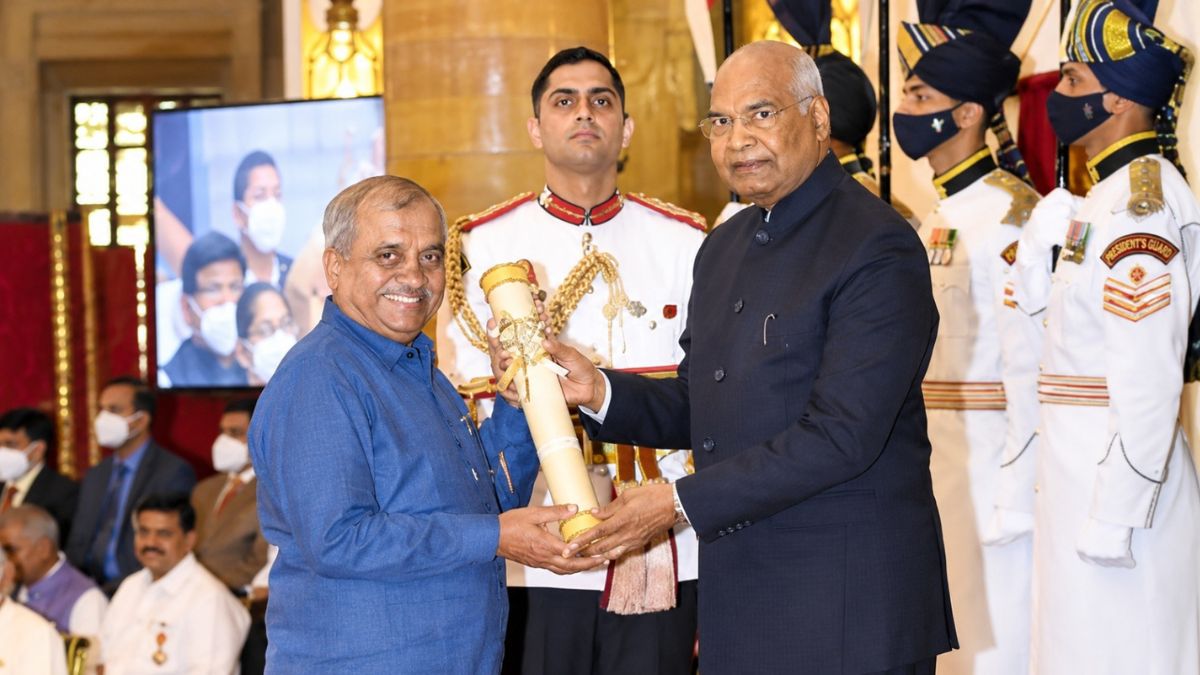
He was given the Padma Shri in 2020. Karnataka University, where he once studied as an external student, gave him an honorary doctorate in 2014.
But the detail that stays with you isn't an award.
It's that postcard. A father in Gadag, sure his son was making a mistake, writing his own address on a card and handing it to a stranger. Just in case. The son never gave the landlord a reason to use it. Forty-eight years and thousands of trucks later, he still talks about the rent he never missed, as if that is the achievement.
Maybe it is.
Key Numbers
Market value from Kotak Neo, Q2 FY27 from Angel One, annual figures from factsheet (VRL annual reports).
Then vs Now
Editorial Note: This profile is based on original reporting, including direct communication with VRL Logistics and its representatives. To ensure a comprehensive perspective, FinancialExpress.com corroborated this information with public records and third-party sources. FinancialExpress.com retains full editorial independence and final authority over all editorial decisions.