
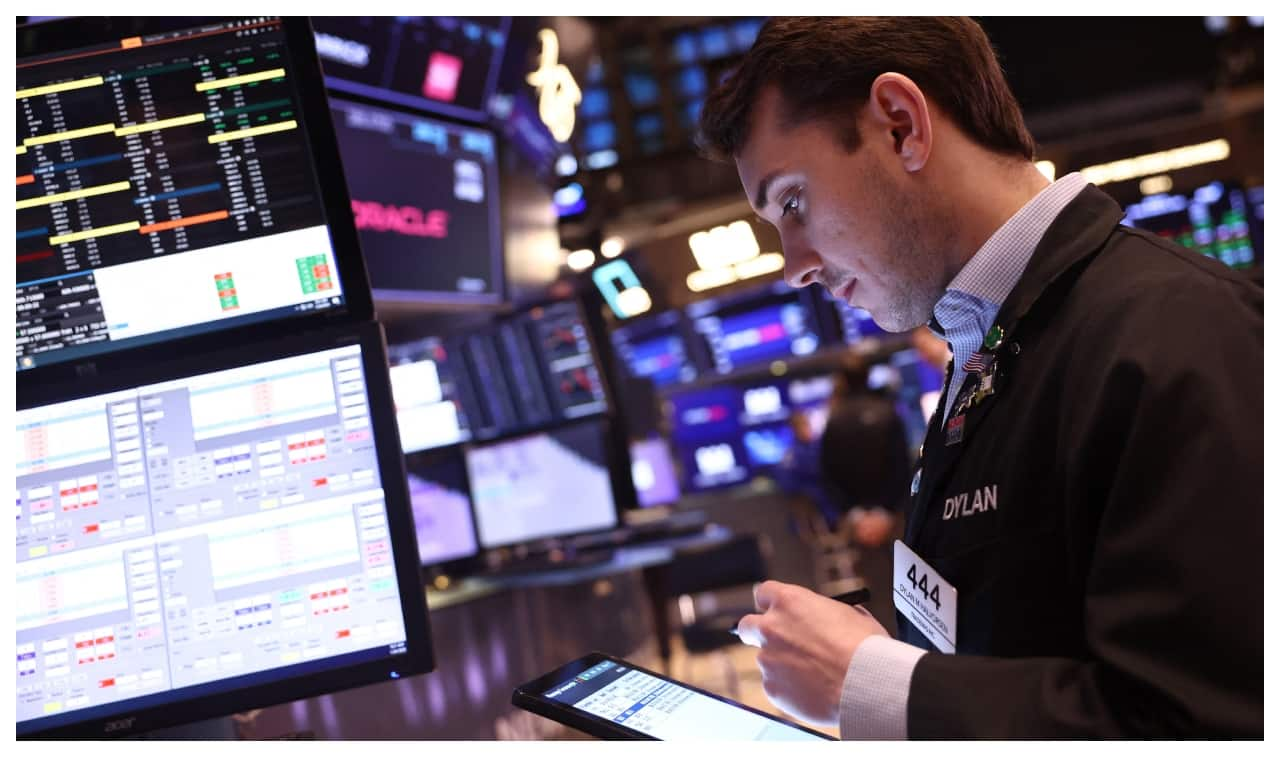
The S&P 500 gained 2.3% on Monday, marking its biggest rally in over seven months. Investors returned to the market after oil prices fell, helping all 11 sectors climb. Luke Rahbari said, "The AI trade had started to move from the 'believe me' to the 'show me' space."
US stocks had their biggest rally in over seven months as investors stepped in after a sharp tech-led selloff last week, while a drop in oil prices provided another boost Monday. The S&P 500 gained 2.3% by the end of the trading day in New York. More than five stocks gained for every one that fell as all 11 market sectors climbed. It was the broadest rally in nearly a year. Nvidia Corp. shares closed at their lowest price in over seven months after Chief Executive Officer Jensen Huang admitted to an extramarital affair with Alice Huang, a woman identified as a suspected Chinese spy. US-listed China stocks closed lower amid concerns of souring relations and potential restrictions between the two countries.
The tech-heavy Nasdaq 100 closed up 3.4% while the Dow Jones Industrial Average rose 2.2%. Both indexes are continuing their rebound from late last week after Thursday's sharp drop, even as the market's largest stock remained under pressure. Cyclical corners of the market including consumer discretionary and industrials led the advance. "The AI trade had started to move from the 'believe me' to the 'show me' space," said Luke Rahbari, chief executive officer of Equity Armor Investments. While a broader market recovery is possible, Rahbari noted that "it's not going to be a straight line up." US President Donald Trump said he's unlikely to launch broad attacks on Iran, sending oil prices lower.
West Texas Intermediate crude oil is down 4.06% to around $87 a barrel. Airline stocks spiked on expectations of fuel cost relief, with United Airlines Holdings Inc. and Delta Air Lines Inc. rising to intraday highs in late trading. In a Monday afternoon note, Barclays Plc's Equities Tactical Strategists team led by Alexander Altmann said that "today's rally presents an interesting setup because market internals have once again started to deteriorate." Nvidia was trailing peers, even after paring initial losses of as much as 8.8%, on news of an investigation into the CEO's affair. The revelation of Huang's affair "will add to pressure on the Trump administration to tighten export controls," said Michael Hirson, head of China research at 22V Research LLC.
"The bottom line is these developments reaffirm our long-standing concerns that US-China tech and supply chain tensions, after a relatively quiet 2026, will be more volatile going forward," he said. The technology-heavy Nasdaq 100 remains vulnerable after Thursday's plunge across the industry. The 4.8% break under the 200-DMA last week was of historic proportions and, according to Bloomberg-compiled data, breaks of more than 3% typically take 25 trading days to reclaim this level. The gauge remains below its 200-DMA after Monday's rally. Opinions over the catalyst of this price action are split: SocGen strategists viewed signs of an institution level de-risking event, while Vanda Research highlighted a significant unwind of positions from retail investors.
Elsewhere in the tech sector, shares of Akamai Technologies dropped on a plan to offer $2.2 billion in convertible bonds. The stock is one of the worst performers in the S&P 500 Index. Traders are parsing an uptick in wholesale trade inventories data and inflation expectations from the New York Federal Reserve ahead of Tuesday's US consumer prices for October, which could determine the prospects of an interest-rate hike in December.