
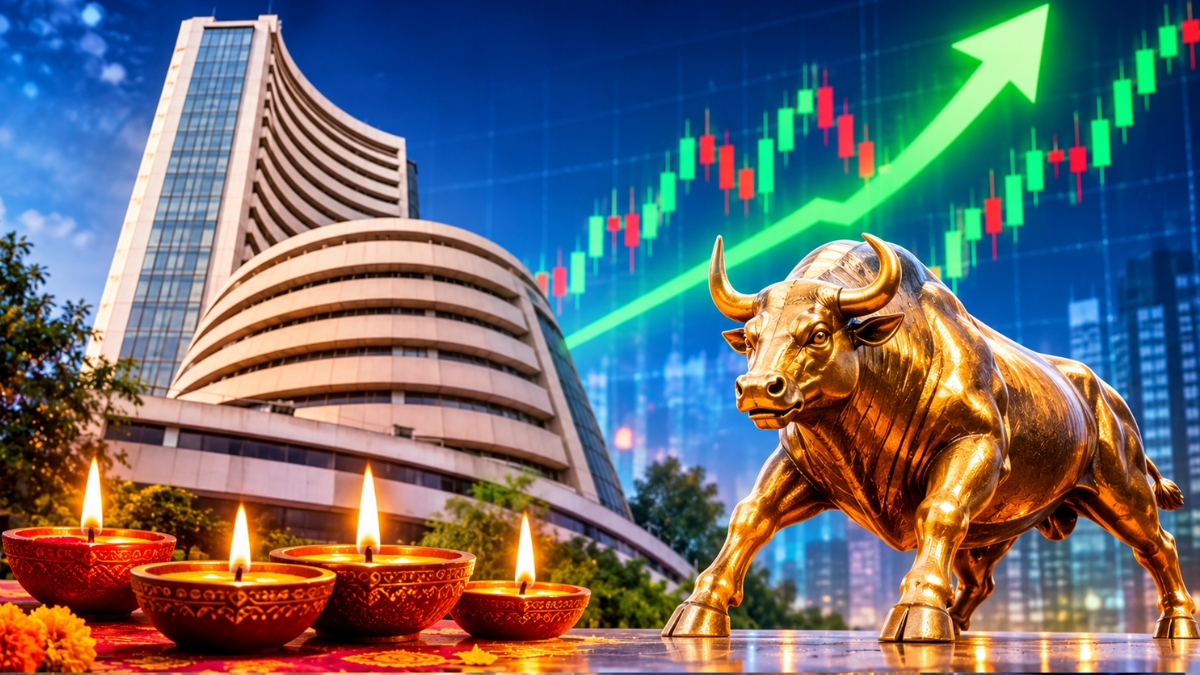
Sensex and Nifty ended higher in each of the five Muhurat sessions between 2021 and 2025. As Samvat 2083 begins, experts say corporate earnings growth will be critical in determining market direction. Shripal Shah said, “Equity valuations have become more reasonable and the outlook for earnings growth remains encouraging.”
How Sensex and Nifty performed in the last 5 Muhurat sessions
Both benchmark indices ended higher in each of the five Muhurat sessions between 2021 and 2025.
In 2024, the Sensex closed at 79,724.12 and the Nifty at 24,304.35. In 2023, the indices settled at 65,259.45 and 19,525.55, respectively. In 2022, the Sensex ended at 59,831.66, while the Nifty closed at 17,730.75. In 2021, the two benchmarks settled at 60,067.62 and 17,916.80, respectively.
The latest session in 2025 saw relatively modest gains, with the Sensex rising 0.07% and the Nifty advancing 0.10%. While the five-session record has been positive, it does not guarantee a similar performance in the upcoming session.
Muhurat Trading 2026: Key factors to watch
Somil Mehta, Head of Retail Research at Mirae Asset Sharekhan, said corporate earnings growth will be critical in determining market direction. He also identified crude oil prices, geopolitical developments, RBI policy decisions and foreign institutional investor flows as important factors for Samvat 2083.
“As we enter Samvat 2083, investors should closely monitor a few important factors that could influence market performance. Corporate earnings growth will be critical in determining market direction. Crude oil prices and geopolitical developments will impact India’s inflation, currency and economic outlook. Investors should also track RBI’s repo rate decisions and retail inflation, as these will influence borrowing costs, consumption and corporate profitability. FII flows, US interest rate decisions and the rupee’s movement against the dollar will remain important. Additionally, government spending on infrastructure and manufacturing, along with domestic consumption trends, could support economic growth. Overall, improving earnings and stable economic conditions could drive Indian equities higher.”
Mehta’s assessment puts earnings and domestic economic activity alongside global developments as key factors for the market. The direction of crude oil prices, the rupee and foreign investment flows could also influence market performance.
Samvat 2083 outlook: What Kotak Neo CEO expects
Shripal Shah, MD & CEO of Kotak Neo, sees reasons for optimism in the new Samvat, citing more reasonable equity valuations and an encouraging earnings growth outlook. He said India’s long-term growth opportunity remains compelling, even though short-term market movements are difficult to predict.
“As we enter the new Samvat, there are reasons to look ahead with optimism. Equity valuations have become more reasonable and the outlook for earnings growth remains encouraging. While market movements are difficult to predict in the short term, India’s long-term growth opportunity remains compelling.”
Shah advised investors to focus on staying invested and making staggered investments instead of trying to time the market. He also recommended diversification across market capitalisations and asset classes.
“For investors, the focus should therefore be less on timing the market and more on staying invested and investing in a staggered manner with a long-term perspective. It is equally important to build a well-diversified portfolio, across large, mid and small-cap companies; across asset classes; and across direct equities and mutual funds. With the interest-rate environment evolving, debt too could offer interesting opportunities for investors in the year ahead and play an important role in a balanced portfolio.”
He added that discipline and a long-term approach would be important for investors in the new Samvat.
“As we step into Samvat 2083, my message is simple: stay disciplined, diversify and think long term. Opportunities will emerge across markets and asset classes, and a considered, staggered approach can help investors participate without trying to predict every market move.”
Conclusion
The Sensex and Nifty have recorded gains in each of the last five Muhurat trading sessions, providing a positive historical backdrop for the November 8 session. For Samvat 2083, the market outlook will depend on earnings growth, domestic consumption, crude oil prices, inflation, interest rates and foreign fund flows. While Mehta identifies these factors as key market drivers, Shah’s advice centres on staggered investments, portfolio diversification and a long-term approach.