
Consumer goods companies are losing their profit edge in quick commerce as costs rise. Brands said profitability now matches traditional kirana stores. Higher advertising and promotional spending have narrowed the gap significantly. "Profits are now more or less similar, whether it's GT or any alternative channel," said Shrikant Kanhere.
Consumer goods companies are experiencing a decline in profit margins from quick commerce due to rising costs. Previously, they earned significantly more from quick commerce compared to traditional kirana stores. Advertising costs and promotional spending have notably increased for these companies within the sector. As a result, profitability in quick commerce is now comparable to general trade profitability.
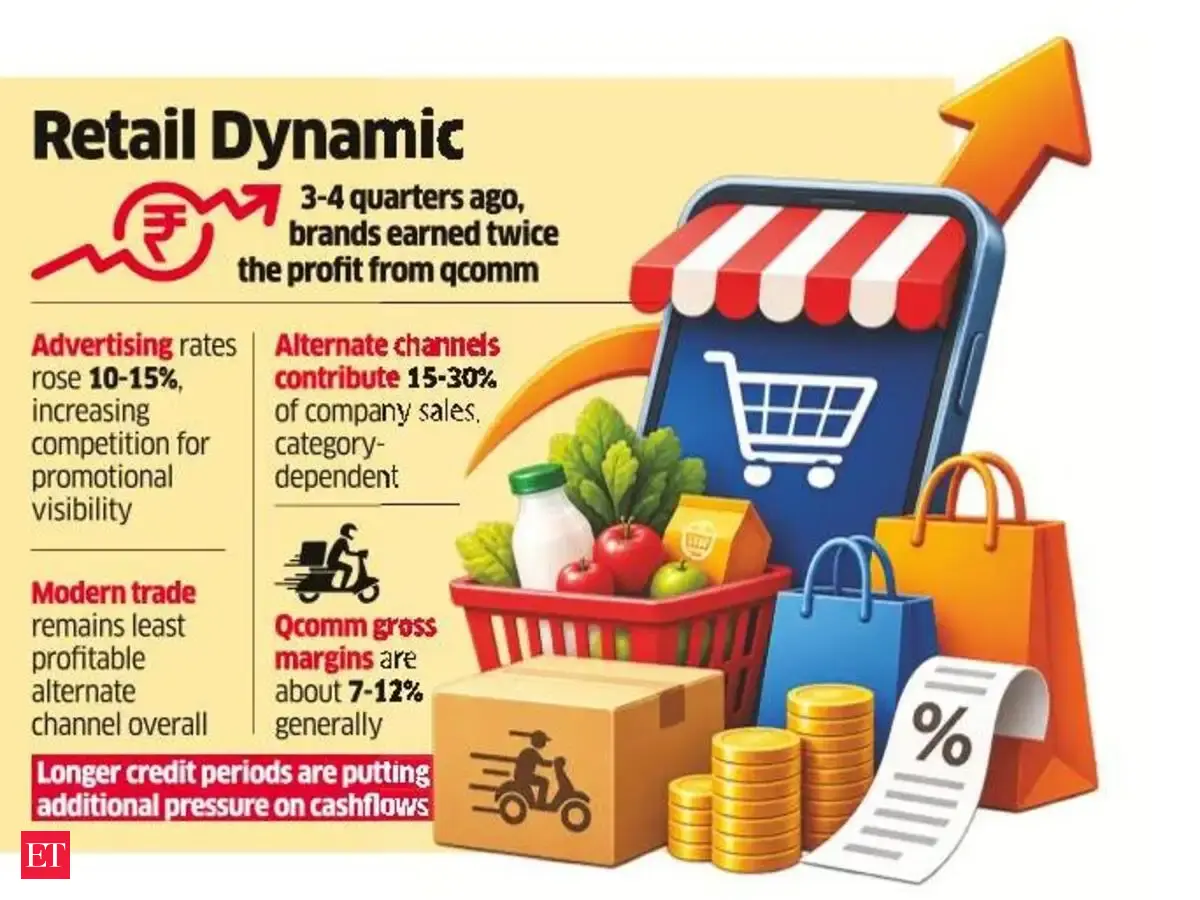
Kolkata: Consumer goods companies are losing the margin advantage they had in quick commerce over neighbourhood kirana stores, as rising advertising costs, promotional spending, inventory replenishment needs and longer credit cycles erode returns from what was their most profitable sales channel, industry executives said. Three to four quarters ago, brands earned as much as twice the profit from quick commerce as from kiranas. The gap has since narrowed, with profitability now largely on a par.
"Profits are now more or less similar, whether it's GT (general trade) or any alternative channel," said Shrikant Kanhere, managing director and chief executive of AWL Agri Business, the country's largest packaged edible oil company that markets the Fortune brand.
Alternative channels comprise ecommerce, quick commerce and modern trade, or organised retail chains, with executives saying profitability was the lowest in modern trade due to both higher spending and their hard negotiation on lowest margin. Traditional ecommerce is also losing relevance, as pure-play platforms such as Amazon and BigBasket increasingly pivot towards quick commerce.
Rising advertising, promotional spending and longer credit cycles weigh as quick-commerce profitability matches kiranas now
"Since we are investing in these (alternative) channels on various promotions, schemes, searches, fill rate, there are a lot of things which we have to spend and therefore the profitability is more or less similar to what we see in general trade," Kanhere told analysts recently.
Parle Products chief marketing officer Mayank Shah said profitability in quick commerce in the biscuit category was earlier 1.5-1.6 times that of general trade, but increased spending eroded the advantage. "The spending on the channel has gone up by 20% in the past one year, whereby profitability is either the same or marginally higher," he said.
You Might Also Like:
ChrysCapital among 3 PE funds in final race to buy minority stake in Hocco ice cream
Quick commerce platforms raised advertising rates by 10-15% for keyword searches and other promotional placements, Shah said. "As more brands want a larger play in these channels, rates and bids go up."
Quick commerce, however, remains the fastest-growing channel for fast-moving consumer goods (
FMCG) companies. In some makers, sales from the channel nearly matched those from modern trade, which has been around for more than 25 years. The contribution of alternative channels to sales now ranges from 15% to 30% across companies, depending on the category.
Besides shrinking margins, consumer goods companies are also grappling with longer credit periods in quick commerce, unlike general trade where credit is either negligible or limited.
You Might Also Like:
India Inc is roaring again, but who might spoil the profit party?
Tarun Arora, chief executive,
Zydus Wellness that markets Complan and Glucon-D, said profitability was similar between quick commerce and general trade, though it varied across product categories. "However, the higher credit period means an impact on cash flow. Having said that, quick commerce has become a meaningful channel now," he said.