
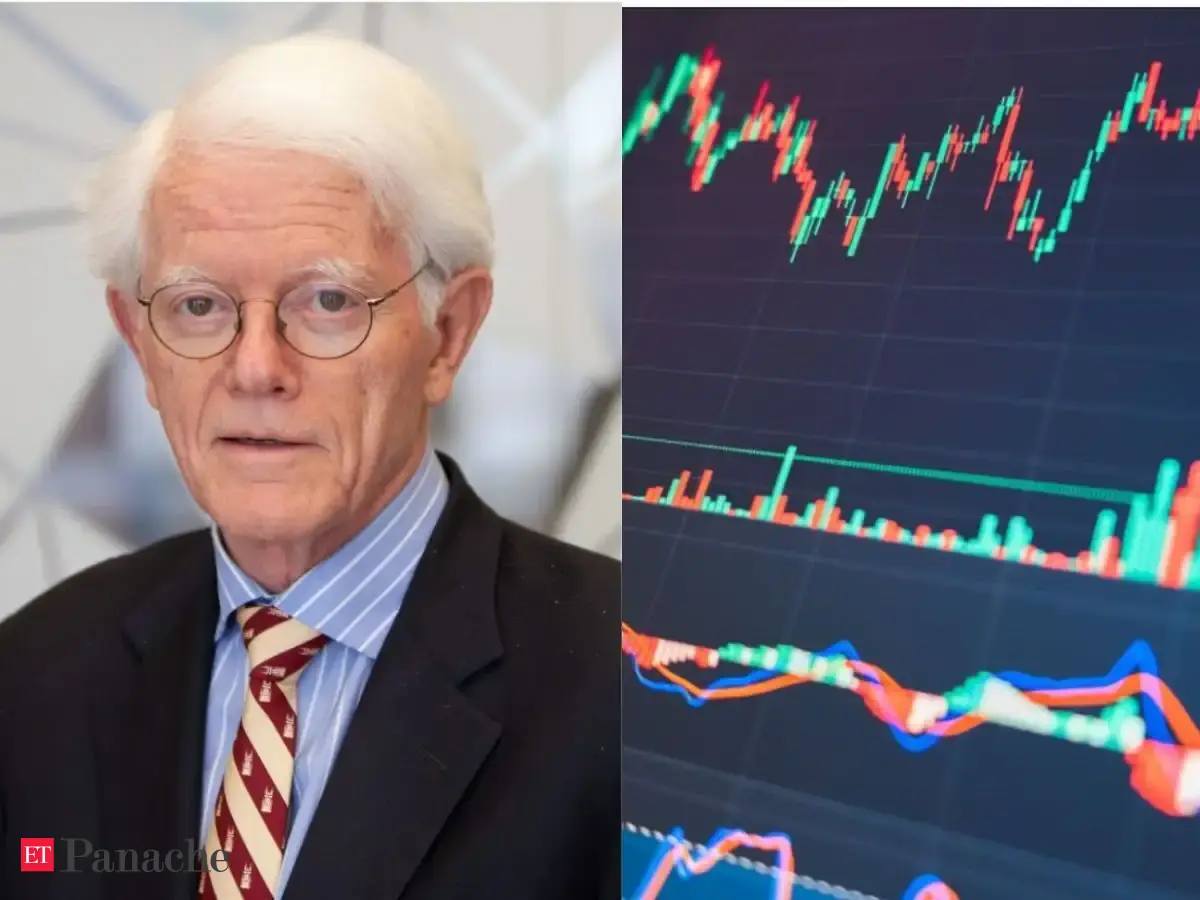
Legendary investor Peter Lynch said, "In the stock market, the key organ in your body is stomach - not the brain." Speaking in October 1994, he explained that investors often worry about the economy. He showed that patience matters more than math when you pick a few good companies.
Synopsis
Peter Lynch had managed Fidelity's Magellan Fund from 1977 to 1990 with remarkable success. Speaking about what makes a successuful investor, he said that there will always be a worry factor in the stock market but the key is look beyond that and concentrate on a select few promising companies.
Listen to this article in summarized format
Loading...
×
Peter Lynch is widely regarded as one of the most successful investors in Wall Street history, having turned Fidelity's Magellan Fund into a market-beating powerhouse through a disciplined approach to stock picking. But his investing philosophy was built on a simple idea: investors do not need to find dozens of winning stocks to build wealth. A handful of good investments, held with conviction, can make a significant difference.
Meaning of Peter Lynch quote
"In the stock market there is always something to worry about. The key organ in your body in the stock market is your stomach it's not the brain."
Speaking at National Press Club in October 1994. Peter Lynch in argued that investors will always find reasons to worry about the stock market, regardless of how well the economy or markets are performing. Recalling the 1950s, he said people feared that the United States would slip back into the Great Depression, believing that the recovery from the earlier economic crisis had depended on World War II. Nuclear war was another major concern. Despite these fears, he said, the 1950s turned out to be one of the strongest decades of the 20th century for the stock market. Yet many people stayed away from stocks because they were worried about economic collapse and nuclear conflict.
Lynch said this pattern of pessimism had repeatedly resurfaced over the years, be it fears of a oil crisis or another depression or a geopolitical threat making people question their investments.
Lynch emphasised that successful investing requires more than intelligence or advanced mathematical knowledge. He argued that an investor's temperament and ability to withstand uncertainty matter more than complicated calculations. Investors do not need sophisticated mathematics to succeed, but they must learn to remain patient when markets become frightening.
You Might Also Like:
Quote of the day by Benjamin Franklin: 'Either write something worth reading or do something worth writing' - Life lesson on how to build a legacy explained by the American physicist and philosopher
Rather than allowing fear to dictate investment decisions, he said, investors should study businesses carefully and maintain their conviction through periods of uncertainty. There will always be something to worry about when you own stocks and the key is to look beyond the fear, focus on good companies and have the patience to let investments work over time, he said.
Peter Lynch's track record
Lynch managed the Magellan Fund from May 1977 to May 1990, during which it delivered returns that outperformed the market by more than 14 percentage points annually.
Peter Lynch's central principles
One of Lynch's central principles is that investors should focus on identifying a few promising businesses rather than constantly searching for the next big opportunity. As he has explained, a person does not need many stocks to generate substantial wealth. Finding even a few investments that multiply several times in value can have a lasting impact on a portfolio.
He also believes investors must accept that being wrong is part of the process. "In this business if you're good, you're right six times out of ten. You're never going to be right nine times out of ten," Lynch has said.
Another key lesson from Lynch is to avoid selling successful investments too early while continuing to hold on to underperforming stocks. He has compared this mistake to "watering the weeds and cutting out the flowers". Investors, he argues, often book profits on stocks that are rising while refusing to let go of investments that are struggling.
Lynch's love for the stock market began when he was a teenager working as a caddie at a golf club in West Newton, Massachusetts. In an interview, he recalled that he started caddying at the age of 11, during the 1950s, when the stock market was performing strongly. He often heard corporate executives discussing the stocks they were buying. Curious, he began looking up those companies in newspapers and tracking their performance over the following months and years. Watching their prices rise sparked his interest in investing, even though he did not yet have money of his own to put into the market.
After earning a bachelor's degree from Boston College in 1965 and an MBA from the University of Pennsylvania's Wharton School in 1968, Lynch returned to Fidelity as a research analyst. He later stepped away from managing Magellan in 1990 to devote more time to his family and charitable work.
(Catch all the Business News, Breaking News, and Latest News Updates on The Economic Times.)
Subscribe to The Economic Times Prime and read the ET ePaper online.
...moreless
(Catch all the Business News, Breaking News, and Latest News Updates on The Economic Times.)
Subscribe to The Economic Times Prime and read the ET ePaper online.
...moreless
The ABCD of the US mid-term elections – Part 1: Why it matters across the globe
Onion inflation at 108%? Yes, but not really. What is different this time?
Curbing rupee bets: What the RBI’s new rules mean for the hedge-now-or-wait question