
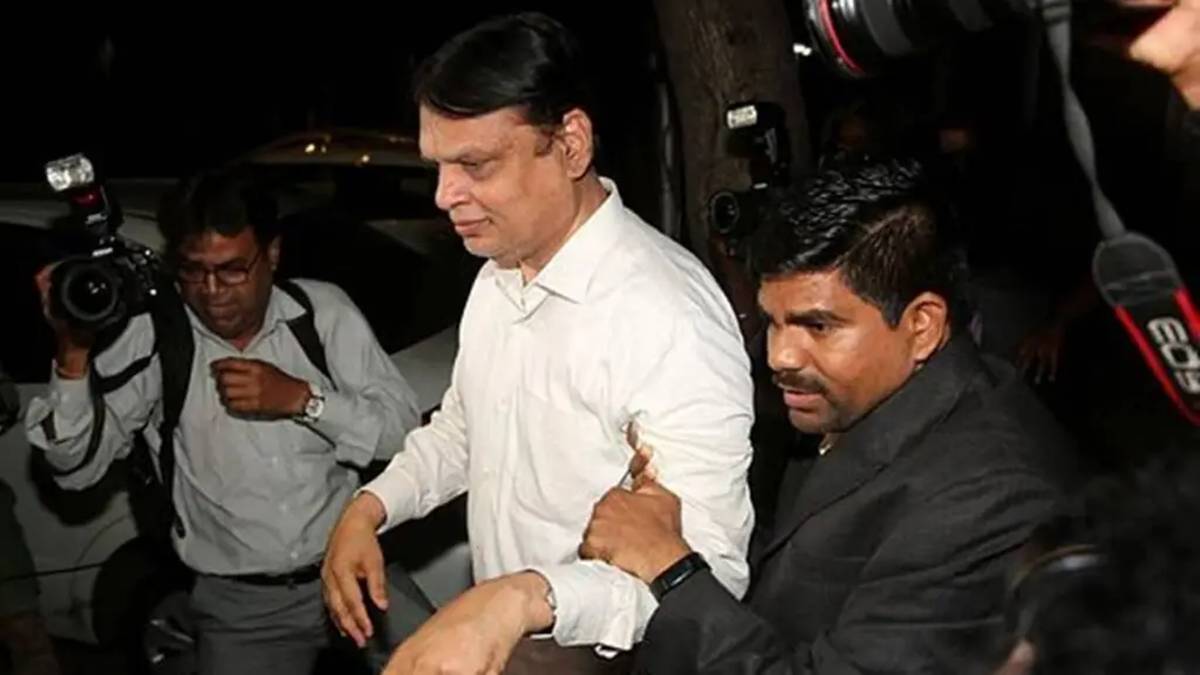
The National Company Law Tribunal declared Videocon Group promoter Venugopal Dhoot bankrupt. Once a household name for televisions and appliances, Dhoot now faces a Rs 12,668 crore claim from the State Bank of India. He once said, "If you fail, you will fall," a prophecy for his steep business decline.
You know, business is actually like a circus where an artist moves from one trapeze to another. If you fail, you will fall." Venugopal Dhoot said this years ago, in the easy, reflective way he had with journalists. Today it reads almost like a prophecy.
The promoter of the Videocon Group, whose televisions, refrigerators and washing machines once stood for middle-class aspiration, has been declared bankrupt by the National Company Law Tribunal (NCLT). That makes him one of the most prominent industrialists to meet this fate under the Insolvency and Bankruptcy Code (IBC), and the State Bank of India is pursuing him for Rs 12,668 crore. Few falls in Indian business have been steeper.
Dhoot was never the reclusive tycoon. He took calls, met journalists and seemed to enjoy conversation. Pinning him down on an uncomfortable question was another matter. He would drift away from it gracefully, often into philosophy, and most often into the Bhagavad Gita, which he knows by heart. "Lord Krishna's answers give you mental stability and focus," he once said. He then gave a lucid discourse on the text without once fumbling for a verse. Neither the Lord, nor the flute could obviously curb his entrepreneurial spirit with an appetite for expansion that would eventually stretch his group past breaking point.
Son of a rich businessman, Dhoot got his first break in the 1970s as a distributor of Bajaj Auto products. He was an electrical engineering graduate from Pune University and had trained in Japan. When demand for television sets took off in the 1980s, he was ready for it. As for many of his peers, the turning point was the 1982 Asian Games in Delhi, which brought colour broadcasting to Indian living rooms. His father, Nandlal Madhavlal Dhoot, founded the group, but it was Venugopal who made Videocon a household name.
Videocon International was set up in 1986 with the aim of making 100,000 television sets a year. Its Bazooka and Bazoomba models soon became familiar names. Viewers of that generation will remember its Picture-in-Picture feature, which let them watch two channels at once. It seems quaint now, but it was a breakthrough for its time. Refrigerators, washing machines and air-conditioners followed, all sold through a formidable distribution network. Videocon also became one of the world's largest makers of colour picture tubes.
Dhoot wasn't content with leading Indian consumer electronics. He wanted a global conglomerate, and acquisitions were how he planned to get there. Videocon bought Philips' manufacturing operations in India, Electrolux Kelvinator's Indian business and, in 2005, Thomson's global colour picture tube operations. For a while, it looked big enough to take on the world's majors. But diversification soon carried it far from the business it understood best.
Telecom was the most consequential bet. The group won licences in 21 circles in 2008, only to see them cancelled by the Supreme Court in 2012 amid the 2G spectrum controversy. It later bought spectrum in six circles and sold it to Bharti Airtel in 2016 for around Rs 4,500 crore. Dhoot himself admitted that telecom had added heavily to the group's debt. Videocon also went into oil and gas, with a stake in the Ravva field off Andhra Pradesh and exploration assets as far away as Brazil. Its direct-to-home venture, Videocon d2h, built a large subscriber base before merging with Dish TV in 2018. Each of these businesses needed huge upfront spending and took years to pay off.
Meanwhile, the original business was losing ground. Samsung and LG were investing heavily in technology and design, and cheap products with wide distribution were no longer enough. Consumer electronics still brought in most of the group's revenue, but it couldn't carry the weight of the new ventures. By December 2015, Videocon Industries had debt of Rs 47,554 crore against a net worth of just Rs 8,090 crore.
The financial strain soon came with reputational damage. Dhoot became a central figure in the ICICI Bank loan case, in which the Central Bureau of Investigation (CBI) alleged that the bank sanctioned loans to Videocon group companies in breach of its norms while Chanda Kochhar was its chief executive. The agency also alleged that, in return, Dhoot invested Rs 64 crore in NuPower Renewables, a company run by her husband, Deepak Kochhar. The CBI arrested Dhoot in December 2022, days after arresting the Kochhars, and the Bombay High Court granted him interim bail the following month. For a promoter who had once been courted by bankers, it was a striking reversal.
Videocon Industries entered the corporate insolvency resolution process in June 2018. In 2021, the NCLT approved Twin Star Technologies' resolution plan of about Rs 2,962 crore against admitted claims of nearly Rs 64,939 crore. That was a recovery of less than 5%, and the appellate tribunal later set the plan aside. SBI then went after Dhoot personally, as guarantor for loans taken by Videocon companies. The NCLT admitted insolvency proceedings against him in April 2026. Creditors rejected his offer to repay Rs 600 crore over three years, which depended on a real estate project in Siliguri.
His personal bankruptcy is legally separate from Videocon's insolvency. Still, it shows how personal guarantees can leave promoters within lenders' reach long after their companies have collapsed.
In the end, Dhoot's story is about an entrepreneur who understood the aspirations of a rising middle class and built a brand around them. Then he tried to repeat that success in unrelated businesses that swallowed capital.
In his own words, the artist kept reaching for the next trapeze, until there was no bar left to catch.