
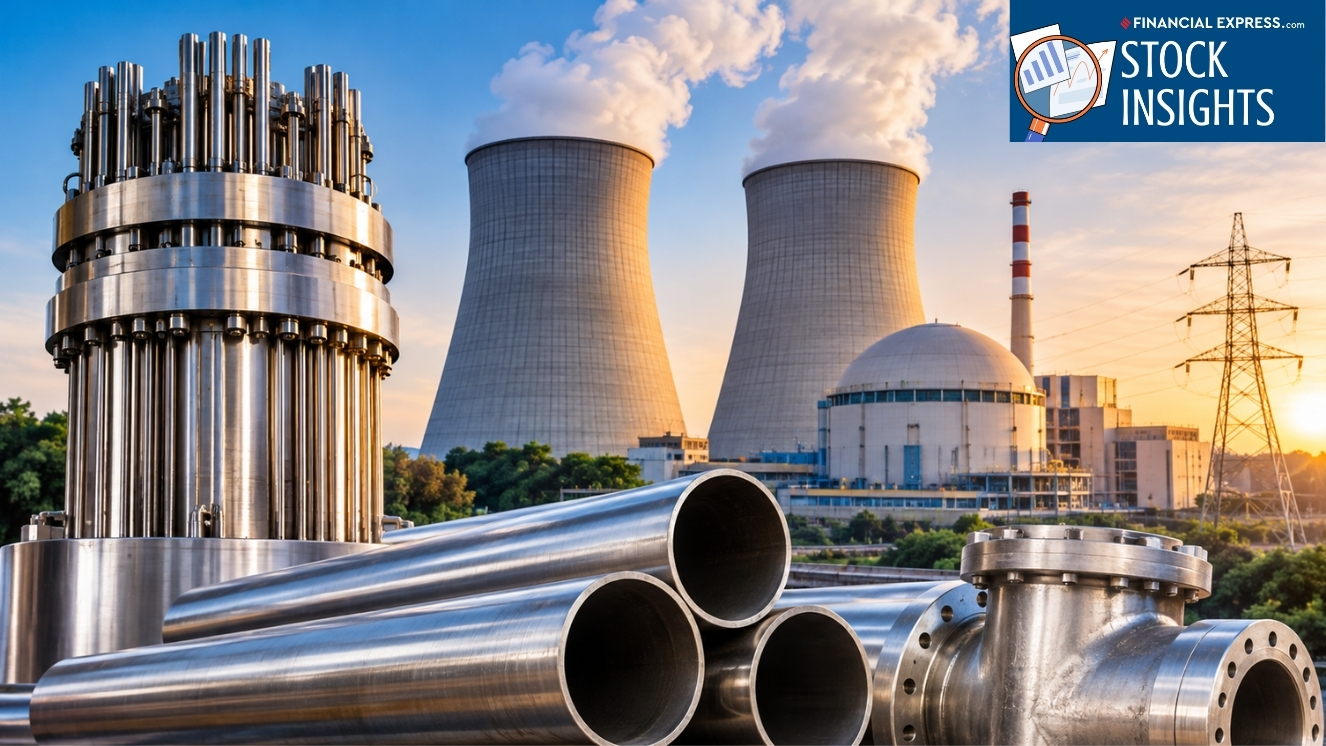
India plans to raise nuclear power capacity to 100 GW by 2047, requiring up to ₹20 lakh crore in investment. Three specialist firms are supporting this massive push. MTAR Technologies, a key player, collaborates with NPCIL and currently holds an ₹820 crore nuclear order book as of Q2 FY27.
India wants to increase its nuclear power capacity from the current 9 GW to 100 GW by 2047. Achieving this target will not be easy. At an estimated construction cost of ₹18 crore to ₹22 crore per MW, this translates into a total investment of ₹16.4 lakh crore to ₹20 lakh crore over the next two decades. This implies an annual investment of approximately ₹82,000 crore (at ₹18 crore per MW) to ₹1 lakh crore.
For the companies supplying the components, piping systems and construction expertise, this expansion could translate into a long-term order opportunity. The opportunity, therefore, is not simply about how much India plans to spend on nuclear power. It is about which companies are already part of the nuclear power supply chain.
This article discusses three companies with exposure to the nuclear sector. One manufactures precision-engineered assemblies that perform critical functions inside nuclear reactors. Another is expanding its presence in specialised nuclear-grade tubes and fabricated piping.
The third has contributed to building nearly 60% of India's installed nuclear power capacity and is looking to secure a larger share of upcoming reactor construction projects.
#1 How MTAR is Fueling India's Nuclear Reactor Push
MTAR Technologies collaborates with the Nuclear Power Corporation of India (NPCIL). NPCIL oversees all civil nuclear reactors across India. MTAR manufactures more than 15 specialised products for critical nuclear reactor functions. Among its products, the Fuel Machining Head is its flagship and most complex nuclear assembly.
The fuel machining head is a complex assembly comprising over 700 individual precision components. It is used directly in nuclear reactors to insert and remove fuel bundles during refuelling. Along with the Fuel Machining Head, MTAR produces complementary core assemblies for reactor fueling, control and containment.
MTAR Technologies' Expanding Role in NPCIL Nuclear Reactors
In recent years, MTAR has expanded its nuclear capabilities to manufacture larger structural assemblies, including Fuel Transfer Systems, End Shields and Calandria assemblies. MTAR supplies these core assemblies to major domestic projects, including the Prototype Fast Breeder Reactor (PFBR) and the Kaiga Units 5 & 6 expansion project (a Rs 504 crore contract).
Q2 FY27 Update: Breaking Down MTAR's ₹820-Crore Nuclear Order Book
As of Q2 FY27, MTAR's nuclear order book stood at ₹820 crore, representing 13.7% of its total order book of ₹5,976.5 crore. In H1 FY27, the nuclear business generated ₹8.7 crore in revenue. Management expects activity to pick up from H2 FY27. As major projects progress, revenue is expected to increase significantly from FY28 onwards.
The ₹504-Crore Kaiga Reactor Expansion and Refurbishment Orders
MTAR secured its largest nuclear order inflow to date of ₹504 crore to supply fuel handling and core equipment for the Kaiga 5 & 6 reactor expansion. In FY27, MTAR also received over ₹130 crore in fresh orders to supply replacement assemblies and components for older operational reactors undergoing life-extension refurbishment.
Execution Timelines and MTAR's ₹1,000-Crore Private Sector Opportunity
The Kaiga project has a 3 to 3.5-year execution cycle, while refurbishment orders span 2 years. In addition, MTAR has submitted preliminary budgetary quotes to private sector players. These players are bidding to build four 700 MW reactors for the NTPC-NPCIL joint venture. Management estimates this opportunity at ₹700 crore to ₹1,000 crore.
#2 Ratnamani Metals & Tubes:
Ratnamani Metals & Tubes supplies specialised pipes, tubes, and fabricated piping components to the nuclear power and atomic energy sectors. The company serves nuclear projects in India and international markets. Ratnamani produces specialised stainless steel and nickel alloy products designed for heat exchangers and high-pressure steam systems in nuclear plants.
NPCIL Approvals and International Nuclear Breakthroughs
NPCIL placed a development order with Ratnamani for steam generator tubes in alloy grade UNS N08800. This approval gives Ratnamani access to future domestic nuclear power projects. Internationally, Ratnamani received its first order for hairpin heat exchanger seamless tubes in grade UNS N04400. Another overseas order is for cold-finished, high-pressure heater tubes.
The RFSS Joint Venture: Expanding Manufacturing Capacity
Ratnamani Finow Spooling Solutions (RFSS) handles nuclear piping fabrication. RFSS is a JV between Ratnamani Metals (75% stake) and Technoenergy AG, Switzerland. Technoenergy AG is the holding company of FINOW GmbH, Germany, a nuclear piping and boiler-work specialist. RFSS is an approved vendor of NPCIL.
The RFSS plant at Anjar in Kutch has a total capacity of 7,000 metric tonnes per year. This comprises 4,000 MT of pipe spools, 2,500 MT of induction bends, and 500 MT of hangers and supports. RFSS also fabricates pipe spools, hot induction bends, and support structures for nuclear power stations.
Q2FY27 Financials: 138% EBITDA Growth and ₹3,000Cr Backlog
Production of induction bends at RFSS is scheduled to commence in Q3FY27. The remaining equipment is set to become operational over the next two quarters. This capacity expansion will enable RFSS to execute its order backlog of over ₹3,000 crore. In Q2FY27, RFSS secured an overseas order worth ₹2,700 crore, pushing the company's total order book past ₹3,000 crore.
RFSS reported revenue of ₹157 crore in Q2FY27, up from ₹110.4 crore in Q2FY26. EBITDA (Earnings Before Interest, Tax, Depreciation, and Amortisation) more than doubled (+138%) to ₹85.9 crore. EBITDA Margin expanded to 54.7% in Q2FY27, up from 32.7% in Q2FY26. Net profit surged 153.7% to ₹64.7 crore.
#3 HCC
Hindustan Construction Company has constructed 60% of India's installed nuclear power capacity. This work covers between 55% and 60% of all existing nuclear power plants in the country. HCC's core scope centres on the civil construction of main plant buildings and ancillary plant structures.
Its execution includes heavy fabrication and specialised structural steel work. HCC is actively building the Fast Reactor Fuel Cycle Facility (FRFCF). At this project, cell slab works are finished in Blocks 3 and 4, while building work continues across all other blocks. The combined Nuclear & Buildings sector accounts for 3% of HCC's total order backlog of ₹12,901 crore.
Expanding Capacity Across Advanced Nuclear Reactor Designs
HCC positions its capabilities to support projects across reactor designs, including PHWR, LWR, VVER, EPR, and AP1000. This positions the company to win new contracts. HCC is engaging with government entities (such as the NTPC-NPCIL JV) and private sector developers examining new nuclear power investments. Management expects significant nuclear order wins by FY28.
Moving forward, HCC plans to expand into large turnkey projects through partnerships.
Q2FY27 Financials: Margin Pressures from New Contract Executions
Financially, HCC's total income fell 6.7% year-on-year to ₹925.2 crore in Q2FY27. EBITDA fell 30.4% to ₹102.8 crore while margins shrank 378 bps to 11.1%. As a result, net profit declined 52.8% to ₹22.6 crore. Management attributed this dip to expenses for around ₹8,000 crore of new contracts secured over the past 15 months.
The ₹85,907-Crore Bidding Pipeline and FY27 Outlook
HCC's existing order book provides revenue visibility of about 3.5 years. HCC maintains its target of securing about ₹15,000 crore in new orders during FY27. Conversion of submitted bids is expected to gain momentum toward the end of Q3 and Q4FY27. The company is actively pursuing a bidding pipeline worth ₹85,907 crore.
Management expects revenue in FY27 to remain flat (at around ₹4,000 crore) compared to FY26. For FY28, as revenue from new orders begins to increase, management is targeting a revenue growth of 15% to 25%. EBITDA margin is targeted at 13-14% across its order book. HCC aims to become debt-free by paying down its existing debt of ₹2,000 crore.
Execution Watch: Evaluating Bid Conversion and Balance Sheet Risk
MTAR and Ratnamani lead the group with a Return on Equity (ROE) of 12.6%. However, on Return on Capital Employed (ROCE), HCC leads both Ratnamani and MTAR.
Valuation-wise, Ratnamani and HCC trade at a premium to both the industry median P/E and their own historical 3-year median valuation. Meanwhile, following a recent correction, MTAR trades at a discount to its 3-year mean.
India's nuclear expansion offers a long-term opportunity for companies in the value chain. MTAR already has an ₹820 crore nuclear order book, including the ₹504 crore Kaiga contract. This provides revenue visibility over the next three to four years.
Ratnamani has a different growth trigger. NPCIL's approval for steam generator tubes, combined with expansion in its nuclear piping fabrication business, could unlock additional domestic and international opportunities.
HCC, meanwhile, brings an established execution track record, having constructed nearly 60% of India's installed nuclear power capacity. However, converting its bidding pipeline into firm orders remains important. Keep these companies on your watchlist.
Disclaimer
Note: Throughout this article, we have relied on data from http://www.Screener.in and the company's investor presentation. We used an alternative, widely accepted source only when the data were unavailable.
The purpose of this article is only to share interesting charts, data points, and thought-provoking opinions. It is NOT a recommendation. If you wish to consider an investment, we strongly advise you to consult your advisor. This article is strictly for educational purposes only.
About the Author: Madhvendra has been deeply immersed in the equity markets for over seven years, combining his passion for investing with his expertise in financial writing. With a knack for simplifying complex concepts, he enjoys sharing his honest perspectives on startups, listed Indian companies, and macroeconomic trends.
A dedicated reader and storyteller, Madhvendra thrives on uncovering insights that inspire his audience to deepen their understanding of the financial world.
Disclosure: The writer and his dependents do not hold the stocks discussed in this article.
The website managers, their employees (s), and contributors/writers/authors of articles have or may have an outstanding buy or sell position or holding in the securities, options on securities, or other related investments of issuers and/or companies discussed therein. The articles' content and data interpretation are solely the personal views of the contributors/ writers/authors. Investors must make their own investment decisions based on their specific objectives and resources, and only after consulting any independent advisors as necessary.