
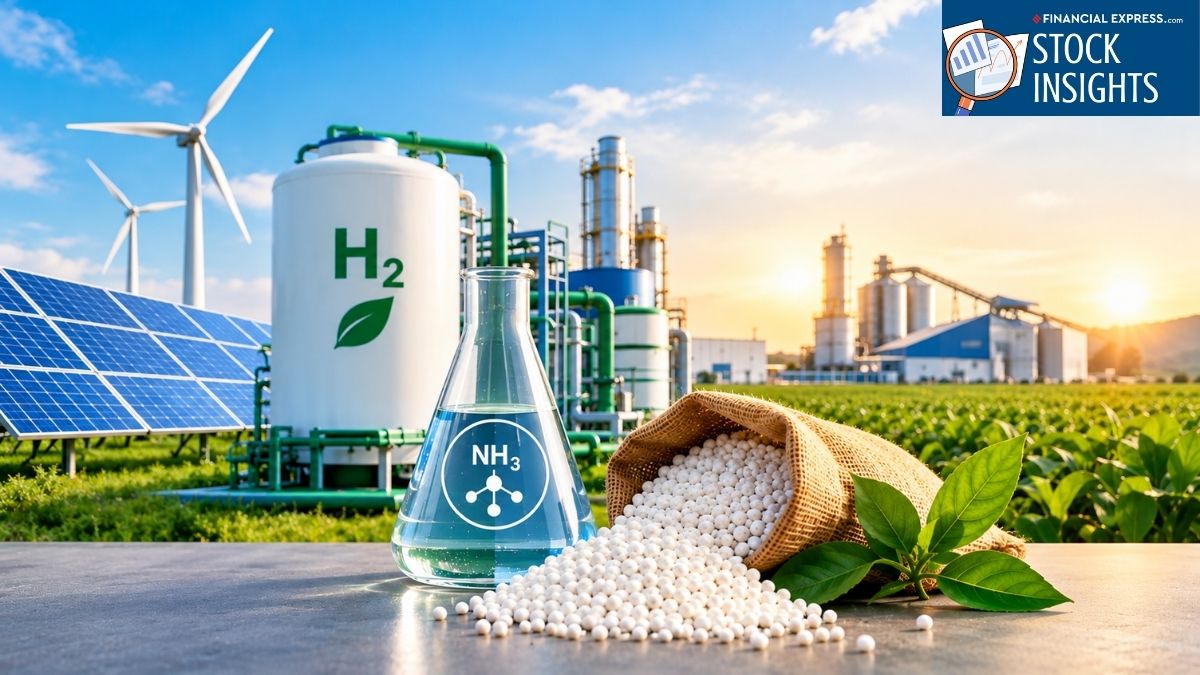
The government allocated 7.24 lakh tonnes of green hydrogen per year to 13 fertiliser units under the ₹19,744 crore National Green Hydrogen Mission. This move helps companies replace imported fossil-fuel-based ammonia. By using renewable electricity, firms like Paradeep Phosphates hope to manage input costs and reduce reliance on global gas.
The government, under the ₹19,744 croreNational Green Hydrogen Mission (NGHM), has allocated 7.24 lakh tonnes per annum (TPA) of supply across 13 fertiliser units at discovered prices ranging from ₹49.75 to ₹64.74 per kg. The agreements aim to replace imported fossil-fuel-based ammonia, improve supply security and reduce emissions.
The Ammonia Switch: Could Cleaner Fertiliser Inputs Mean Stronger Margins?
Green ammonia could offer fertiliser manufacturers something more valuable than a lower carbon footprint: a different way to manage one of their largest input-cost risks. Conventional ammonia is made using hydrogen derived largely from natural gas, linking its production cost to global gas prices and exposing buyers to international supply disruptions. Green ammonia uses hydrogen produced through renewable electricity to reduce dependency on fossil fuels during production.
For Indian fertiliser companies, the upside is in how this changes the cost and reliability of getting a critical raw material to plants. If manufacturers can source contracted green ammonia at a competitive delivered price, they may gain better visibility on part of their future input costs. That could help them plan production and reduce exposure to sudden changes in conventional ammonia prices. Domestic green ammonia production could also cut dependence on imports over time.
Moving ahead, the key question is which listed fertiliser companies have progressed furthest from policy participation to commercially meaningful adoption. We identified three such companies.
#1 Paradeep Phosphates: The NPK Fertiliser Maker With a Defined Green-Ammonia Allocation
Paradeep Phosphates Limited (PPL) manufactures phosphatic and nitrogen-phosphorus-potassium (NPK) fertilisers, including di-ammonium phosphate (DAP) and complex fertilisers. Its manufacturing network spans Paradeep in Odisha, Goa and Mangalore, with operations supported by phosphoric acid, sulphuric acid and ammonia-related infrastructure. This integrated footprint makes raw-material availability and pricing important to production costs. Green ammonia could eventually change the company’s sourcing mix.
Two Allocations, Two Confirmed Locations in the Company’s Disclosures
PPL’s allocation under the Solar Energy Corporation of India (SECI) auction totals 100,000 TPA: 75,000 tonnes for Paradeep at ₹55.75 per kg and 25,000 tonnes for Zuarinagar, Goa, at ₹62.84 per kg. SECI identifies ACME Cleantech Solutions as the selected supplier for both locations. The allocation gives PPL a defined route towards adopting green ammonia at existing manufacturing facilities, but the two prices also show that the economics are not uniform across plants.
The important distinction is between a supply allocation and a realised operating benefit. In its February 2026 investor call, management described the arrangement as being at a preliminary stage and indicated that supply could take another two to three years. The next meaningful milestones are a confirmed offtake agreement, the scheduled commencement of supply and evidence that the contracted volume is being delivered.
Acid Capacity and Fertiliser Volumes Strengthen the Operating Context
PPL’s Q1FY27 investor presentation lists ammonia capacity of approximately 290,000 TPA at each of its Goa and Mangalore facilities. Its Paradeep operations include 500,000 TPA of phosphoric acid capacity and 2 million TPA of sulphuric acid capacity. The company reported that higher sulphuric acid production following capacity expansion supported its Q1FY27 performance, while the first phase of its phosphoric acid expansion from 500,000 to 700,000 TPA remained on track.
These investments can strengthen raw-material integration, but they should not be confused with green-ammonia project expenditure. PPL does not separately report green-ammonia revenue, earnings or realised cost savings. Its ₹250 crore aluminium fluoride plant investment, approved in Q1FY27, is a separate diversification project.
Q1FY27 Financials: Stronger Revenue, but No Green-Ammonia Earnings Yet
PPL reported consolidated revenue from operations of ₹6,124.3 crore in Q1FY27, up 36% year on year and 30.2% quarter on quarter. Profit after tax (PAT) increased 24% year on year to ₹393.2 crore from ₹317.2 crore in Q1FY26, and more than doubled from ₹161.1 crore in Q4FY26. Total fertiliser sales reached 985,143 tonnes, up 4% year on year.
These figures provide context for the scale of the existing business and its current operating performance.
Cautionary Note on Stock Rebound
Source: Screener.in; Stock Price as on 14th October 2026
PPL’s share closed at ₹144.26 on 14 October 2026 on the National Stock Exchange (NSE). The stock has jumped about 18% in six months but is still down more than 19% in a year. Its price-to-earnings (P/E) ratio was approximately 13.8.
In its 31 July 2026 report, Prabhudas Lilladher maintained an Accumulate rating with a target price of ₹158, valuing PPL at 13 times estimated FY28 earnings per share. This implies 9.53% upside from ₹144.26. The brokerage’s target is a broader stock valuation, not a valuation of PPL’s green-ammonia allocation.
#2 Coromandel International: The Crop-Nutrition Leader With the Largest Disclosed Allocation Among the Three
Coromandel International manufactures phosphatic and NPK fertilisers and operates across crop protection, speciality nutrients, organic fertilisers and agri-retail. Its fertiliser operations rely on a broad raw-material supply chain, including ammonia, phosphoric acid and sulphur. This makes its green-ammonia allocation relevant to a business that already operates at a significant scale. Unlike a company that has only expressed an interest in green ammonia, Coromandel has disclosed procurement allocations at two manufacturing locations.
135,000 Tonnes a Year Across Kakinada and Visakhapatnam
SECI’s auction records show an allocation of 85,000 TPA for Coromandel’s Kakinada facility at ₹50.75 per kg, with Jakson Green and its consortium partners selected as the supplier. A further 50,000 TPA was allocated for Visakhapatnam at ₹51.89 per kg, with ACME Cleantech Solutions selected as the supplier.
The lower discovered prices compared with PPL’s Goa allocation may look attractive, but this is not enough to conclude that Coromandel will earn better margins. The facilities have different operating conditions, and a meaningful comparison requires the conventional ammonia cost avoided, delivery arrangements and the treatment of any price difference under the fertiliser subsidy system.
Backward Integration Offers a Separate Cost Advantage
Coromandel commissioned its approximately ₹1,100 crore investment in sulphuric acid and phosphoric acid plants at Kakinada in Q4FY26. The project includes a capacity of 2,000 tonnes per day of sulphuric acid and 650 tonnes per day of phosphoric acid. Separately, the company’s brownfield fertiliser granulation expansion is expected to add 7.5 lakh tonnes of annual capacity, with completion targeted for Q4FY27.
These projects matter because they expand manufacturing capability and strengthen control over important inputs. They should, however, be treated separately from green ammonia: neither project proves that green ammonia supply has commenced or that its adoption will reduce total production costs.
Part of Coromandel’s supply security strategy is its existing relationship with Saudi Arabian Mining Company (Ma’aden). In April 2025, the companies signed a memorandum of understanding for long-term supplies of DAP and NP/NPK fertilisers, building on their existing relationship, which includes ammonia supplies. This supports the broader raw-material sourcing picture, but it is not a green-ammonia procurement agreement.
Q1FY27 Financials: Sequential Recovery, but Annual Profit Pressure
Coromandel reported consolidated revenue from operations of ₹8,164.77 crore in Q1FY27, up 16% year on year and 36% quarter on quarter. Consolidated PAT was ₹381.56 crore, compared with ₹501.59 crore in Q1FY26 and ₹114.64 crore in Q4FY26. The year-on-year decline reflected pressure from higher raw-material costs and fertiliser margins, while the sequential improvement partly reflects seasonal differences in fertiliser sales.
The comparison requires proper reading because NACL Industries became a subsidiary on 8 August 2025, bringing additional crop-protection operations into the consolidated business. The quarterly performance therefore provides context for its overall financial position.
A Broker’s Bullish Bet Against a Falling Stock
Source: Screener.in; Stock Price as on 14th October 2026
Coromandel closed at ₹1,747 on 14 October 2026 on the NSE. It declined around 16% over six months and 21% over the preceding 52 weeks, while its P/E ratio was approximately 27.6.
Motilal Oswal maintained a Buy rating in its report dated 25 July 2026, with a target price of ₹2,530. At ₹1,740, that target implies potential upside of approximately 45.4%. The brokerage’s rationale included the company’s broader growth prospects, crop-protection performance and cost pressures.
#3 The Fertilisers and Chemicals Travancore Limited: The Integrated Fertiliser and Chemicals Producer Still at the Exploration Stage
The Fertilisers and Chemicals Travancore Limited (FACT) manufactures fertilisers, including Factamfos and ammonium sulphate, and also operates a caprolactam business that uses ammonia as a raw material. Its facilities at Udyogamandal and the Cochin Division at Ambalamedu, Kerala, are supported by ammonia storage and handling infrastructure, including a 10,000-tonne storage tank commissioned at the Cochin Division. This established ammonia requirement makes procurement reliability important to FACT.
Procurement Tenders Show Demand, Not a Green-Ammonia Project
FACT issued procurement notices in March, April and May 2026 for refrigerated, liquid anhydrous fertiliser-grade ammonia, including consignments of up to 8,000 tonnes for delivery to Kochi. A separate long-term ammonia supply tender was also listed in June 2026. These notices demonstrate the company’s continuing need to secure ammonia, but they do not establish the final supplier, contracted price or awarded volume unless the corresponding award is disclosed.
FACT’s memorandum of understanding with Oil India Limited covers exploration of green hydrogen, green ammonia, green methanol and related clean-energy opportunities. However, it is a potential starting point for future projects.
Fertiliser Output Provides Scale, but Not an Ammonia Volume Estimate
FACT’s installed annual capacities include 633,500 tonnes of Factamfos and 225,000 tonnes of ammonium sulphate. In FY2024-25, it produced 644,768 tonnes of Factamfos and a record 250,578 tonnes of ammonium sulphate. Ammonium sulphate sales rose 20% year on year to 266,683 tonnes.
These figures demonstrate the scale of FACT’s fertiliser operations. They should not be used as a proxy for ammonia production or consumption.
Q1FY27 Financials: Higher Revenue Did Not Prevent a Quarterly Loss
FACT reported revenue from operations of ₹1,253.40 crore in Q1FY27, up 20.2% year on year but down 15.5% quarter on quarter. It recorded a loss after tax of ₹61.94 crore, compared with profits of ₹4.28 crore in Q1FY26 and ₹3.16 crore in Q4FY26.
FACT’s Market Slide Continues Despite Its Fertiliser Footprint
Source: Screener.in; Stock Price as on 14th October 2026
FACT closed at ₹734.90 on 14 October 2026 on the NSE. The stock had declined around 13.6% over six months and 16.6% over one year. Its trailing P/E ratio is not a useful comparison with profitable peers because the latest quarterly result was loss-making and trailing earnings are very low.
The Green-Ammonia Cost Equation Has More Than One Moving Part
The first roadblock is the difference between an auction price and the actual economic cost of using green ammonia. The discovered tariffs of ₹49.75–₹64.74 per kg are important reference points, but they should not be compared mechanically with a single conventional ammonia price. The comparison needs to account for the relevant period, delivery terms, customs duties where applicable and local transport.
The current policy framework has also introduced production incentives of ₹8.82 per kg in the first year, ₹7.06 in the second and ₹5.30 in the third for eligible projects. These incentives support early adoption, but readers must distinguish temporary support from the underlying cost of producing and supplying ammonia over the full contract period.
Renewable electricity is the next constraint. Electrolysers require a dependable power supply to split water into hydrogen and oxygen, but solar and wind generation fluctuate. Developers must manage this through a suitable mix of renewable generation, grid supply, storage and operating schedules. Lower electrolyser utilisation spreads fixed capital costs over fewer units of hydrogen, potentially raising the cost of every tonne of ammonia. Water treatment, electrolyser degradation, maintenance and replacement also affect lifetime economics. A low auction tariff is commercially meaningful only if the selected producer can deliver the contracted volume reliably at that price.
The third challenge is the delivery schedule. SECI’s framework requires developers to establish production facilities and arrange associated storage and transportation up to the delivery point at the fertiliser factory. That makes project construction, commissioning, transport infrastructure and the scheduled commencement of supply important milestones. A delay could leave a fertiliser manufacturer dependent on conventional ammonia for longer than expected, postponing any change in its input mix.
The First-Mover Advantage Belongs to Execution, Not Announcements
PPL and Coromandel have the clearest documented procurement positions among the three companies covered, while FACT’s disclosed green-ammonia activity remains at the exploration stage. PPL has a defined allocation across two facilities, whereas Coromandel has the larger combined allocation and lower discovered tariffs at its two sites. These differences help identify where investors should look for progress, but they do not establish which company will generate the greatest financial benefit.
The decisive evidence will emerge when contracted supplies begin and companies disclose enough information to assess their actual consumption, delivered costs and ability to recover any premium. Until then, green ammonia is best treated as a developing input-security and decarbonisation opportunity within these fertiliser businesses, rather than a separately measurable earnings driver.
It may be a good idea to add these stocks to your watchlist and keep track to see how they perform in time to come.
Disclaimer
Note: We have relied on data from www.Screener.in throughout this article. Only in cases where the data was not available, have we used an alternate, but widely used and accepted source of information.
The purpose of this article is only to share interesting charts, data points and thought-provoking opinions. It is NOT a recommendation. If you wish to consider an investment, you are strongly advised to consult your advisor. This article is strictly for educative purposes only.
Rishabh Sinha is a seasoned financial content creator with over 10 years of experience in BFSI domain. His portfolio spans over 20 of India’s most trusted financial brands. Rishabh brings depth, structure, and a reader-first approach to every piece he crafts.
Disclosure: The writer and his dependents do not hold the stocks discussed in this article.
The website managers, its employee(s), and contributors/writers/authors of articles have or may have an outstanding buy or sell position or holding in the securities, options on securities or other related investments of issuers and/or companies discussed therein. The content of the articles and the interpretation of data are solely the personal views of the contributors/ writers/authors. Investors must make their own investment decisions based on their specific objectives, resources and only after consulting such independent advisors as may be necessary.