
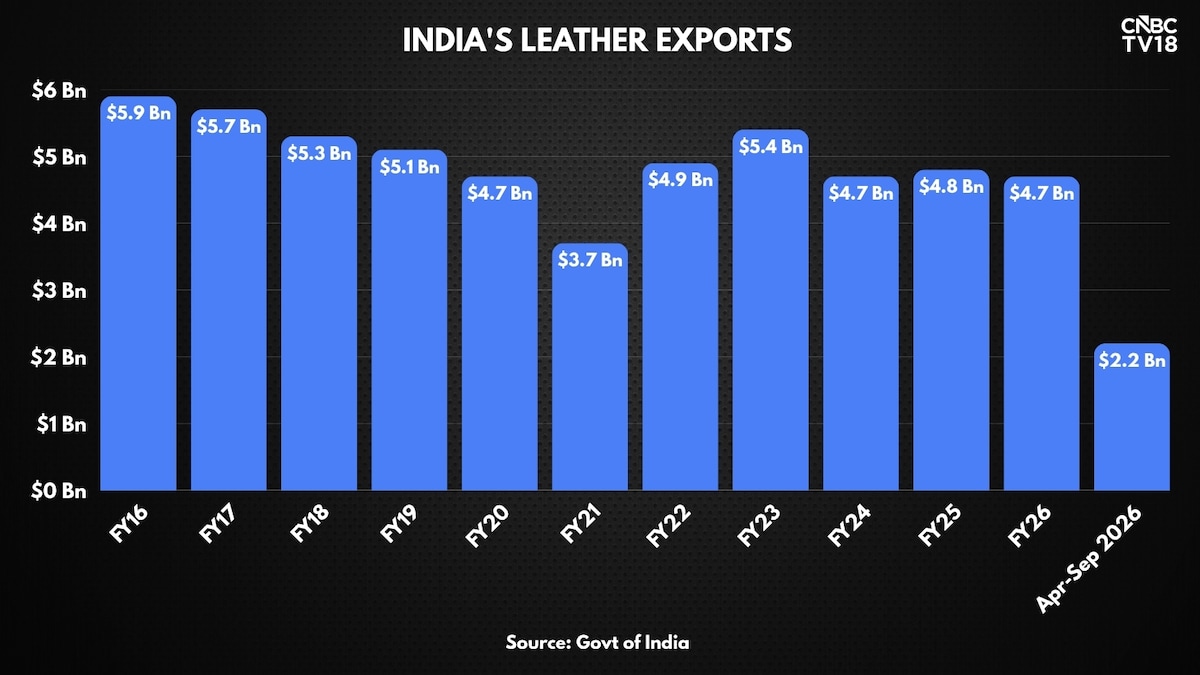
India’s leather exports fell to $4.75 billion before dropping another 3% in the five months ending September 2026. High shipping costs and infrastructure gaps continue to hurt the sector. Syed Hamid from Crest Container Lines said, "It has a crippling effect on shippers," as many workers face ongoing financial pressure.
Surging shipping costs, domestic infrastructure bottlenecks, and rising artisan wages continue to batter India's leather exports despite recent government duty reliefs and policy support. Weakening global demand and cheap synthetic alternatives further compound pricing pressures for millions of workers. Find out what policymakers cad do to overhaul regional transport networks to revive the sector.
Despite a series of government efforts and the rupee becoming over 40% more competitive against the US dollar in the last decade, there seems to be no respite. Budget 2026 provided duty relief, more time to meet export obligations, and special outlays to support credit and investment in the leather sector, alongside other measures, but exports have continued to decline.
India's leather exports stood at $5.9 billion in the financial year ended March 2016. It fell to $4.75 billion a decade later before declining another 3% year-on-year in the five months ending September 2026.
Rising freight costs and declining demand have added to the challenges. Trade Minister Piyush Goyal's $15 billion exports target now seems like a far cry for an industry struggling to stem a decline that has stretched over a decade now.
Some of the added pain is due to the war in West Asia. "Freight from Nhava Sheva to New York was $1,800 per FEU (Forty-Foot Equivalent Unit), which is now $12,000. Freight from Nhava Sheva to Jebel Ali was $.200 per FEU, which is now $4,500. It has a crippling effect on shippers," Syed Hamid from Crest Container Lines Pvt. Ltd. says. "There are also transhipment delays because we cannot always predict which vessel the shipment will get on."
India's own infrastructure gaps add to the woes. "At present, mother ships can't dock in India, so vessels need to use other countries' ports. Our Vizhinjam port has the required depth. We must build infrastructure so that it can be used fully," explained Ashish Gupta, CFO of Rahman Industries Limited, which manufactures leather and footwear for fashion, accessories, safety footwear and upholstery.
Beyond international freight, domestic connectivity remains a challenge, particularly for manufacturing units located in Tier-2 and Tier-3 cities. For exporters, the logistics chain begins well before the container reaches the port. Delays in moving goods from factories to ports, followed by waiting time before a vessel sails, can add to both costs and delivery times.
"If there is direct rail connectivity or better movement of goods from industrial areas to ports, it would reduce both costs and transit times," Gupta says.
The jolt is severe, especially for footwear makers who account for 40% of the total leather industry. The government in Uttar Pradesh, India's largest leather-exporting state, accounting for 46% of exports, is reportedly reviewing concerns raised by manufacturers over raw-material availability, skilled manpower, logistics, financing and marketing.
"The cost of hiring highly skilled artisans in Dharavi has increased by 30-40% due to their dwindling availability. In some cases, the increase can exceed 50%, depending on the skill required. This is the case for most leather manufacturers in Dharavi," Sachin Shinde, Founder & Creative Director of Maruti Leather Crafts in Mumbai's Dharavi area, told CNBC-TV18. The locality is home to thousands of small units manufacturing leather products.
Declining demand in Europe and cheaper alternatives like artificial leather have added to the pricing pressure.
India is the fifth-largest exporter of leather goods, with a massive headroom for growth that's less reliant on imports and can create jobs. Two in every five of the 4.4 million people working in the industry are women.
"Footwear is the clearest case of capability lagging potential, consistent with India's 1.7% share of FTA-partner imports against 28.4% for China," an October 2026 report from Ambit Asset Management said while describing India's leather industry as underdeveloped compared to its potential.