
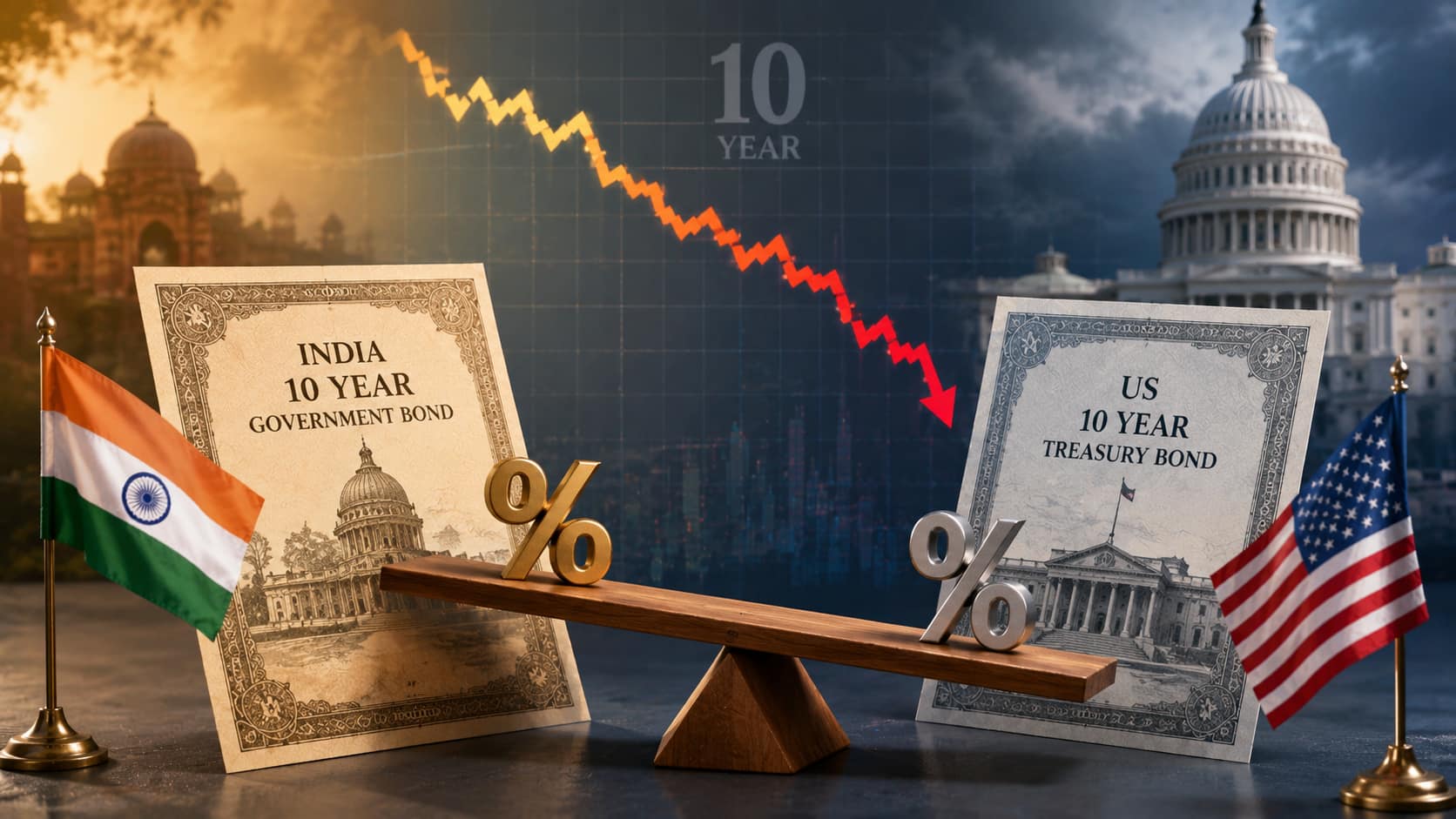
The spread between India’s 10-year government bond yield and the US counterpart widened beyond 250 basis points. Market participants said, "The unwinding of the US AI investment trade could add to pressure on Indian bonds." This shift happened as domestic borrowing costs rose and global investors reassessed their technology stock positions.
The spread between India's 10-year government bond yield and its US counterpart has widened beyond 250 basis points, as rising domestic borrowing costs and inflation risks collide with a shift in global investment flows triggered by the unwinding of the US artificial intelligence trade, said market participants. The spread has widened back above 250 basis points for the first time in around four months, since June 2026, after narrowing to about 194 basis points in early October. India's 10-year benchmark yield is at 7.47 percent, against 4.96 percent for the US 10-year Treasury, putting the differential at 251 basis points. The widening comes as Indian bonds face pressure from tighter banking-system liquidity and expectations of further monetary tightening, while global investors reassess exposure to AI-linked assets and US Treasuries benefit from safe-haven demand. The spread has fluctuated sharply over time. It was around 250 basis points in June 2026, when the US 10-year yield was near 4.5 percent and the Indian benchmark traded in the 6.90-7 percent range. It had narrowed to nearly 160 basis points in May 2025, after exceeding 500 basis points in 2020-21. AI trade reversal adds to global flow uncertainty The AI trade had drawn substantial investment into US technology and semiconductor stocks on expectations of strong returns from artificial intelligence and the infrastructure required to support it. Growing scrutiny of valuations, capital expenditure and the returns expected from these investments has prompted investors to reassess positions. The resulting correction in equities has supported demand for US Treasuries, while potentially making investors more cautious about emerging-market exposure, said market participants. "The unwinding of the US AI investment trade could add to pressure on Indian bonds if global investors redirect capital towards US assets, reducing their exposure to Indian equities and government securities. Growing scrutiny of AI valuations, infrastructure spending and expected returns has prompted investors to reassess positions in technology stocks, while US Treasuries have benefited from safe-haven demand. This shift could further widen the gap between Indian and US government bond yields," a treasury head at a private bank said. US yields, however, have not moved uniformly lower. The 10-year Treasury yield rose to around 5.3 percent before falling below 5 percent, reflecting changing risk sentiment as well as persistent inflation and fiscal concerns. Federal Reserve guidance has also shaped expectations: markets have interpreted its communication as pointing away from a rate hike in October, while leaving open the possibility of one in December. Crude, liquidity and rate expectations keep Indian yields elevated Brent crude was trading at around $113 a barrel on October 23, amid concerns over supply disruptions linked to escalating geopolitical tensions, keeping pressure on the inflation outlook for oil-importing economies such as India. Higher oil prices raise the risk of imported inflation, put pressure on the balance of payments and could complicate the RBI's efforts to contain currency volatility. Markets are already pricing in further domestic tightening, with overnight indexed swaps indicating expectations of nearly 100 basis points of additional rate increases, according to market participants. Liquidity, which had supported government bonds after the large FCNR(B) inflows, has tightened considerably. Overnight rates have moved close to the marginal standing facility (MSF) rate, adding to speculation that the RBI could offer support or adjust the rate corridor. There has been no confirmation of an MSF rate hike by the central bank. "The market is expecting RBI to provide some support, there has been some talks happening in the market that hiking MSF rate could benefit. If the RBI raises the MSF rate, it could lead to further flattening of the yield curve. Bonds with maturities of six months to one year could face greater selling pressure, while longer-dated bonds may see a relatively smaller impact," a dealer at a state-owned bank said. Bond supply is another pressure point. State governments are undertaking a large share of their borrowing in the second half of the financial year, while the Centre has shifted some ultra-long issuance into this period. The additional supply of state debt and bonds with maturities of 15 years and above is likely to weigh more directly on the longer end of the curve, even if its impact on the 10-year benchmark is less direct. Outlook: 7.5% is the key level The 10-year G-sec yield could stabilise around 7.5 percent if crude prices remain near current levels and US Treasury yields settle around 5 percent. A further rise in oil prices, however, could push Indian yields higher by intensifying inflation concerns and strengthening expectations of RBI tightening. "If crude rises to $120 a barrel, Indian G-sec yields could move higher. The US would also face inflationary pressures because of higher oil prices, potentially prompting markets to price in a sharper Fed tightening cycle. However, as a net oil exporter, the US would be in a relatively better position from a macroeconomic perspective," Gaura Sengupta, chief economist at IDFC First Bank, said. India would face both higher imported inflation and risks to growth, leaving domestic bonds vulnerable even if the US yield eases. The spread's next move will therefore depend on the interaction between global capital flows, the trajectory of crude prices, domestic liquidity and how much further monetary tightening markets price in.