
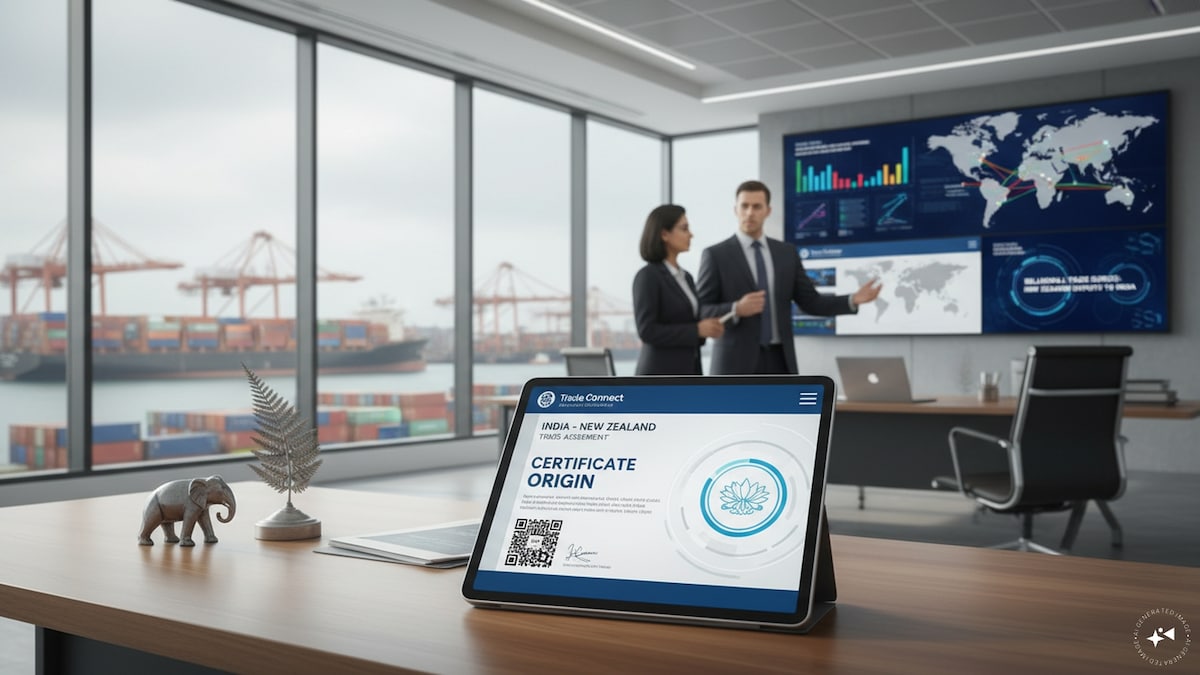
India authorised 17 agencies to issue Certificates of Origin for exports to New Zealand under the trade pact that started on October 20. The Directorate General of Foreign Trade issued this order on November 13. Exporters can now use the Trade Connect ePlatform to get digital certificates for zero-duty access.
Exporters can now secure digital certificates via a centralized portal to tap zero-duty access across New Zealand's market following the trade pact rollout. Discover how specific exclusions protect domestic dairy and agricultural producers from tariff cuts.
India has recently authorised 17 government agencies to issue Certificates of Origin (CoO) for Indian exports to New Zealand under the India-New Zealand Free Trade Agreement (FTA), which came into force on October 20, 2026.
The move will allow exporters to obtain preferential certificates through a digital platform and access benefits under the trade agreement.
The Directorate General of Foreign Trade (DGFT) issued the authorisation on November 13. The 17 agencies include 10 government bodies and seven Special Economic Zone (SEZ) authorities, with their respective responsibilities covering different product categories.
The Directorate General of Foreign Trade and its regional offices, along with the Export Inspection Council and Export Inspection Agencies, can issue certificates for all products.
The Agricultural and Processed Food Products Export Development Authority (APEDA) will handle agricultural and processed food products, while the Marine Products Export Development Authority (MPEDA) will cover marine products.
The Central Silk Board will issue certificates for silk products, and the Coir Board will cover coir and coir products.
The Development Commissioner of Handicrafts will issue certificates for handicrafts, the Spices Board for spices and cashew nuts, and the Textile Committee for textiles, including technical textiles, apparel and made-ups. The Tobacco Board will handle tobacco and tobacco products.
Seven SEZ authorities have also been authorised to issue certificates for all products manufactured by SEZ units and Export Oriented Units (EOUs) within their respective jurisdictions.
These are Cochin SEZ, Falta SEZ, Kandla SEZ, SEEPZ SEZ, NOIDA SEZ, MEPZ SEZ and Visakhapatnam SEZ. Kandla SEZ's jurisdiction also includes Surat SEZ.
Apply online
The preferential CoO facility is available through the Trade Connect ePlatform (www.trade.gov.in), the central digital platform for applications and issuance of electronic Certificates of Origin for Indian exports.
Exporters applying under the India-New Zealand FTA must select "India-New Zealand Free Trade Agreement (Agency Issued)" as the agreement name under the Certificate of Origin service. They can then choose from the list of authorised issuing agencies notified by both countries.
After the authorised agency approves an application, the system generates an electronic certificate carrying a QR code and digital signature. It also includes the specimen signature of the issuing officer and the stamp of the issuing agency. Exporters can download and use the certificate.
Exporters can access the platform using their existing DGFT website credentials without creating a separate account. Additional user accounts linked to the same Importer Exporter Code (IEC) can also be created through a Digital Signature Certificate (DSC).
The DGFT has advised exporters to ensure that their names match across their DGFT and Trade Connect profiles and digital signatures. They must also keep their IEC details updated in the DGFT system to ensure accurate information appears in their applications.
Authorities can verify the authenticity of certificates through the Trade Connect platform by entering the relevant CoO number under the verification service. The DGFT has also provided toll-free assistance and an email helpdesk at coo-dgft@gov.in for queries related to the electronic certification facility.
Trade benefits
The India-New Zealand FTA provides zero-duty market access to 100% of India's exports to New Zealand. India, in turn, has offered tariff liberalisation across 70% of its tariff lines, covering 95% of bilateral trade.
India has kept several products outside the agreement due to domestic sensitivities. These include dairy products, coffee, milk, cream, cheese, yoghurt, whey, caseins, onions, sugar, spices, edible oils and rubber.
However, duty-free access has been provided to manufacturing inputs such as wooden logs, coking coal, metal scrap and waste.
India's bilateral merchandise trade with New Zealand stood at $1.3 billion in FY25, registering growth of nearly 49% over the previous financial year. Both countries aim to double bilateral trade by 2030 and have also signed mutual recognition agreements for organic products.
Under the agreement, New Zealand has committed to facilitate investments worth $20 billion in India over the next 15 years. These investments are expected to support manufacturing, infrastructure, services, innovation and employment.
Investment push
The agreement is also expected to help Indian businesses expand their presence in New Zealand and access markets across the Pacific Island countries.
The India Trade Promotion Organisation (ITPO) is set to open an office in New Zealand to promote bilateral trade, while New Zealand has assured support through an agricultural productivity partnership aimed at benefiting Indian farmers.
New Zealand's High Commissioner to India, Patrick John Rata, had described the agreement as a "hugely important opportunity" for businesses in his country to establish a presence in India.
He had said the FTA would open up opportunities in a market of 1.4 billion people and strengthen bilateral ties beyond the existing strategic partnership. New Zealand is also looking to bring its agri-tech and fintech capabilities to India, while Indian consumers are expected to gain access to products such as New Zealand lamb, kiwi fruit and apples.
With the implementation of the agreement, India now has trade pacts with all members of the Regional Comprehensive Economic Partnership (RCEP), except China.