
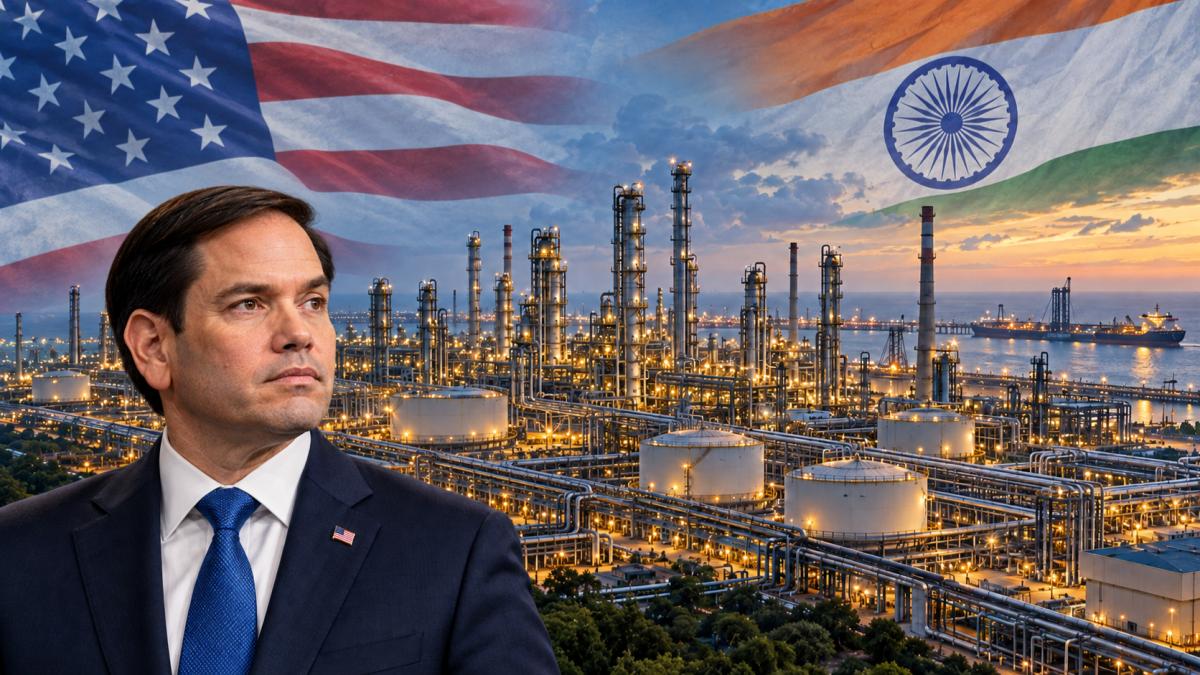
US Secretary of State Marco Rubio visited Mumbai on Tuesday, October 20, to meet External Affairs Minister S Jaishankar. He is scheduled to visit Reliance Industries' Jamnagar refinery on Wednesday. The trip highlights energy cooperation and trade ties, as both nations seek to manage differences while boosting their economic partnership.
India's oil purchases from US-sanctioned countries have been a source of friction with Washington. New Delhi's ability to turn that oil into refined petroleum products for global markets now offers an opening for cooperation. US Secretary of State Marco Rubio's visit brings both sides of that relationship into focus.
Rubio met External Affairs Minister S Jaishankar in Mumbai on Tuesday (October 20) and is scheduled to visit Reliance Industries' Jamnagar refinery complex on Wednesday. His second India visit this year comes as the countries seek to conclude a trade agreement while managing differences over tariffs and Russian crude purchases.
The US State Department's announcement identified energy cooperation, investment and economic ties as priorities. Jamnagar gives those discussions a commercial setting: a company that buys crude internationally, supplies fuels across markets and is backing a proposed American refinery.
Why does the timing matter?
The economic relationship is substantial despite political friction. According to the US Trade Representative, bilateral goods and services trade reached $239.6 billion in 2025, up 12.1% from 2024. However, America's merchandise trade deficit with India widened to $58.4 billion, explaining Washington's interest in securing additional sales.
The February 2026 India-US joint statement, published by the White House, envisaged an 18% reciprocal tariff on specified Indian goods and further market-opening measures. It also recorded India's intention to purchase $500 billion of American energy, aircraft, technology and other products over five years.
That figure covers several sectors and expresses an intention; it is not an energy contract. But it establishes why oil and gas purchases feature prominently in trade diplomacy.
For India, the challenge is to secure predictable access to the American market without allowing diplomatic commitments to raise energy costs. For Washington, commercially viable energy agreements could help translate negotiations into measurable exports and investment.
The Ministry of External Affairs has also identified defence and critical and emerging technologies among the discussion areas. A more stable economic relationship would support cooperation across that wider agenda.
Why is Jamnagar so important?
Jamnagar's significance rests on scale, flexibility and access to overseas buyers. According to an Indian Express report, Reliance's twin refineries have combined capacity of 68.2 million tonnes annually, including 35.2 million tonnes in the export-oriented refinery. That means slightly more than half the complex's capacity belongs to a unit built around international markets.
Reliance's refining and marketing disclosures adds another dimension: Jamnagar has a refining complexity index of 21.1 and marine infrastructure capable of handling the largest crude carriers. The company says it can adjust fuel grades and sales between domestic and export markets as demand changes.
In practical terms, sophisticated processing equipment allows a refinery to handle different crude qualities and produce higher-value fuels. This makes Jamnagar relevant both to countries selling oil and to buyers seeking diesel, petrol and aviation fuel.
The Indian Express reported that Washington faces pressure over fuel availability and prices ahead of November's midterm elections, amid disruptions involving West Asia and Russia.
That creates a plausible reason for American interest in Reliance's export capacity. However, the IE report explicitly noted that there is no confirmed indication Rubio's visit is intended to secure US-bound diesel shipments. Any such sales would depend on prices, freight, specifications and competing markets, the report said.
Has the Russian oil dispute eased?
The immediate tariff threat has receded, but the underlying disagreement remains. According to an executive order published by the White House on October 16, Trump waived duties and specified sanctions under the new Lindsey O Graham Sanctioning Russia and Iran Act. The measures included additional 100% duties on goods from the five largest importers of Russian oil and gas under specified conditions.
The order preserved earlier sanctions and required continued monitoring of Russian energy purchases. The waiver therefore provides negotiating space without guaranteeing permanent relief.
According to Indian Express, Rubio had said in Uzbekistan that the approaching India-US trade agreement was a consideration behind the waiver.
India's commercial constraints remain substantial as the petroleum ministry told Parliament that crude import dependence was 88.2% in 2024-25 and 88.6% during April-January 2025-26. Replacing suppliers therefore involves large volumes and potentially significant additional costs.
Discounted Russian crude became attractive after Moscow's 2022 invasion of Ukraine. Washington's objective of restricting Russian revenues consequently intersects with India's concern over affordable supplies. Jamnagar offers an opportunity to discuss that tension with a major buyer directly.
For Washington, this creates competing objectives: restricting Moscow's earnings while preventing a tighter fuel market from lifting prices.
What is the Texas connection?
Reliance's involvement in the proposed Brownsville refinery gives Washington another reason to engage the company.
President Donald Trump identified Reliance as an investment partner when announcing the project in March. Developer America First Refining described a capital investment and a binding 20-year offtake term sheet with a global energy company.
However, the widely cited $300 billion figure needs careful interpretation. The developer's announcement estimates $125 billion for 1.2 billion barrels of crude and $175 billion for the resulting refined products over the agreement's life. These are projected transaction values over 20 years, not a $300 billion construction investment.
The proposed plant would process around 60 million barrels annually. In April, engineering company Fluor announced its selection for front-end engineering and design, providing a concrete indication of project development.
For Washington, the attraction is foreign capital supporting American refining and domestic shale production. For Reliance, the project offers a deeper commercial presence in the US energy market.
Could American and Venezuelan oil gain ground?
According to IE report, increased American energy purchases and Venezuelan crude as potential discussion points. It reported that the US is currently India's fifth-largest crude supplier, behind Russia, Iraq, Saudi Arabia and the UAE.
Venezuelan oil presents a different opportunity. Its heavier crude is suited to sophisticated refineries such as Jamnagar and Reliance is already an important buyer, according to the IE report. US sanctions permissions and payment arrangements remain relevant: Treasury licences governing Venezuelan oil transactions impose conditions on authorised trade.
These possibilities show why diversification involves more than replacing one country's barrels with another's. Crude quality, processing costs, shipping and regulatory certainty all influence procurement.
What would count as progress?
The most useful outcomes would be clearer trade terms, commercially workable supply arrangements and firmer investment milestones. A refinery visit alone cannot establish that these have been secured.
Jamnagar's inclusion nevertheless highlights India's dual position in energy markets: a large importer exposed to supply shocks and a major processor capable of supplying other economies.
Rubio's visit tests whether that industrial capability can help both governments manage their disagreements.