
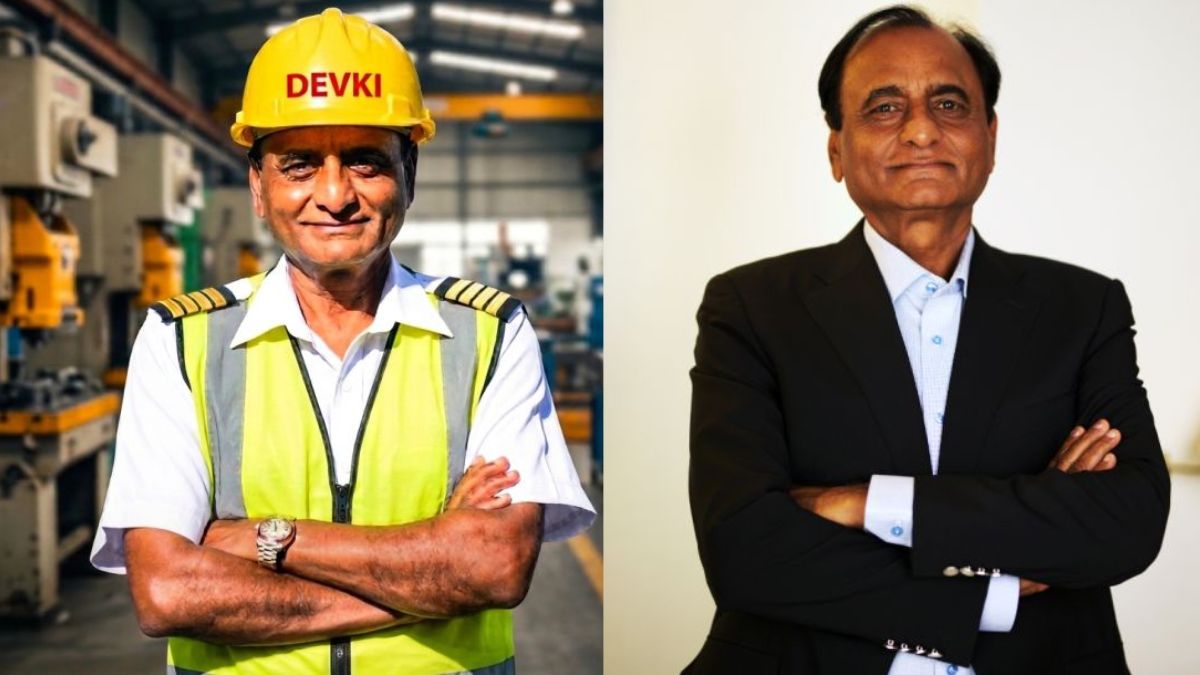
Narendra Raval grew his Devki Group from a small hardware shop into a massive business with 18,000 employees. After moving to Kenya in 1978, he started steel manufacturing despite early financial struggles. He said, "Within 6 months, I was almost on my knees," but his company eventually found great success.
Narendra Raval's first attempt at steel manufacturing nearly pushed him to the brink of financial collapse.
Competing against established manufacturers, he struggled to sell his products and pay workers. But the business survived, eventually becoming the foundation of Devki Group, one of East Africa's major industrial businesses.
Over 30 years later, the group's workforce has grown from about 180 employees to more than 18,000. Its businesses span steel, cement, roofing sheets, fertilisers, packaging and other industrial activities, with operations and investments extending beyond Kenya.
Popularly known as "Guru", Raval built his business around manufacturing products used in construction and infrastructure. The expansion has involved acquisitions, substantial capital investments and institutional financing.
Yet he has resisted selling National Cement to Nigerian industrialist Aliko Dangote, saying he wants to retain family ownership.
From temple work to a steel business in Kenya
Born in Gujarat in 1962, Raval moved to Kenya in 1978 to work as an assistant at a temple in Kisumu, according to a Forbes interview. He later married and left temple work to earn a living outside the religious establishment.
He found work at a hardware shop and a steel mill in Nairobi, gaining experience in the construction-materials trade. In 1990, after his employer closed the business, Raval opened a small hardware shop in Nairobi's Gikomba market with his wife, Neeta.
Selling products made by other companies gave him an entry into the market, but Raval wanted to manufacture steel products locally and offer customers more affordable options for construction and fencing.
"I wanted to change this," he told Forbes.
He subsequently moved into steel manufacturing, establishing a small rolling mill in Athi River, according to his account of the business's early years. Competing against larger manufacturers proved difficult because they had greater purchasing power and established customer networks.
The factory needed capital, raw materials and customers willing to buy from an unfamiliar producer. Within months, the business was struggling financially.
"Within 6 months, I was almost on my knees," Raval told Forbes in 2015.
He recalled struggling to sell his inventory and pay workers. Employees agreed to accept reduced salaries while the company worked through its difficulties. Raval credited their support, along with his decision to work alongside them on the factory floor, with helping the business survive.
The situation improved when steel prices rose, allowing him to sell inventory purchased at lower prices, pay employees and settle bank loans. The recovery gave the business room to continue expanding.
How steel became foundation for Devki Group
Steel manufacturing became the starting point for Devki's expansion into a wider industrial business. The International Finance Corporation (IFC) identifies Devki as a steel and trading company established by Raval in 1986.
The group's official website lists businesses including Devki Steel Mills, National Cement, Maisha Mabati Mills, Maisha Minerals & Fertilizers, Maisha Packaging and CEMTECH. Its portfolio also includes Cimerwa in Rwanda and Northwood Aviation Agencies.
These businesses span steel products, roofing sheets, cement, clinker, fertilisers, packaging and aviation-related services. Together, they connect Devki to several stages of construction and industrial production.
Raval has described local manufacturing as a way to create employment, support businesses and reduce dependence on imported products. In recent LinkedIn posts, he has spoken about the role of new factories in creating jobs closer to where people live.
Expanding manufacturing, however, requires substantial capital. Unlike a trading business, a factory must invest in land, machinery, energy and raw materials before it can generate revenue.
Devki's subsequent growth has therefore depended on financing, production expansion and acquisitions.
Why cement became a major turning point
Cement emerged as one of Devki's most significant businesses through National Cement, which expanded its production capacity and acquired assets from ARM Cement.
Business Daily had earlier reported that National Cement would acquire ARM Cement's assets and businesses for 5 billion Kenyan shillings. The transaction strengthened National Cement's position in Kenya's cement industry and gave it access to existing industrial assets.
The expansion required substantial investment. An IFC disclosure for an earlier National Cement project estimated the total project cost at $188 million. The IFC approved $70 million in financing, comprising a $55 million loan and $15 million in equity.
The project included an expansion of the Athi River grinding plant and a clinker production line near the Nairobi-Mombasa highway.
A separate IFC project, disclosed in 2018 and approved in 2019, involved a planned investment of about $200 million to increase clinker and cement capacity in Kenya and Uganda. The IFC approved $28.5 million for this project, comprising a $25 million loan and $3.5 million in equity.
The project was expected to expand clinker production in Kenya and add cement capacity through National Cement's Ugandan subsidiary.
These project-specific figures are distinct from a broader financing arrangement reported by Forbes in April 2018. That report said National Cement had secured $97 million in financing, while Raval and his family planned to invest a further $100 million in an expansion programme costing close to $200 million.
Why Raval said no to Dangote
Raval's approach to ownership became clear when he discussed a reported offer from Aliko Dangote, whose group has major cement operations across Africa.
In an earlier Forbes interview, Raval said Dangote had offered to buy him out of National Cement. He also said he rejected a subsequent proposal for a significant stake in the company.
"I said no because it is my family business," Raval told Forbes. "I want to keep the business within the family," he said.
His account suggests that retaining ownership mattered beyond the financial terms of a potential sale. He viewed National Cement as a family enterprise that he wanted to build over the long term.
That did not mean he rejected outside investment. National Cement accepted equity investment from the IFC alongside debt financing, allowing the business to fund expansion while retaining its existing ownership structure.
The reported Dangote approach also placed National Cement within a wider contest among African industrial groups seeking to expand across the continent. However, the details of the offer are based on Raval's account and should not be treated as independently verified transaction terms.
How Raval defines wealth
Despite building a large industrial business, Raval has publicly emphasised employment and community support as measures of wealth.
A Business Daily profile described his preference for a simple lifestyle, including owning few clothes and sometimes using a boda boda to avoid Nairobi traffic.
The same report said he redirected production at one of his steel factories to make oxygen for public hospitals during the Covid-19 crisis.
"My money is not what I have in the bank. My money is the 6,500 people who work for me," he told Business Daily. He also cited oxygen supplied to hospitals and food provided to poor children as part of his wealth.
His more recent account of Devki's growth places the group's workforce at more than 18,000, up from about 180 employees. In a LinkedIn post, he credited his family and employees for building the business step by step.
The expansion from a small hardware shop to a diversified industrial group has relied on manufacturing, acquisitions, financing and investment in production capacity. Its next phase will depend on managing costs, competition, energy prices and demand across the markets in which it operates.
For Raval, the journey has also been about building a business that creates jobs and remains under family control. The steel mill that once struggled to sell its products became the starting point for a much broader industrial enterprise.