
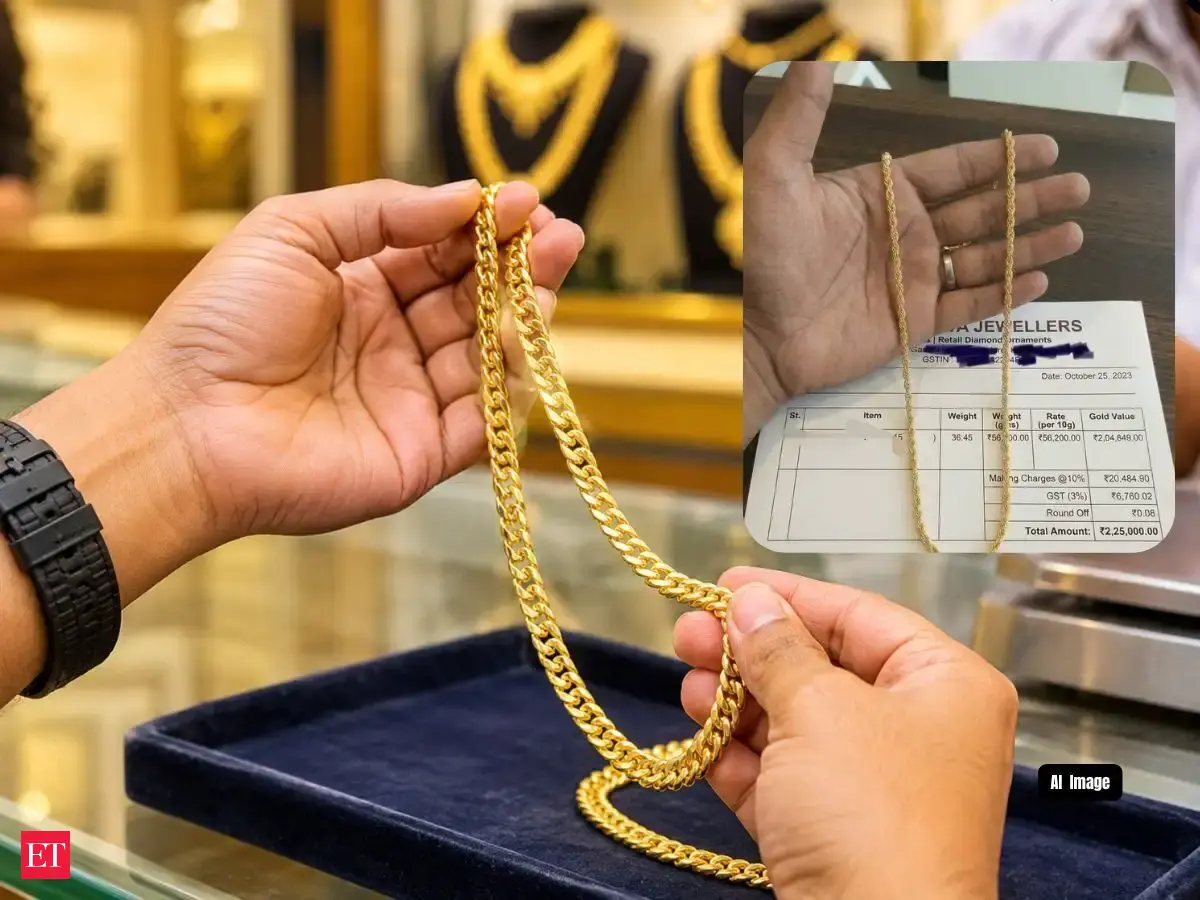
A Kerala man got a shock when a goldsmith offered him only Rs 4 lakh for his 36.45-gram gold chain. He expected Rs 6 lakh as gold prices rose. The goldsmith said the chain was 18-karat gold, not 24-karat, which lowered the value. He then took his chain back home.
Synopsis
Kerala man's gold chain shocking story: Kerala man shared his disappointing experience of trying to sell a 36.45-gram gold chain purchased three years ago for Rs 56,000. Despite gold prices rising to Rs 2 lakh per 10 grams, a goldsmith reportedly offered him only a little over Rs 4 lakh instead of the expected Rs 6 lakh.
A sharp rise in gold prices has made jewellery owners hopeful of earning handsome returns on their old purchases. However, one man's experience of trying to sell a gold chain has highlighted why the market price of gold and the actual resale value of jewellery can be very different. In a post on X, a user named Himanshu Mishra shared how he was left disappointed after approaching a goldsmith to sell a gold chain he had purchased three years ago.
According to Mishra, he had bought the chain for Rs 56,000 when the price of 10 grams of gold was around that amount. The chain weighed 36.45 grams, he said. Over the years, gold prices climbed sharply. When the rate reached near Rs 2 lakh per 10 grams, Mishra began calculating how much his jewellery could fetch in the market. He expected to make a substantial profit from the investment. However, his excitement did not last long.
Gold chain worth Rs 6 lakh? Goldsmith offers only Rs 4 lakh-plus
When Mishra approached a goldsmith to sell the 36.45-gram chain, he expected to receive around Rs 6 lakh based on the prevailing gold prices. But the final valuation came as a shock. The goldsmith reportedly told him that he would receive only a little over Rs 4 lakh for the jewellery. This was considerably lower than what Mishra had anticipated.
Initially, he was furious with the valuation. However, the goldsmith explained that the chain was made of 18-karat gold, rather than 24-karat gold, which affected its resale value. The difference in purity meant that the jewellery did not carry the same value as an equivalent weight of pure gold. Mishra eventually decided against selling the chain and took it back home. Reflecting on the experience, he questioned whether buying more gold made financial sense at a time when prices were already so high.
Live Events
You Might Also Like:
Rs 50 lakh from garden leaves: How IIT Bombay turned waste into cooking fuel to cut LPG cost by 60%
Why does old gold jewellery sell for less than the market rate?
Mishra's experience also highlights an important aspect of buying gold jewellery that many consumers may overlook. The gold rate displayed in the market generally refers to 24-karat gold, which has a purity of 99.9%. However, jewellery is commonly made using lower-purity gold.
For instance, 18-karat gold contains 75% pure gold, while 22-karat gold contains approximately 91.6% pure gold. This means a 36.45-gram 18-karat gold chain does not contain 36.45 grams of pure gold. Its actual pure gold content is approximately 27.34 grams.
Jewellers also calculate resale value after checking purity and net gold weight. Any stones, non-gold components or other materials are excluded from the gold valuation. Making charges paid when purchasing jewellery are generally not recovered during resale. Depending on the jeweller and transaction, additional deductions may also apply.
Therefore, the market price of 10 grams of 24-karat gold can't simply be multiplied by the total weight of an 18-karat jewellery piece to determine its selling price.
You Might Also Like:
Odisha man eats dog on highway in Sambhalpur after it was hit by a vehicle, video goes viral
Gold jewellery versus gold as an investment
Gold has traditionally been considered a store of value in Indian households. Many families purchase jewellery during weddings, festivals and other important occasions. However, jewellery purchases and investments in gold are not exactly the same.
While jewellery carries emotional and cultural significance, buyers should understand that making charges, wastage charges and resale deductions can affect the returns they eventually receive. Those looking to invest purely in gold may also consider alternatives such as gold ETFs and sovereign gold bonds, subject to availability and applicable terms.
(You can now subscribe to our Economic Times WhatsApp channel)
Is CoreWeave's movement signalling a return of the AI trade?
How India’s INR22.5 lakh crore gold loan boom is hiding a big hole
KYC and KYB: Pidilite's margin keeps finding its way back, though costlier raw materials can knock it off course – Part 2 of 3
Business of Odd Things: The farm that needs no land, freshwater, or fertiliser
KYC and KYB: Inside Pidilite, the company that turned Fevicol into a word for a strong bond – Part 1 of 3
Seoul halts trading, Nifty has its best week since 2021: Money leaving the AI trade – will it land in India?