
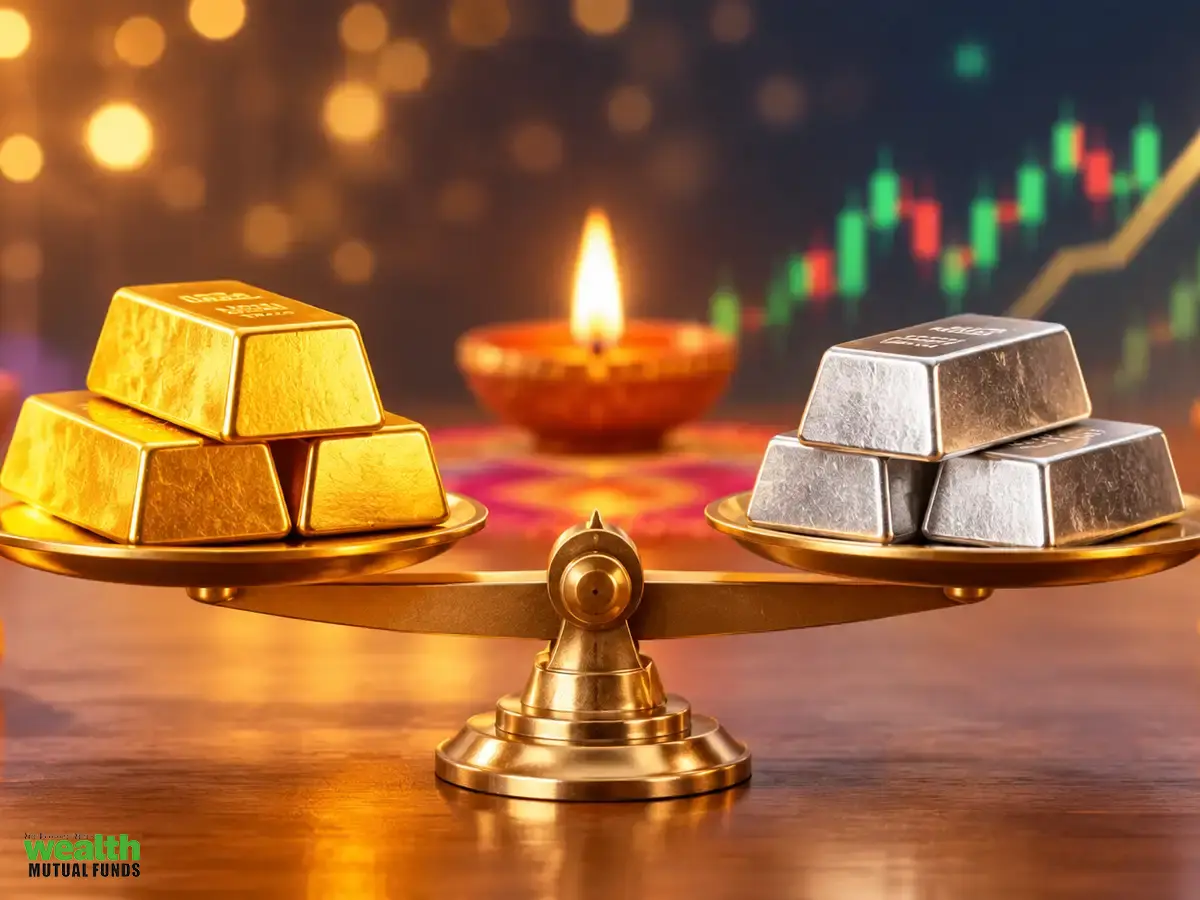
Investors often choose gold or silver during Diwali for security. Recent data showed gold ETFs gave 9.22% returns, while silver ETFs got 14.05%. Experts said, “Gold may be a better starting point for first-time investors or those uncomfortable with volatility.” Many suggest balancing both metals to manage market risks well.
Synopsis
During the festive season of Diwali, savvy investors often gravitate towards gold and silver seeking security. Experts recommend evaluating personal investment goals to decide on gold, known for its stability, or silver, which presents higher risks but potential for greater returns. Recent data shows gold ETFs delivered 9.22% returns, while silver ETFs outperformed with 14.05%. A balanced approach within your portfolio can lead to sustainable wealth amidst market fluctuations.
As the festive season begins, investors traditionally turn to precious metals such as gold and silver, both regarded as symbols of prosperity and stability. This Diwali, however, choosing between the two calls for a closer look at their role in an investor's portfolio as gold is known for its relative stability whereas silver for its industrial demand and potential opportunities.
Market experts say that at this point investors should push back on the "either-or" argument and should first assess whether they need exposure to gold or silver in their portfolio rather than making decisions based on their recent returns.
Abhisek Bahinipati, Head – Passive Investments, Invesco Mutual Fund told ETMutualFunds that gold and silver play different roles in a portfolio. Comparing gold and silver solely on the basis of their returns over the past year is akin to investing through the rear-view mirror, an approach that may not always lead investors to the most comfortable journey ahead.
Best MF to invest
Looking for the best mutual funds to invest? Here are our recommendations.
View Details »
Bahinipati further said that investors should let their financial situation and investment objectives guide their decision rather than last year's performance rankings. “Gold may be a better starting point for first-time investors or those uncomfortable with volatility. Investors with an existing gold allocation and a longer horizon can add silver for diversification. With the gold-silver ratio at around 77 against its long-term average of 63, silver appears relatively cheaper, but this does not mean it should replace gold altogether.”
Live Events
Manish Srivastava, Executive Director, Anand Rathi Wealth Limited told ETMutualFunds that although gold and silver have outperformed equities recently, they have corrected around 22% and 52%, respectively, from their January 2026 highs.
Srivastava further said that investors should avoid silver due to its higher volatility and dependence on industrial demand. Gold can hedge against inflation and market uncertainty, but should not replace equities as a core asset for long-term wealth creation. It can, however, replace part of the debt allocation. “Investors can consider Gold ETFs, but those with sufficient gold exposure should avoid adding more and gradually rebalance excess holdings towards diversified equity mutual funds.”
How gold and silver ETFs performed?
Since the last Diwali celebrated on October 20, 2025 gold ETFs have delivered an average return of 9.22%. There were 22 gold ETFs in the said time period, of which UTI Gold ETF delivered the highest return of around 9.60%, followed by LIC MF Gold ETF that gave 9.52% in the same time period. Nippon India ETF Gold BeES, the largest gold ETF based on the assets managed, delivered the lowest return of 8.94% in the said time period.
Silver ETFs delivered an average return of 14.05% in the same time period. There were 16 silver ETFs in the said time period, of which Tata Silver ETF delivered the highest return of around 17.35% whereas Zerodha Silver ETF delivered the lowest return of around 13.37% in the same time period.
Gold or silver or hold both?
Post seeing strong performance by silver ETFs since last Diwali, the important question is should one hold one between gold and silver or allocate in both the metals?
Srivastava said that for a long-term portfolio, investors should avoid silver altogether, given its weaker risk adjusted performance compared to equity. While sharing the historical performance and sharpe ratio generated by these two metals, he further said that an investor following an 80:20 allocation between equity and debt can maintain 80% in equity, 10% in debt and 10% in gold. Therefore, there is no need to hold both metals together as silver adds volatility without offering equally attractive long-term risk adjusted returns.
Bahinipati said that for most investors, allocating around 15% of the portfolio to precious metals is a sensible approach. Within that allocation, keep roughly two-thirds in gold and one-third in silver, translating to about 10% in gold and 5% in silver.
He further said that more conservative investors may consider capping silver exposure at around 3% given its higher volatility, while younger investors with longer investment horizons can afford to tilt modestly more towards silver. While gold and silver tend to move in the same direction over time, they do not move in lockstep and can help protect against different risks.
Rahul Khetawat, Senior Vice President and Fund Manager, 360 One Asset told ETMutualFunds that given the prevailing macroeconomic and geopolitical uncertainties, he continue to maintain a measured approach to precious metals allocation with gold making up a relatively larger share of the exposure.
Book profits or continue holding gold and silver ETFs?
January 2026 was a very eventful month for gold and silver. Prices of both metals went up sharply during most of the month as many investors rushed towards safe options because of uncertainty in global markets. People looked at gold and silver as protection for their money, which pushed prices higher.
Investors who have benefited from the rally earlier this year may be wondering whether to book profits or remain invested. The experts said that the decision should depend on their overall portfolio allocation and investment goals rather than short-term price movements.
Bahinipati said investors should neither sell all their holdings nor double down on their investments. Instead, he recommended rebalancing their portfolios based on a predetermined target allocation.
If gold and silver have exceeded their intended portfolio weight because of their appreciation while equities have corrected, investors could consider trimming the excess and reallocating it to asset classes where they are underweight. He pointed out that the Nifty had declined around 11% since last Diwali. If the precious metals allocation remains within the desired range, staying invested may be the better course of action.
He cautioned against booking profits based on market headlines, as it is difficult to identify market tops. Rebalancing allows investors to book profits systematically without having to predict market turning points. Investors should also factor in the tax implications of any gains realised from their gold and silver holdings before making changes.
Srivastava said that when gold and silver prices were near their peaks, both these categories received huge inflows and the investors who entered at these elevated levels are sitting on losses highlighting recency bias of investing based on recent returns.
He further said that investors who have benefited from the recent rally should review their asset allocation. Investors holding silver in their portfolios should gradually exit and move the allocation towards diversified equity funds whereas the ones holding gold can continue holding it as long as the allocation remains within 10% of their long term portfolios.
Gold and silver ETFs: role in portfolio and SIP or lumpsum?
Gold and silver ETFs track the price of the underlying metal and are often used as a hedge against inflation or uncertainty. Their returns are directly linked to commodity price movements. Gold and silver funds are used for portfolio diversification.
Srivastava said that investors should understand that volatility is part of investing in equity markets and is temporary.
“investors should look at equity market corrections as opportunities to accumulate more units of diversified equity mutual funds rather than shifting excessive money towards precious metals.”
He further said that gold should remain within the defensive portion of the portfolio, while silver should be avoided due to its higher volatility and for investors looking to build gold exposure, can prefer staggered investments through SIPs rather than investing a lumpsum.
Bahinipati said one should think of gold and silver as shock absorbers in a portfolio, they don't make the ride faster but they can make rough markets far more bearable and 2026 has been one such rough patch.
While commenting on SIP or lumpsum, he further said that for silver he prefers SIPs, investors with lumpsum to invest should stagger investments over three to six months.
If one is investing around Dhanteras, the prudent approach would be to deploy 15-20% of the precious metals allocation as lumpsum to mark the occasion and invest balance through a SIP, Shrivastava further said.
Way ahead for gold and silver
In the last one year, gold ETFs gave an average return of whereas silver ETFs gave an average return of in the same period.
In the last three months, gold ETFs on an average lost and silver ETFs were down.
Bahinipati said gold and silver are facing near-term pressure from interest rates. For Indian investors, a weaker rupee could provide an additional layer of support to precious metals returns.
He expects volatility to persist in the near term, while the longer-term direction remains constructive. Investors who focus on asset allocation and gradual accumulation may be better placed than those trying to time short-term price movements.
Shrivastava said that gold prices may continue to receive support from geopolitical uncertainty, inflation concerns and global interest rate movements. Silver remains more unpredictable because its prices are influenced by industrial demand, global economic activity and speculative trading.
Along with the data on how gold and silver have performed compared to Nifty50, he further said that investors should opt equities for long-term wealth creation, with gold forming a limited part of the defensive allocation. Investors should continue to avoid silver as a part of their portfolio.
Khetawat said that gold may be well placed in current environment, silver may also offer opportunities.
If you have any mutual fund queries, message on ET Mutual Funds on Facebook/Twitter. We will get it answered by our panel of experts. Do share your questions on ETMFqueries@timesinternet.in alongwith your age, risk profile, and twitter handle
(Catch all the Mutual Fund News, Breaking News, Budget 2024 Events and Latest News Updates on The Economic Times.)
Subscribe to The Economic Times Prime and read the ET ePaper online.
...moreless
(Catch all the Mutual Fund News, Breaking News, Budget 2024 Events and Latest News Updates on The Economic Times.)
Subscribe to The Economic Times Prime and read the ET ePaper online.
...moreless
Some elections matter more than you know: No crop changed in the fields, yet sugar, coffee and soya got cheaper in a day
You can buy a walkie-talkie online. But can you legally use it?
KYB and KYC: Quick commerce, the Damani premium and what DMart must deliver – 3rd and concluding part
KYC and KYB: Inside Damani’s DMart, the retail chain for the middle class. And stock for the long term? – Part 2 of 3
Will it be a regulatory nightmare if an exchange lists on its own platform?
KYC and KYB: Inside Damani’s Avenue Supermarts that refuses to charge more – Part 1 of 3