
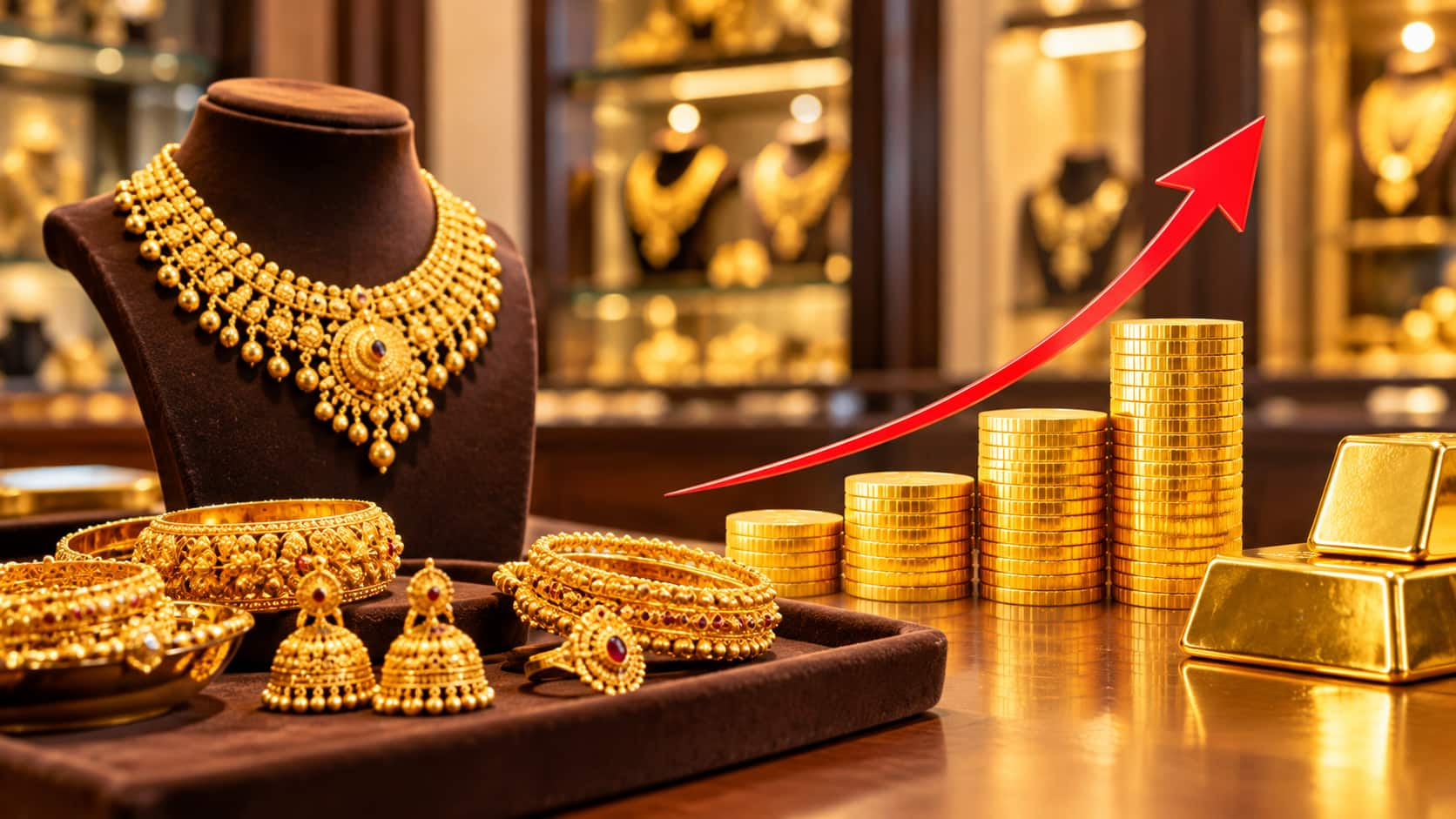
Indians are spending more on gold jewellery despite buying less of the metal, says a WGC report. Jewellery demand fell 18 percent in the first nine months of 2026, but spending rose 29 percent. "Consumers therefore continued to gravitate towards lighter-weight pieces," the report noted, as record-high prices changed habits.
Market Mastery
Webinar by Vishal Malkan
Find the weak links
in your portfolio by Vishal Malkan
Indians are spending more on gold jewellery despite buying significantly less of the metal, highlighting how record-high prices are changing household purchasing patterns. Jewellery demand fell 18 percent year-on-year to 241.1 tonnes in the first nine months of 2026. Yet the value of purchases rose 29 percent to Rs 3,618.3 billion, according to the World Gold Council’s (WGC) Gold Demand Trends: India Focus Q3 2026 report.
The report captures the widening gap between the quantity of gold bought and the money spent on it. “The increase in value was entirely price-led,” the WGC said. In other words, higher gold prices, rather than an increase in the volume of purchases, are driving the rise in jewellery spending. The trend suggests that households are committing more money to gold even as the quantity they take home shrinks.
The pressure was visible in the September quarter as well. Indian gold jewellery consumption declined 20 percent year-on-year to 99.9 tonnes, although it recovered 33 percent sequentially from the subdued April-June quarter. Spending, however, rose 16 percent year-on-year to Rs 1,487 billion. The average domestic gold price was Rs 1,48,891 per 10 grams in Q3, around 45 percent higher than a year earlier, making affordability a key consideration for buyers.
“Affordability remained the overriding constraint,” the WGC said. Consumers responded by shifting towards lighter-weight pieces, lower-carat gold and studded jewellery, reducing the fine-weight gold content of their purchases. This means a buyer may spend a similar or higher amount but receive less pure gold than before. The shift also reflects how jewellers and consumers are adapting product choices to keep purchases within reach.
The WGC’s consumer survey offers a closer look at these adjustments. Among respondents who expected to change or maintain their buying behaviour, 77 percent said they would trade down on purity or carat, up from 72 percent in the previous survey. The share considering an exchange of old jewellery to fund new purchases also increased from 70 percent to 76 percent. Interest in paying through EMIs and regular gold-savings schemes remained broadly stable.
The findings suggest that high prices are changing not just how much gold Indians buy, but also how they finance and choose their jewellery. "Consumers therefore continued to gravitate towards lighter-weight pieces," the report noted. With wedding and festive purchases supporting demand, jewellery buying may recover further in the final quarter, but elevated prices are likely to keep volumes under pressure.