
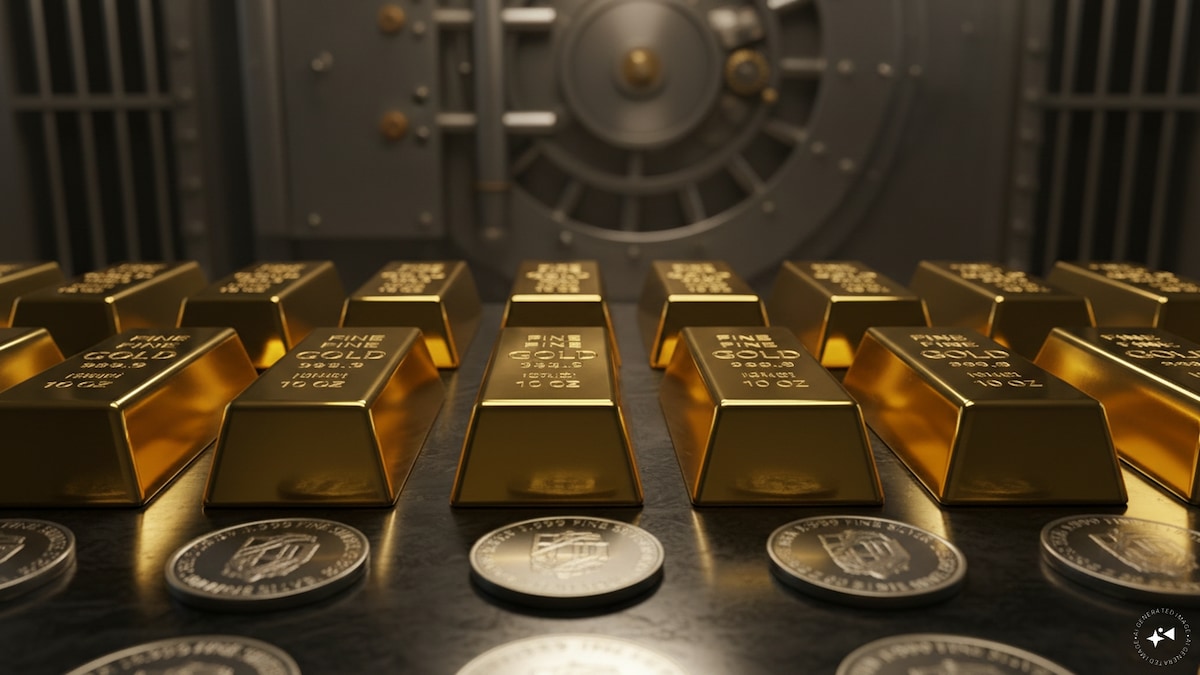
Gold and silver prices rose in overseas trade on Friday, October 16, recovering from recent losses due to West Asian tensions. On COMEX, gold reached $4,177.50 per ounce. Justin Khoo said, "markets remain sensitive to US inflation data and changing expectations for the Federal Reserve's policy path." Investors remain cautious.
Gold and silver prices rose in overseas trade, recovering from recent losses, driven by safe-haven demand from West Asian tensions.
Gold and silver prices edged higher in overseas trade on Friday, October 16, recovering some ground after a sharp selloff earlier in the week. However, expectations of tighter US monetary policy, inflation concerns and developments in West Asia are likely to influence the precious metals' near-term direction.
On COMEX, gold futures were trading at $4,177.50 per ounce, up $7.40 or 0.18%, while silver futures were at $57.430 per ounce, up $0.274 or 0.48%, according to data last updated on October 16.
In the domestic market, gold prices fell for a fourth consecutive session on Thursday (October 15), declining ₹900 to ₹1.49 lakh per 10 grams in New Delhi.
Silver prices dropped ₹6,000 to ₹2.15 lakh per kilogram, according to market data reported by PTI. A stronger rupee and subdued physical demand weighed on domestic prices.
What is driving gold and silver prices?
US inflation and interest-rate expectations
Higher-than-expected US inflation has raised concerns that the Federal Reserve may keep monetary policy tighter for longer or consider raising interest rates. September's US Consumer Price Index rose 3.7%, against expectations of 3.6%, according to commodity market commentary.
Higher interest rates and bond yields tend to weigh on gold and silver because these precious metals do not generate interest income. A stronger US dollar can also make dollar-denominated bullion more expensive for buyers using other currencies, potentially limiting demand.
Justin Khoo, Senior Market Analyst - APAC at VT Markets, said markets remain sensitive to US inflation data and changing expectations for the Federal Reserve's policy path. He noted that a higher-than-expected inflation reading could push Treasury yields and the dollar higher, putting pressure on gold, while softer inflation could support prices.
Investors are also watching US economic data and remarks by Federal Reserve Chair Kevin Warsh for clues about the interest-rate outlook.
Geopolitical tensions provide support, but do not eliminate volatility
Developments in West Asia remain another factor influencing precious metals. Escalating tensions involving Iran, Saudi Arabia and Yemen's Houthi movement, alongside attacks on shipping in the region, have kept geopolitical risks elevated.
Such uncertainty can support demand for gold as a safe-haven asset. However, the impact is not always sustained, as movements in the dollar, bond yields and expectations for interest rates can offset geopolitical support.
Prithviraj Kothari, Managing Director of RiddiSiddhi Bullions Ltd. and president of the India Bullion and Jewellers Association, said geopolitical risks remain elevated, including developments around the Strait of Hormuz and attacks on energy infrastructure.
Why domestic prices may move differently from global bullion
International bullion prices are quoted in US dollars, while domestic prices are influenced by the rupee-dollar exchange rate, import costs, duties and local demand.
The rupee strengthened for a fifth consecutive session on Thursday (October 15), closing 12 paise higher at ₹95.05 against the US dollar, according to PTI.
The appreciation, along with subdued physical demand, contributed to the weakness in domestic gold prices even as overseas bullion recovered.
Consequently, a rise in international gold prices does not necessarily translate into an equivalent increase in Indian prices. A stronger rupee can moderate the impact of gains in global bullion, while a weaker rupee can amplify them.
What is the outlook for gold and silver?
Kothari said gold had recovered from the $4,080 an ounce level and identified price declines as potential buying opportunities. For silver, he pointed to support around $55-$56 per ounce and said short-covering could help prices move towards $58.50.
Khoo's technical assessment identified $4,280 as a level to watch for gold, with $4,055 as downside support. For silver, he highlighted $58.95 and $57.40 as levels on the downside.
These technical levels are market indicators rather than guaranteed price targets. The near-term direction will depend on whether inflation data and Federal Reserve signals strengthen expectations of higher interest rates, or whether easing yields and geopolitical uncertainty support renewed demand for precious metals.