
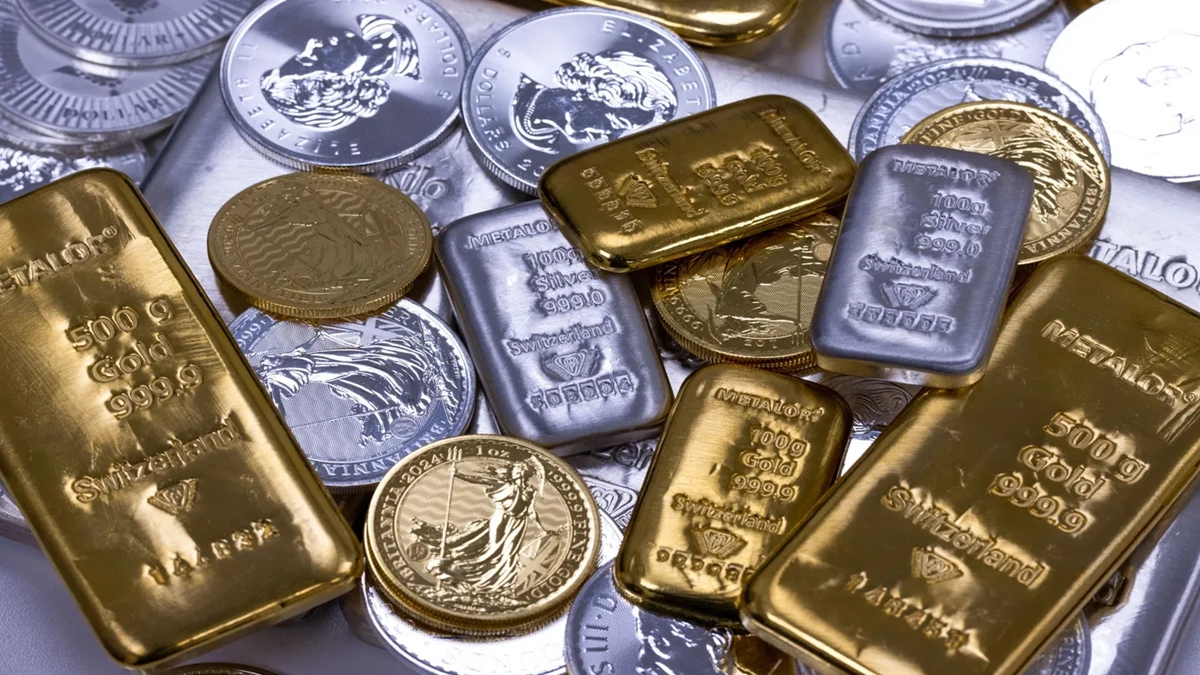
Gold opened at Rs 1,23,077 per 10 grams on Friday, down 9.3% from last week. Silver also fell over 15% to Rs 1,50,382 per kg. Selling pressure intensified as investors reassess US interest rates. A stronger dollar and potential rate hikes made these metals less attractive, causing prices to drop significantly.
In the domestic market, gold opened at Rs 1,23,077 per 10 grams on Friday, down by 9.3% from its closing level last Friday. Silver opened at Rs 1,50,382 per kg, declining by Rs 27,208 per kg over the same period, a fall of over 15%. According to PTI, the opening rates for bullion in Mumbai are as follows: Silver Spot is priced at Rs 150,650 per kilo, Standard Gold (99.5) is Rs 123,089, and Pure Gold (99.9) is Rs 123,584.
Selling pressure continues on Friday. Gold futures were trading nearly 4% lower at Rs 1,22,450, while silver futures were down over 5.5% at Rs 1,48,816.
In the international market, gold was trading at around $3,459 an ounce and silver at $41.8 an ounce on Friday. Both metals fell another 1.5% from their previous closing levels. On Thursday, silver had already plunged over 5%, while gold lost around 2%.
Gold prices moved towards $3,500 an ounce on Friday, hitting their lowest levels since September 2025. Silver also approached $42 an ounce, marking its weakest level since September 2025.
How far have they come down? The decline has significantly widened the gap between current prices and the January peaks. Gold, which touched Rs 1,76,306 per 10 grams in January, is now down over 30% from that level. Silver has fallen approximately 61% from its January peak of Rs 3,84,632 per kg.
Domestic gold and silver prices
Source: MCX
What is really pulling gold and silver down?
The selloff in precious metals has intensified as investors reassess the outlook for US interest rates. A stronger US dollar and growing expectations that the Federal Reserve may maintain a more aggressive monetary policy stance have weighed on gold and silver.
Several Fed officials have expressed support for higher interest rates to bring inflation closer to the central bank’s 2% target. The big blow came this week from Fed Governor Christopher Waller. He also indicated that a larger 50-basis-point rate hike could be considered in December.
Higher interest rates increase the opportunity cost of holding non-yielding assets such as gold. This makes the precious metal less attractive to investors.
Interest rate expectations are not the only factor driving the selloff. The AI-driven decline in global equities has also created liquidity pressures. This is prompting investors to sell precious metals to cover losses in other parts of their portfolios.
Nasdaq Composite and S&P 500 both fell nearly 6% in the last five days of trading. “There seems to be a bit of forced liquidation going on across the market in general, with expectations of imminent US rate hikes and inflation that could be persistent, leading to high yields and a higher US dollar as a result, pressuring gold,” said Kyle Rodda, senior financial market analyst at Capital.com, to Reuters.
Why is silver getting hit even harder? It has faced heavier selling amid weakness in industrial commodities and concerns about global economic growth. Softer US labour market and manufacturing data have added to these concerns. Continuing US-Iran tensions have failed to generate sustained safe-haven demand.
Recent US economic indicators have pointed to further weakness in underlying economic momentum. Labour market conditions are deteriorating, regional manufacturing activity is slowing and leading economic indicators are declining.
Friday bullion rates in Mumbai
Source: PTI
The bond market is making its own case
The US 10-year Treasury yield moved lower towards 5% on Friday, extending its decline for a fifth consecutive session. Demand for safe-haven bonds has increased amid the AI-driven selloff in global equities.
Gary S. Wagner, a technical market analyst for 25 years, shared his views on gold with Kitco.
“Selloff has much more to do with interest rates than with the dollar, and the bond market continues to make that case. In early November, the 10-year Treasury yield bottomed near 4.82%. Last week’s hotter-than-expected CPI report sent it surging back above 5%, and by the end of the week it had touched roughly 5.17%. It has closed above 5% in every session since. Over that same stretch, gold futures fell from their early-November high near $4,150 to Thursday’s close. Put simply, a rise of roughly 35 basis points in the 10-year yield has coincided with a decline of more than 12% in gold,” says Wagner.
And the dollar keeps climbing
Meanwhile, the dollar index is getting stronger. The dollar held near a 19-month high on Friday. This extends its recent rally and makes greenback-priced bullion more expensive for holders of other currencies.
The US dollar index climbed toward 104 on Friday. It reached its strongest level since April 2025 and is heading for a fourth consecutive weekly advance. The driver is an AI-driven selloff in global equities, which boosted safe-haven demand for the greenback.
Can central banks cushion the fall?
Despite the recent correction, central bank demand remains an important factor supporting the long-term outlook for gold.
According to the World Gold Council, strong buying in the third quarter has taken central bank demand to 321 tonnes, surpassing the five-year quarterly average. Central banks purchased 120 tonnes in Q3, primarily driven by buying from China and Poland.
This took central bank gold purchases to 675 tonnes in the first nine months of the year, 6% higher than the corresponding period last year.
Whether continued central bank buying can provide sufficient support to gold prices amid rising interest rate expectations and heavy investor selling remains to be seen.
What to watch from here
Keep an eye on bond yields and the dollar index for now. The direction of US bond yields will remain important for gold prices. If yields continue to ease, some pressure on the precious metal could reduce.
Gold is currently hovering around the important $3,500-an-ounce level. This makes the next move in bond yields and investor demand particularly important.