
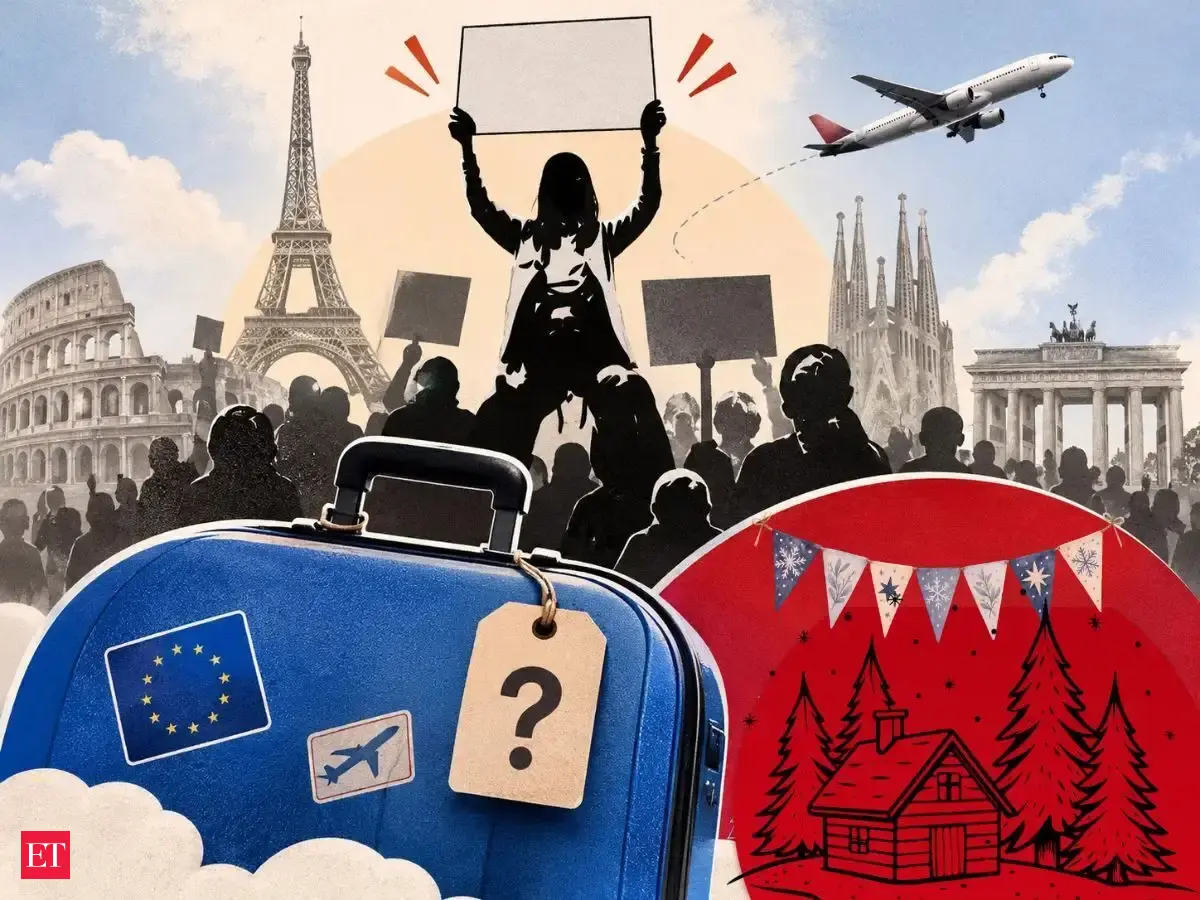
Indian tourists are turning away from Europe this winter due to ongoing protests and travel uncertainty. EaseMyTrip reported a 15%-25% drop in enquiries for traditional destinations like France and Switzerland. Many travellers now prefer places like Thailand and Malaysia, as safety concerns and visa delays cloud their holiday plans.
As the year-end holiday season approaches, Indian tourists are less interested in traditional European destinations. Protests and unrest across several European countries have raised concerns about travel safety and convenience. Many travellers are considering shifting their plans to alternative destinations like Thailand and Malaysia. Travel companies report a notable decline in enquiries for multi-country European itineraries specifically.
For many Indians, a holiday in Europe is something to save for, plan months ahead and look forward to. This year, however, protests, public disruption and uncertainty at destinations are adding another consideration to winter travel plans.
With the year-end holiday season approaching, the developments could affect travel decisions just as European tourism operators prepare for the winter rush. The impact will depend on whether travellers go ahead with their bookings, postpone trips or choose alternative destinations.
There are signs of a shift in Indian travellers' interest in parts of Europe. Online travel company EaseMyTrip has reported a 15%-25% year-on-year decline in enquiries for traditional Western and Southern European destinations during the April-June 2026 peak travel season, compared with the corresponding period in 2025.
The destinations include France, Switzerland, Italy, Spain and Portugal, although the decline has not been uniform across individual countries, Rikant Pittie, CEO and co-founder of EaseMyTrip, told ET Online.
Source: Eurostat
Meanwhile, data from hospitality consultancy MKG Consulting, cited by AFP, shows that Paris hotels have lost some of their booking advantage over last year, with the slowdown particularly visible in near-term and high-end stays.
The concerns go beyond tourism as French retailers are reporting losses from damaged stores and weaker customer activity ahead of the Christmas shopping season. For Indian travel companies, the question is whether uncertainty will translate into fewer confirmed bookings. For European businesses, the stakes extend to hotels, restaurants, retailers and other services that depend on visitor spending.
Unrest raises travel uncertaintyEaseMyTrip said the decline in enquiries reflects a broader change in travel planning rather than a uniform loss of interest in Europe.
"The 15%-25% decline primarily reflects a moderation in Indian traveller enquiries for traditional Western and Southern European destinations, including France, Switzerland, Italy, Spain and Portugal. The trend has been influenced by a combination of factors, including Schengen visa appointment delays, currency fluctuations, flight disruptions arising from Middle East airspace restrictions and broader travel uncertainty. Importantly, this appears to be more of a shift in travel planning timelines and destination preferences than a complete withdrawal of interest in Europe," Pittie said.
The company said travellers are paying greater attention to developments at their destinations before committing to international trips, particularly when their itineraries involve multiple European countries.
"Travellers today are paying closer attention to what's happening at their destination before committing to an international holiday. With protests, local disruptions and travel advisories influencing perceptions of safety and convenience, some travellers are taking a more cautious approach to Europe, particularly when it comes to planning multi-country itineraries," Pittie said.
However, fewer enquiries do not necessarily mean cancellations of confirmed holidays. Some travellers may be delaying decisions, while others could change destinations or simplify their itineraries.
"It is still important to distinguish between a decline in enquiries and actual cancellations, as not every traveller who postpones a decision eventually drops their travel plans," Pittie said.
EaseMyTrip has not disclosed the number of confirmed cancellations or the share of its European business potentially at risk.
Paris hotels see booking momentum weakenThe concern is no longer limited to what travellers might do. There are early signs of a slowdown in hotel booking momentum in Paris.
According to MKG Consulting data reported by Euronews and AFP on October 21, the booking advantage Paris hotels had over the corresponding period last year narrowed sharply within 24 hours.
For stays between October 20 and 29, the proportion of rooms booked was 1 percentage point ahead of the comparable period in 2025 on October 19. By October 20, that advantage had narrowed to just 0.2 percentage points.
For stays between October 20 and 25, the lead over last year fell from 3.5 percentage points to 1.9 percentage points. Bookings were still ahead of last year's levels, but the pace of growth had weakened. MKG said the slowdown was particularly noticeable in near-term and high-end stays.
Didier Arino, head of consultancy Protourisme, told AFP that a day of rioting and urban violence in central Paris had led to cancellations equivalent to around 1% of monthly hotel bookings.
Laurent Abitbol, head of the executive board of travel agency group Selectour, told AFP: "If this lasts two weeks, that's not so serious. However, if this continues for several months it will be catastrophic."
The numbers are an early warning rather than evidence of a tourism downturn across France. But they show how quickly images of unrest can influence booking decisions, even among visitors whose travel dates are still weeks away.
French retailers count the costThe economic consequences are also becoming visible outside the travel industry.
A Reuters report on October 29 said the French Chamber of Commerce estimated that around 2,400 stores had been damaged during weeks of demonstrations and unrest, with losses exceeding 1 billion euros. Estimates that include uninsured damage and lost sales approached $2 billion.
More than a quarter of the damaged outlets remained closed, while several other retailers had temporarily shut their stores to protect employees and property.
The French government is also trying to address the cost-of-living concerns behind the protests. Prime Minister Sébastien Lecornu announced on November 9 that the planned minimum wage increase would take effect in December instead of January.
The 1.6% increase will take the monthly net minimum wage to 1,502 euros from 1,478 euros. However, the move has not satisfied labour groups. CFDT, France's largest union, called the increase insufficient, while CGT leader Sophie Binet described it as "crumbs" and called for fresh protests on November 17, Reuters reported.
The unrest began with demonstrations in schools over underfunding in September before spreading to wider concerns over living costs, public services and political stagnation.
France is not the only country dealing with protestsThe unrest has not been confined to France, although the reasons and scale differ from country to country.
In Germany, demonstrations over education and living costs took place across 34 cities on October 31. Most were peaceful, but violence broke out in some places. Reuters reported that rioters looted stores in Frankfurt that night.
Portugal has also seen protests over housing costs and living expenses. Tens of thousands marched in Lisbon on October 17, Reuters reported. Housing activists also set up camps in Lisbon and Porto, while police cleared protest camps during October.
Spain has seen a fresh round of demonstrations over housing affordability. More than 3 million people took part in a nationwide general strike on November 11, according to unions, protesting against rising rents and evictions.
The strike, the country's first general strike in 14 years, led to demonstrations in Madrid, Barcelona and other cities. At least 115 people were arrested, mainly during evening clashes in Madrid and Barcelona. Several shops, including outlets on Madrid's Gran Via shopping street, shut amid the demonstrations and a heavy police presence, Reuters reported.
The protests come as Spain faces a housing shortage. The country has a deficit of around 750,000 homes, which is expected to exceed 1 million by 2028, according to the Bank of Spain.
For now, France offers the clearest evidence of businesses feeling the strain. The wider European protests provide context, but they should not be mistaken for a continent-wide tourism downturn.
Why the unrest matters for Indian travel companiesThe developments come at a time when Europe remains an important destination for Indian international travellers.
According to European Commission data, Indians filed more than 1.15 million Schengen visa applications in 2025, making India the third-largest source market after China and Turkey. Switzerland received 226,044 applications, followed by France with 204,184 and Germany with 153,179.
The Embassy of India in France issued an advisory on October 21 asking Indian nationals to remain vigilant, avoid large gatherings and follow instructions from local authorities. It also asked travellers to monitor local news and public transport disruptions.
Alternative destinations gain attentionSome Indian travellers are considering alternatives as uncertainty affects their holiday plans.
EaseMyTrip said travellers exploring other options are looking at Thailand, Vietnam and Malaysia, along with domestic destinations such as Goa, Kashmir and Rajasthan.
"Travel preferences are becoming more responsive to changing circumstances. When planning an international holiday, travellers are looking beyond the destination itself and considering connectivity, ease of travel and the flexibility to change plans," Pittie said.
Within Europe, the company expects some travellers to favour single-country holidays over multi-country itineraries because they are easier to manage if disruptions arise.
It is also seeing a shift towards shorter trips. "We are also seeing a growing preference for spontaneous, short-duration trips, with bookings in this segment increasing by approximately 50% year-on-year," Pittie said.
Cleartrip's booking data points to interest in a wider range of international and domestic destinations, although the company did not directly attribute this trend to the European unrest.
"Our PeekABoo Travel Trends Tracker shows that travellers are considering a broader mix of destinations, both within India and internationally. International flight bookings are growing for destinations less conventional for Indian travellers. Taipei leads with 146% growth, followed by Cebu at 117%, Dublin at 110%, Phu Quoc at 106%, and Osaka at 74%," Pallavi Saxena, chief marketing and revenue officer at Cleartrip, said.
Domestic travel also saw growth ahead of Diwali. Leisure hotel bookings increased 135% for the festival, according to Cleartrip. Udaipur recorded 316% growth, followed by Bengaluru at 189% and Jaipur at 174%. Flight bookings to Agatti rose 130%, Gaya 98% and Dimapur 80%.
Europe's tourism economy has a lot at stakeThe scale of the tourism industry makes the current developments significant.
Eurostat reported that tourist accommodation establishments across the European Union recorded nearly 3.1 billion overnight stays in 2025, an increase of 2.2% from the previous year. France accounted for 471.7 million nights, while Spain recorded 513.6 million, Italy 476.9 million and Germany 442.1 million. Together, the four countries accounted for 61.7% of the EU's total overnight stays.
Pittie said the eventual impact would depend on how conditions evolve and whether travellers postpone trips, modify itineraries or explore alternatives.
For travellers who have already booked, he advised checking airline, hotel and package cancellation conditions before making changes. Travel insurance coverage for civil unrest and government advisories also varies by policy.
"The objective should be to make a well-informed decision rather than cancel a trip solely on the basis of uncertainty," Pittie said.