
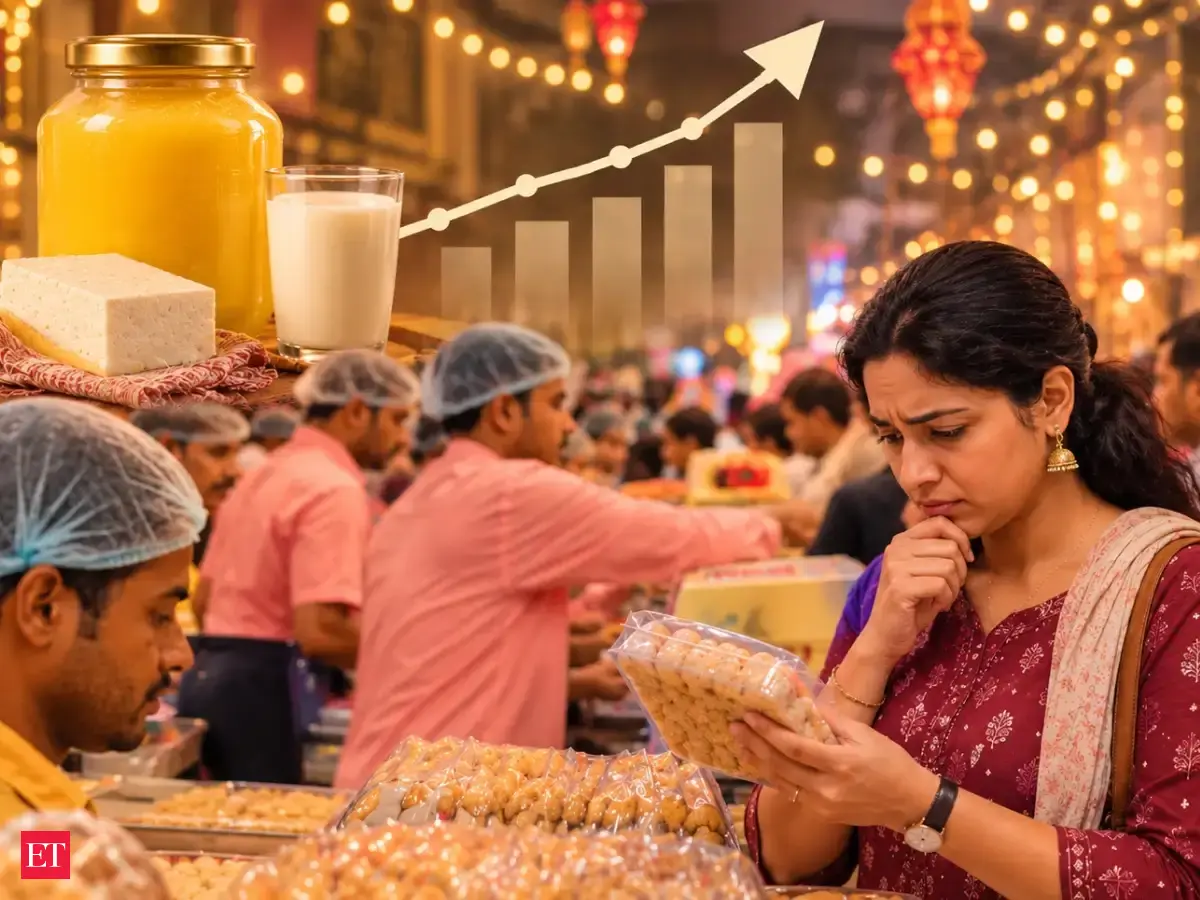
Diwali shopping gets costlier this year as prices for milk, ghee, butter, and dry fruits rise. Major brands like Amul and Nandini raised rates due to high demand and supply constraints. From November 4, the Bengaluru Milk Union revised prices, making festive sweets and everyday cooking much more expensive for households.
Milk and ghee prices: Rising costs of key ingredients are affecting both consumers and manufacturers during this Diwali season. Dairy prices have seen significant increases, with major brands raising their rates amid high demand. Additionally, dry fruit prices have surged, reaching record highs over the past year. Corporate gifting has also become more expensive, forcing companies to reduce their gift quantities or opt for smaller packages.
Diwali's celebrations may come with a bigger bill this year, as the rising cost of everyday ingredients threatens to make festive indulgences more expensive. From homemade laddoos and barfis to boxes of kaju katli and other mithai, higher raw material prices are pushing up costs for both households and sweet manufacturers gearing up for the festive rush.
The pressure extends beyond mithai counters. From everyday cooking ingredients to LPG used in household kitchens, food preparation has become costlier. India faced LPG supply shortages earlier this year amid the Middle East conflict, adding another layer of pressure on consumers ahead of the festive season.
Which ingredients are driving up Diwali costs this year?Recently, dairy majors Amul and Karnataka's Nandini have raised prices amid a seasonal surge in demand, while supply constraints have made some products increasingly difficult to find. Tamil Nadu has also announced a price hike, the first by the state-run dairy cooperative under Chief Minister C Joseph Vijay's government.
Sources told TOI that Amul's 1-kg ghee carton now costs Rs 680, up from Rs 630, while its 500-gm pure ghee pouch is priced at Rs 345, compared with Rs 325 earlier. Butter prices have also increased, with the 100-gm pack rising to Rs 66 from Rs 63 and the 500-gm pack to Rs 325 from Rs 310.
Amul raises butter, ghee prices: Check new prices and reason
The price increase has coincided with supply constraints. Amul's online platform lists different varieties of ghee between Rs 700 and Rs 740 per litre, with some products, including pure and buffalo ghee, marked as sold out.
Meanwhile, the Bengaluru Milk Union (BAMUL) has revised prices of Nandini ghee, butter, paneer and Trupti milk from November 4, following the Karnataka Milk Federation's (KMF) recent increase in milk and curd prices. Under the revised rates, Nandini ghee costs Rs 425 for a 500-ml pack and Rs 850 for a one-litre pack. Salted butter is priced at Rs 90 for 100 grams and Rs 380 for 500 grams, while paneer costs Rs 115 for 200 grams and Rs 485 for one kg.
In Tamil Nadu, state-owned dairy cooperative Aavin has increased prices of ghee, butter, curd, milk-based sweets, lassi and cookies. Its 100-ml ghee pack now costs Rs 95, up from Rs 80, while the 200-ml pack has become costlier from Rs 160 to Rs 180. This is the first price revision by the cooperative under Vijay's government.
However, the increase in input costs is not limited to dairy products.
Almonds to pistachios: Dry fruit prices soar before DiwaliPrices of nuts and dry fruits are hovering at record highs this festive season, rising by as much as 70% over the past year despite the reduction in goods and services tax (GST) in September 2025, ET Bureau reported.
Pistachios have become 60-70% costlier since last Diwali, while almond prices have risen 20-40%, depending on the variety. Peshawari pistachios, widely used in Indian sweets, have touched a record Rs 4,000 per kg, up around 40% in the past six months. Wholesale prices of in-shell pistachios have climbed nearly 74% year-on-year to Rs 1,650 per kg.
Cashew prices have increased 5-8% over the past year, while raisins have risen 2-5%, dates 5-10% and anjeer (dried figs) 5-15%, according to trade data.
Importers said sourcing nuts and dry fruits from Iran and Afghanistan has become increasingly challenging amid supply disruptions linked to the US-Iran conflict.
Companies cut back on Diwali gifts as costs soarApart from impact on households and sweet makers, the impact is also seen in the corporate world. Rising input and packaging costs have driven the prices of sweets and premium hampers up by at least 15%, forcing companies across sectors including pharmaceuticals, automobiles and fast-moving consumer goods (FMCG) to prune their gifting lists and opt for smaller packages, reported TOI.
Corporate gifting is a major source of festive business for sweet manufacturers and the packaging industry with companies placing bulk orders for employees, clients and business associates. Retailers said decorative boxes, customised packaging and presentation have become important components of corporate gifting, adding to the overall cost of orders.
Inflation impactIn September, annual retail food inflation accelerated to 7.74%, pushing headline inflation to 5.54%, close to the Reserve Bank of India's upper tolerance limit of 6%. Inflation in sugar, confectionery and desserts accelerated to 13.8% year-on-year in September from 10.9% in August and 3.4% in January, according to data from the Ministry of Statistics and Programme Implementation. Sugar prices rose 29.8% year-on-year in September, compared with 24.3% in August. Inflation in prepared sweets, excluding milk-based products, candy prices, ready-made food and namkeen also increased.
The Reserve Bank of India (RBI) has also flagged concerns over broadening price pressures across the economy. At its monetary policy review earlier this month, members cautioned that inflation was spreading beyond a handful of categories. RBI Governor Sanjay Malhotra noted that 37% of items in the consumer basket recorded inflation of over 4% in August, up from 20% in March, indicating that rising prices are affecting a wider range of goods and adding to the strain on household budgets.