
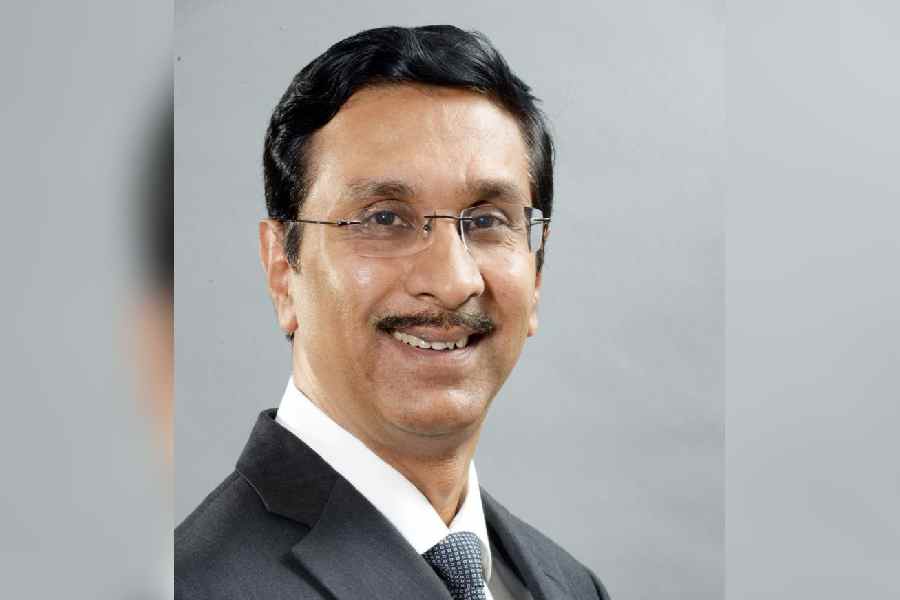
JSW Steel reported a 225 per cent jump in profit and announced a Rs 1.48 lakh crore investment plan. CEO Jayant Acharya said, "The key reason is strong demand in India." The company saw record domestic sales and better cost control, helping them fund projects to reach 62 mt capacity.
Chief executive Jayant Acharya says strong domestic sales, raw material security and a healthy balance sheet support a Rs 1.48 lakh crore investment plan over five years
Sajjan Jindal-led JSW Steel reported a 225 per cent jump in profit and announced a slew of projects worth ₹29,000 crore to reach 62 mt capacity by 2031. In an interview with The Telegraph's Sambit Saha, JSW Steel's joint managing director and CEO Jayant Acharya says domestic demand, control over cost and strong balance sheet give the company comfort to march on. An edited excerpt.
JSW's profit, revenue and EBITDA were all ahead of expectations. What was the driving force?
Jayant Acharya: The key reason is strong demand in India. In spite of the geopolitical challenges, there was 7.5 per cent steel consumption growth in the first half (H1).
We also had strong operational performance. Blast furnace (BF) 3 at Vijayanagar came back in September with utilisation above 90 per cent. Total sales and domestic sales were also the highest, growing 12 per cent, ahead of the market. We also liquidated 210,000 tonnes of inventory.
Moreover, our ability to manage costs better played its part. We contained the coking coal cost increase to about $10. The recovery of prices in the second half of the quarter, especially in long product, resulted in better numbers. Even though we made ₹1,800 less per tonne than Q1 due to lower sales realisation and higher cost, volume made up for it, resulting in better EBITDA and cash flow. It enabled us to do the highest-ever capex of ₹6,400 crore plus in Q2, and H1 capex of ₹11,136 crore, from internal accruals, and still reduce debt.
How confident are you that this momentum will continue in Q3 and the rest of the year?
In the first half, demand in India was about 85 mt. For the second half, our estimates are in the range of 92 mt, which will take us to 177 mt in FY27.
Our H2 volumes will also be better, as BF 3 will fully play out and JVML operations are now fully stabilised, and the annual shutdowns are behind us. In the US, the modernisation of Ohio and Baytown is over. We will have better volumes, and the US price environment is better, so they will do much better. So, there is good traction from both our Indian and international operations in H2.
Which are the sectors driving growth?
Public capex has been good in the first five months, about ₹5.1 lakh crore, growth of 18 per cent. I see public capex continuing in the same direction. So, infrastructure and construction will continue to drive a major part. Private capex has also started and is supplementing it. Automotive numbers are very strong. So, we will see a pickup in consumption in automotive, appliances and commercial real estate.
Is there any pocket of concern for steel demand?
We will have to watch inflation and interest rates, which may rise a bit given energy costs, as the RBI has also guided. As long as those are contained, we are fine.
From Covid to last year, through difficult geopolitical times, we added about 64 mt of demand. When the National Steel Policy was announced in 2017 with 300 mt of capacity and demand of 230 mt, we thought it was high.
Now Crisil says we are likely to end up with 235 mt demand. So directionally, while the short term always seems to bring challenges, over the medium to longer term those bumps get smoothed out. The confidence level today is better.
What is your guidance on steel prices?
We expect prices to remain range-bound. Long product prices have picked up to the levels they were at earlier. From here, it will be driven by demand. On flats, the drop was moderate, and prices have also come back to reasonable levels. So, for both products, prices have reached levels similar to, or a little higher than, where we were in April this year.
JSW announced a spate of projects. What gives management the confidence to plan ₹1,48,000 crore capex over the next 5 years?
Structurally, over time, we are trying to make ourselves stronger. In Q3FY26, when prices were at a six-year low, our EBITDA per tonne was still close to, if I recall, ₹8,800 to 9,000. In a typical crisis 10 years back, such as 2015-16, it would have been much lower. Even when stress came this time, we were at a much better level, because structurally we have built various value drivers: control over raw materials by owning iron ore mines, investments in value-added products, and larger blast furnaces. These have structurally improved our costs.
As of now, 62 per cent of JSW capex is for steel capacity and the rest for other areas. Do you see that changing, with more value-added projects being announced?
Absolutely. Last time, we announced CRNO projects at Vijayanagar, apart from the CRGO joint venture, to increase electrical steel capacity. We are focusing on both motors and transformers, because the electrification drive is the way to go. And there are many more. We will continue to add more value-added steel to our portfolio.
The steel cycle goes through ups and downs. How do you plan to navigate that and continue with the capex?
With 38 mt of capacity, including 32 mt in India, our scale generates strong cash flow to manage our capex cycle. Dolvi's expansion will further add to cash flows next year. Even if we need to take on debt, there is enough headroom. Net debt to EBITDA is now 1.28 times. We have been upgraded by Moody's to investment grade. That gives us comfort.
JSW board announced scaling up Mozambique coking coal asset. Give us a sense of where the company stands on securing raw material, a big part of JSW's competitive strength?
One of the pillars of our growth, apart from capacity, is raw material security, and coking coal is a very key area. We saw an opportunity to add capacity in Mozambique at a lower cost point.
It will give us 9 mt of clean coking coal, starting from 2028. Those 9 mt of prime low-volatile hard coking coal, plus the 2 mt of Illawarra (Australia), will give us very good control over prime coking coal, which is the most volatile in price.
We are also investing in washeries in East India, so we can wash domestic coal and use it. That will reduce our reliance on outside sources and improve our overall cost profile.
On iron ore, we now have 4 mines in Goa. The 3 mines in Karnataka will start by the end of the next half. In Karnataka, we will have about 15 mt of our own iron ore, and Goa will have 6 mt, apart from Odisha. The idea is to fast-track security. Our aim is to have 50 per cent plus on both iron ore and coking coal, and we are working towards that target.