
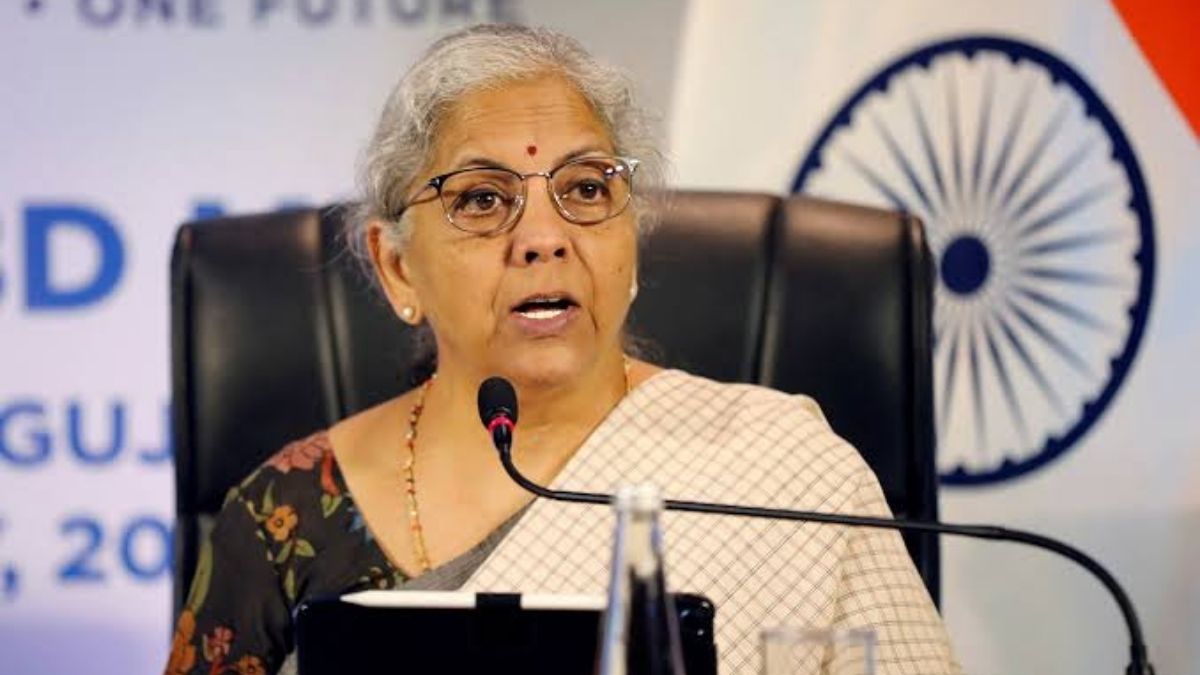
Finance Minister Nirmala Sitharaman said India’s market liquidity allows investors to exit easily despite foreign outflows. Speaking in Bangkok on Friday, she noted that strong domestic inflows helped the economy withstand $33 billion in outflows during 2026. She added that fuel, fertiliser, and foreign exchange remain key challenges for 2027.
“I would say the fundamentals of the Indian economy are fine,” Sitharaman told CNBC on the sidelines of the IMF–World Bank meetings in Bangkok on Friday when asked whether portfolio outflows were due to the persistent weakness in the rupee.
“India is probably the second-largest liquid market available, and because of the ease of liquidity and availability, investors can also exit easily. There is no fundamental weakness,” she asserted.
Strong domestic inflows, particularly through mutual funds, have helped absorb heavy foreign selling and cushion market volatility. The T+1 settlement cycle also enables faster trade settlement, while a busy IPO market offers investors additional exit opportunities. Together, these factors have helped India’s markets withstand $33 billion in foreign outflows in 2026 without triggering broader economic instability.
The rupee hit a record low of 96.96 per US dollar in May 2026 due to surging oil prices and heavy capital outflows amid the West Asia conflict. After hovering near those lows in early October 2026, the currency corrected sharply by nearly 2% to close at 94.92 on October 16 following aggressive dollar-supply measures and derivative curbs introduced by the Reserve Bank of India on October 12.
“The risks that we are facing now, even in 2027, I guess those are risks that we will have to face,” she said, referring to the three ‘Fs’ –fuel, fertiliser and foreign exchange.
Elaborating on the challenges, Sitharaman said crude oil prices, rather than the availability of supplies, remained a key concern for India. While supplies were available, the cost of imports could pressure the economy, particularly if global oil prices remain elevated.
Fertiliser prices and availability were another concern, she said, pointing to a shrinking pool of suppliers as some countries prioritise domestic requirements over exports. Securing supplies on time and at affordable prices would remain a challenge.
Sitharaman also flagged the movement of global capital towards artificial intelligence and the United States as a concern for investment in other economies. Capital that would typically flow across countries and sectors, including renewable energy and advanced chemistry, could become harder to access as investors concentrate on these opportunities.
She said fuel, foreign exchange and capital flows would remain key challenges for India in 2027, with foreign direct investment also warranting attention.
On whether India could absorb another energy supply shock given the state of public finances, Sitharaman said the government had maintained sufficient buffers to manage disruptions in crude oil supplies. These cushions had not been used significantly during the year, although some support was required during difficulties involving cooking gas.
She added that a constraint on availability would pose a greater risk than price increases alone, but said India had identified alternative sources of supply.
Asked how sustained or higher Brent crude prices would affect public finances, Sitharaman said, “It will be a challenge. To what extent, I can’t speculate,” she added.