
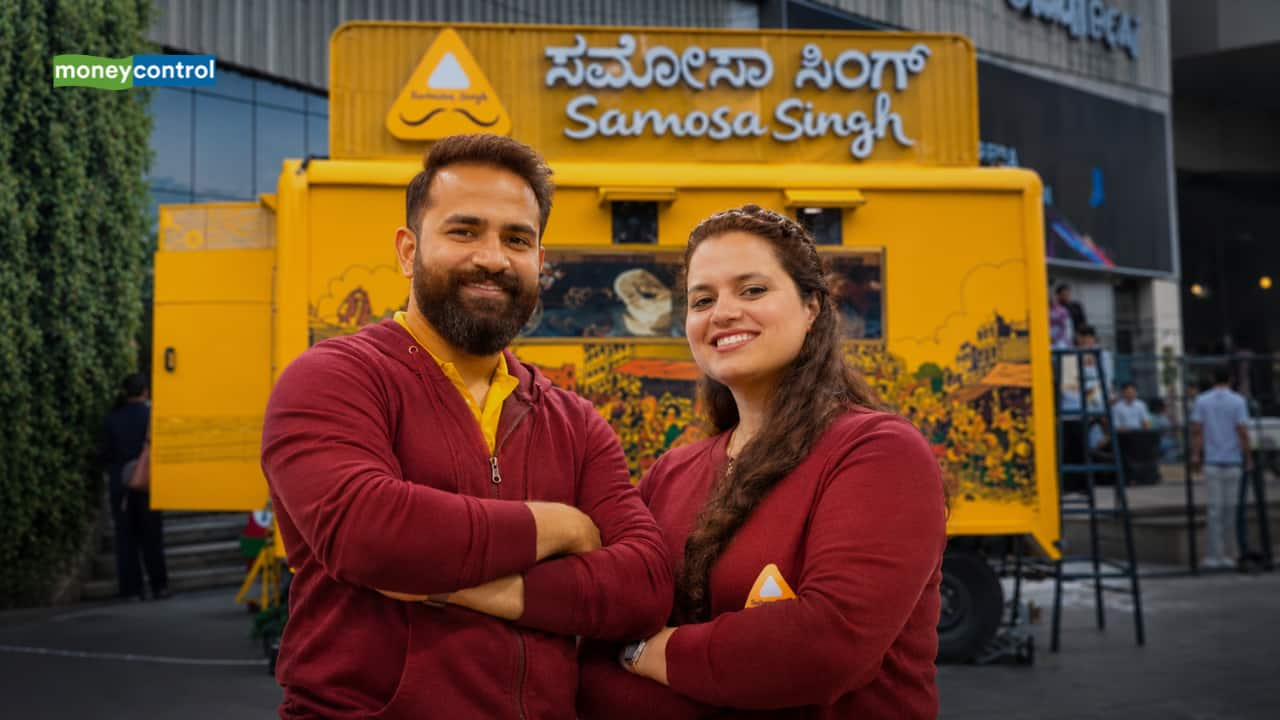
Nidhi and Shikhar Veer Singh quit their corporate jobs in 2015 to start Samosa Singh in Bengaluru. The couple sold their flat to fund the venture, which now has a valuation of Rs 200 crore as of January 2025. They turned a simple snack into a successful, organised business model.
A corporate career, a well-paying job and a home they had spent months customising. Nidhi Singh and Shikhar Veer Singh had much of what a young professional couple would aspire to. But in 2015, they decided to give it up to build a business around one of India's most familiar snacks: the samosa. The decision eventually led to the creation of Samosa Singh, a Bengaluru-based food brand that sought to bring a more organised business model to India's largely unorganised samosa market. Nearly a decade later, the company has expanded beyond its first outlet, built a manufacturing-led operation and attracted external investors.
Its valuation was pegged at around Rs 200 crore following a funding extension in January 2025, according to Tracxn data. Nidhi and Shikhar, both originally from Haryana, met while pursuing biotechnology at Kurukshetra University. After graduating in 2007, their professional paths took different directions. Shikhar went on to pursue an MTech in Biotechnology from the Institute of Life Sciences in Hyderabad. He subsequently joined Biocon in Bengaluru as an R&D scientist and eventually became a principal scientist. Nidhi, meanwhile, moved into business development at a US-based pharmaceutical company.
Starting with a monthly salary of Rs 17,000, she progressed through the organisation, received multiple promotions and was earning around Rs 30 lakh annually when she eventually left in 2017. The idea of starting a samosa business, however, had been on Shikhar's mind much earlier. During his postgraduate years, he began exploring the possibility of creating a dedicated samosa brand. His observation was that while international fast-food chains had established organised formats for burgers and pizzas, India's traditional snacks were still largely sold through independent vendors. He believed the samosa, which was familiar to consumers across the country, could be developed into a scalable food business.
Nidhi was initially unconvinced. In an earlier account of their journey, she recalled how Shikhar repeatedly brought up the idea until she eventually agreed to consider it. Shikhar resigned from Biocon in October 2015, and the couple began working towards launching the venture. The first Samosa Singh outlet opened in Bengaluru in February 2016. The founders initially financed the venture through their personal savings. However, an opportunity to secure a large corporate order soon exposed the limitations of their small kitchen. The business needed a larger production facility to handle bulk requirements.
Rather than immediately raising external capital and diluting their ownership, the couple decided to sell their apartment in Yelahanka, Bengaluru. The four-bedroom flat was worth around Rs 80 lakh. The couple had customised it during construction, changing the layout and selecting the interiors according to their preferences. They had barely spent a day in the completed apartment before deciding to sell it. "We listed our house on Magic Bricks and it sold out for Rs 80 lakh. We needed the money for Samosa Singh, and we had the conviction that we were doing the right thing," Nidhi said in an interview with The Weekend Leader, while recalling the decision.
The money helped them establish a larger kitchen in Electronic City, Bengaluru, giving the business the production capacity required to pursue bigger orders. This shift towards manufacturing became an important part of the company's operating model. Instead of depending entirely on individual outlets, the founders began building processes that could support consistent production and distribution. The founders experimented with different dough compositions, fillings and preparation methods to develop a product that could retain its crispness. The menu also moved beyond conventional potato-filled samosas.
The company introduced variations featuring fillings such as butter chicken and kadai paneer, among others. According to Samosa Singh's official website, the founders invested more than 10,000 hours in product development. The company says its approach combines standardised manufacturing, quality-control processes and structured supply chains. The business subsequently expanded its offerings beyond samosas to include other Indian snacks and quick-service restaurant products. As demand increased, Samosa Singh expanded its operations beyond its original Bengaluru outlet. Its early business model included online deliveries, corporate orders and cloud kitchens.
The pandemic presented a challenge for the food business, forcing the company to adjust its operations and manage changing consumer demand. It later resumed its expansion into additional markets. The company has operated across cities including Mumbai, Pune and Chennai, while also entering markets such as Delhi and Hyderabad. Its business model has gradually expanded beyond online food delivery. The current company website lists retail outlets, online delivery, corporate bulk orders, event catering, institutional supply and B2B partnerships among its channels. While the company has expanded its operations and attracted investor interest, its financial performance shows that scaling the business has come with considerable costs.
According to Tracxn data, Samosa Singh's operating revenue increased to Rs 18 crore in FY25 from Rs 13.9 crore in FY24, representing growth of around 30 percent. However, the company continued to report losses. Its total expenses stood at approximately Rs 23.8 crore in FY25, against which it recorded a net loss of around Rs 5.7 crore. Its EBITDA loss was approximately Rs 3.6 crore. The numbers indicate that higher revenue has not yet translated into overall profitability. Expenditure on employees, manufacturing, operations and expansion continues to weigh on the bottom line. The company has also raised external capital over the years to support its growth.
Its investors have included Fireside Ventures, She Capital and Equanimity Investments, among others. The latest valuation of the company stands at $20.6M (around Rs 200 crore) following a funding extension in January 2025. For Nidhi and Shikhar, the business that began with a small outlet and money from the sale of their apartment has evolved into a multi-city food venture.