
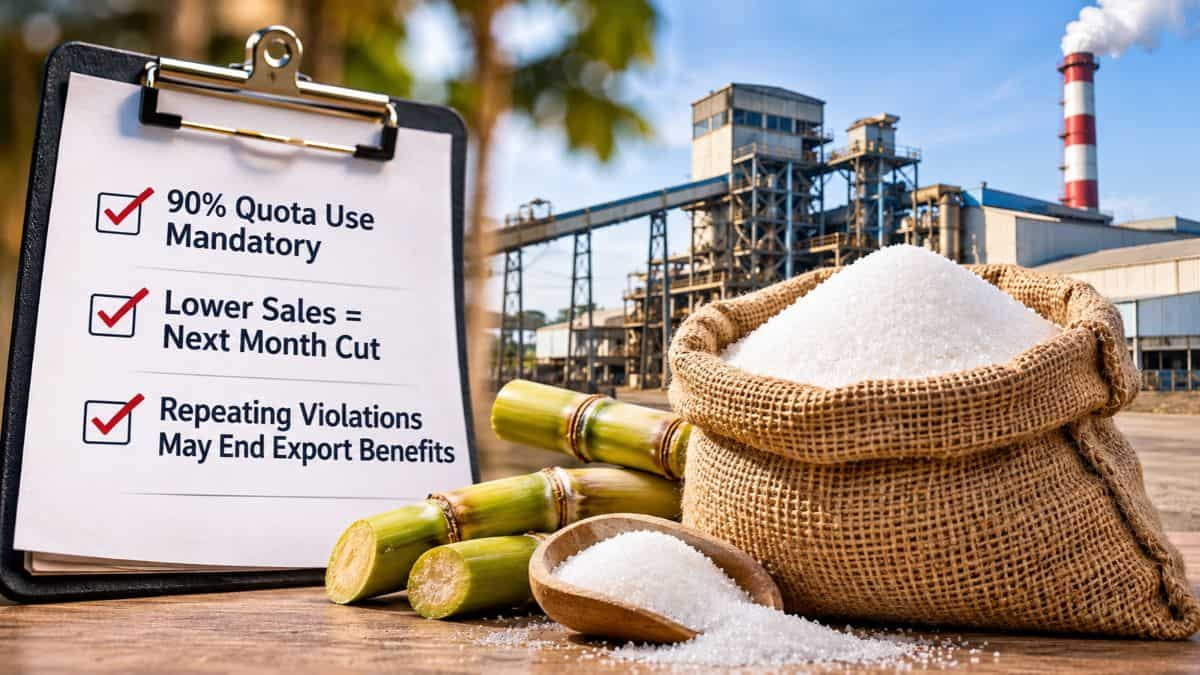
The government issued new rules on November 13 for sugar mills, making 90% monthly quota use mandatory. Mills that fail to meet this target will see their future allocations cut. Furthermore, units that break stock limits more than twice in a year may lose their export benefits and government incentives.
Government tightens sugar mill regulations, making 90% monthly quota utilisation mandatory and introducing stricter penalties for repeated stock-limit violations
Sugar mills in India will have to comply with stricter rules governing monthly sales quotas, stockholding and reporting, following fresh directions issued by the Department of Food and Public Distribution on November 13, 2026. Under the revised guidelines, mills must utilise at least 90% of their allocated domestic sugar sales quota. Failure to meet this requirement could result in a proportionate reduction in their allocation for the following month.
The government has also toughened up penalties against mills that frequently overstock prescribed limits. If units breach the restrictions more than twice in 12 months, they may lose access to export quotas and government incentive schemes. The measures are designed to increase transparency in the sugar distribution system, to avoid accumulation of stocks, and to ensure the availability of sugar for the domestic market.
90% of Sugar mills' monthly sales quota to be utilized
Under the new directions, each sugar mill must consume at least 90% of its monthly domestic sales quota. Any mills that are selling or dispatching less than the required quantity without notifying the department beforehand may be subject to action.
If a mill's usage is below 90 percent of the quota, the following month's quota will be decreased proportionately. Units that fail to meet their quota will notify the department by the 20th of the same month of their reasons for not achieving the quota.
This requirement underscores the importance of advance reporting to mills that foresee problems in the sales or dispatch of their allotted quantities. Incompleteness of information may lead to regulatory action.
Excess sugar sales will affect future allocations
The department has also toughened its approach toward sugar beyond the monthly release quota that is meant for domestic use.
Excess sales above the monthly limit will be deducted from the allocation for the next month of the mill. If the entire excess quantity is not recoverable in the following month's allocation, the remaining adjustment will be applied in the following month(s) until the outstanding amount is recovered.
Violating mills may also have trouble acquiring extra allotments. If adequate adjustments are not made, then transactions made with unregistered buyers and stocks held for more than seven days after sale may impact eligibility for future allocations.
Third stock-limit violation could cost mills export benefits
If multiple violations of stockholding restrictions occur, the penalties will be more severe. New regulations would mean that a mill that exceeds the stock levels if three times within a 12-month period would be ineligible for government benefits such as export quota and export incentives.
This is important for sugar producers because export-related allocations and government support programmes can have an impact on the management of surplus production. The stakes are raised when there is a chance that these benefits may be lost, which leads to greater financial consequences of repeated non-compliance.
The government has also made disclosure requirements for sugar stored in sugar mills under lease agreements with bulk consumers more stringent. Mills shall report such stocks to the department within three days and shall give the department information on the quantity of the stocks and the period of the lease.
Joint inspections and tougher GST reporting
The revised framework stresses more on the physical verification of sugar stocks. Mills that breach the rules could be subject to inspections by a combination of Centre and state government officials.
GST compliance is also one of the crucial factors for domestic quoting. All the sales data for sugar mills should be furnished in their GST returns classified under relevant Harmonized System of Nomenclature codes.
If domestic sugar quotas are not allocated because of failure to provide the sales details as per HSN-wise, the consequences would be disastrous. This is meant to enhance the department's reported sales and stock movement/dispatch comparison.
Government steps up monitoring of pulses and sugar prices
Stricter sugar guidelines coincide with a broader government effort to keep track of the prices of food commodities. The Ministry of Consumer Affairs held discussions with the stakeholders of the pulses industry, including processors, importers, stockists, retailers and large format retailers on 13th November.
The government requested that the industry participants start using the stock declaration system it has put in place on its monitoring portal, which is now mandatory for the industry. It also warned speculators against pushing up prices as it anticipates a good supply of pulses.
The kharif tur industry estimates about 2.5 million tonnes, while the government expects a production of 3.59 million tonnes in 2026-27. Availability was also cited as a favorable factor given available buffer stocks and imports.
However, the short-term challenge for the sugar producers is to adjust to the new quota, stockholding and disclosure regulations. The November 13 directions become effective immediately and it is critical for mills to report and comply with the monthly allocation limits. Multiple occurrences may result in penalties and potentially loss of export eligibility and government incentives.