
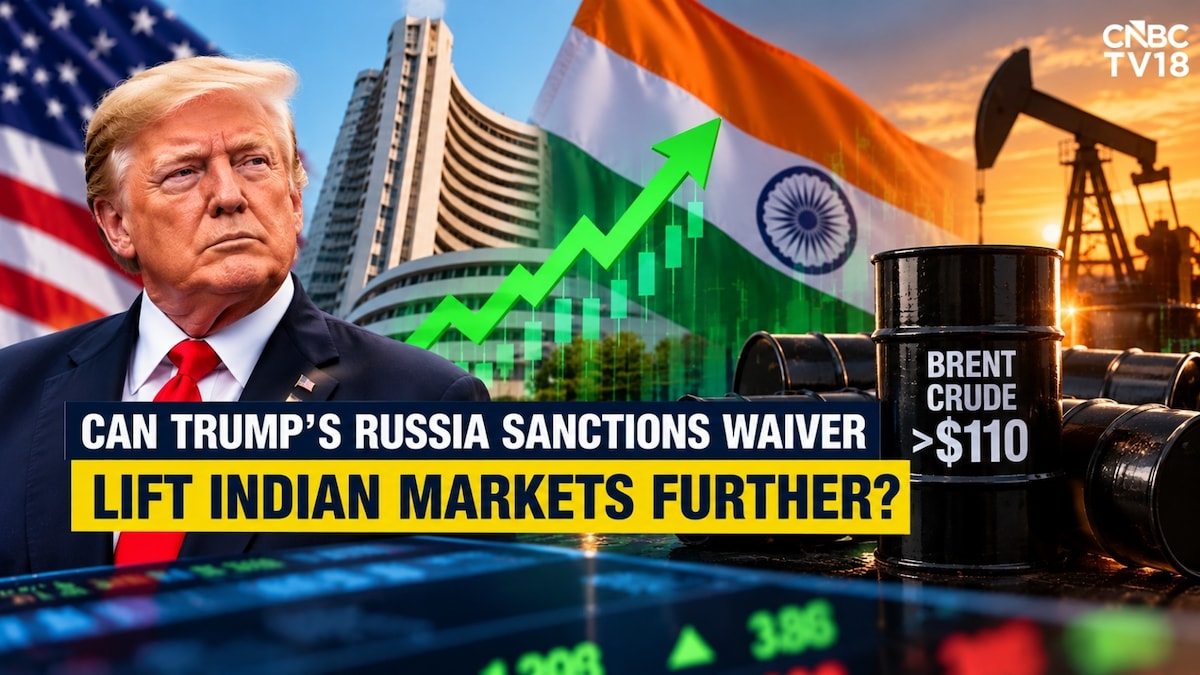
US President Donald Trump waived Russia sanctions on October 16, easing uncertainty for Indian markets. The Sensex and Nifty recorded their biggest weekly gains since April 2026, led by a strong rebound in IT stocks. However, crude prices topping $110 a barrel on October 16 remain a key risk for investors.
Trump's Russia sanctions waiver eases one source of uncertainty for Indian markets as the Sensex and Nifty extend their recovery, led by IT stocks. However, crude prices topping $110 a barrel remain a key risk.
US President Donald Trump's decision to waive new sanctions and tariffs under America's Russia sanctions law could provide some relief to Indian markets by removing an immediate source of uncertainty over the country's purchases of Russian oil.
The Sensex and Nifty recorded their biggest weekly gains since the first week of April 2026, supported by a strong rebound in IT stocks. However, with crude prices surging amid escalating geopolitical tensions and Brent briefly crossing $110 a barrel on Friday, October 16, the outlook for equities remains closely tied to energy prices and global risk sentiment.
Trump, in an executive order dated October 16, waived the sanctions, restrictions and duties provided for under the Lindsey O. Graham Sanctioning Russia and Iran Act of 2026, citing US national interests. The law had envisaged a 100% increase in duties on goods from the five largest importers of Russian-origin crude oil and natural gas if they knowingly made new purchases from October 18, subject to specified exceptions.
India, a major buyer of Russian crude, had faced potential exposure to the proposed tariffs. The waiver removes the immediate threat of these additional duties under the law while it remains in force, although it does not exempt India from other existing US tariffs or sanctions.
IT stocks lead recovery as AI concerns ease
Friday's gains extended the benchmark indices' winning streak to a second consecutive week, taking their weekly advances to the highest level since the first week of April.
IT stocks were among the strongest drivers of the recovery, with Nifty IT index emerging as the best-performing sector last week. It rose nearly 12% to record its biggest weekly gain in 18 years. The index gained another 4% on Friday to close at 31,924, its highest level in eight months.
The rally added nearly $30 billion to the combined market capitalisation of the top 10 Indian IT companies during the week. Tata Consultancy Services accounted for $13.3 billion of the increase, while Infosys added around $7 billion and HCL Technologies saw its market value rise by $5.3 billion.
The rebound followed better-than-expected results from Indian software companies and a pullback in global AI-related stocks, helping revive investor confidence in the domestic IT sector. The rally also came after the Nifty IT index had been the worst-performing sectoral gauge this year until Wednesday.
The gains in IT stocks have helped lift the broader market, although the performance has been uneven across sectors. The Nifty FMCG index fell nearly 1% over the week, while the midcap index declined 67 points to close at 59,130 on Friday. The Bank Nifty ended marginally higher at 55,844.
Veteran investor and BSE member Ramesh Damani said: "I think we are witnessing the early stages of a major rotation in equity markets. The AI-led boom, which has largely overlooked India over the past few years, is now beginning to lose steam amid higher interest rates, stretched valuations and excessive exuberance."
Crude prices remain a key risk
Despite the potential relief from the US waiver, the sharp rise in crude prices remains a concern for India, which depends heavily on imports to meet its oil requirements.
Brent crude crossed $110 a barrel on Friday for the first time since May before closing at $109.86. US benchmark West Texas Intermediate (WTI) settled above $101 a barrel, taking its weekly gain to around 10%. Brent rose more than 5% over the week.
Prices climbed as Iran escalated attacks on vessels in the Strait of Hormuz, Yemen's Houthi rebels continued attacks affecting Saudi Arabia, and Ukraine vowed to continue targeting Russian energy infrastructure.
The conflict has raised concerns over the security of energy supplies and shipping routes. Although Russian crude exports have remained above recent lows, shipments for the week ended Wednesday stood at 9.4 million barrels per day, around 70% of pre-war levels, according to energy research firm Kpler.