
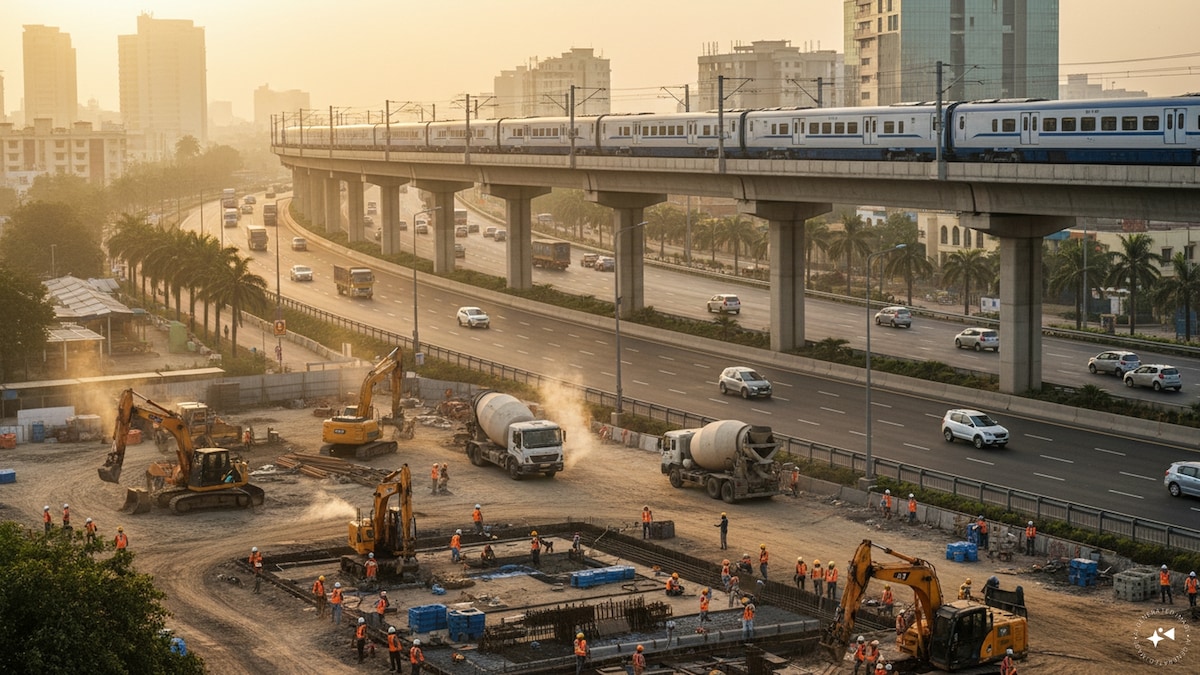
Finance Minister Nirmala Sitharaman will present the Union Budget 2027-28 on February 1, 2027. Many eyes are on whether the Centre raises capital expenditure after spending ₹12.2 lakh crore in 2026-27. This investment helped expand national highways, railways, and airports, as the government looks to boost growth and create jobs.
Public capital investment has surged multi-fold over the past decade, significantly expanding national highways, nearly universal rail electrification, operational airports, and port cargo capacity. Discover how the upcoming fiscal blueprint will balance aggressive asset creation with fiscal consolidation targets.
The Union Budget 2027-28 is scheduled to be presented by Finance Minister Nirmala Sitharaman on February 1, 2027. With infrastructure being a key area of public investment, attention will be on whether the Centre raises its capital expenditure allocation in the upcoming Budget.
India's public capital expenditure increased from around ₹2 lakh crore in 2014-15 to ₹12.2 lakh crore in 2026-27. This spending has supported the expansion of transport networks, housing, water supply and other essential infrastructure.
How much is India spending on infrastructure?
In the Union Budget 2026-27, the Centre announced a record infrastructure spending plan of ₹12.2 lakh crore. This was an increase of 8.8% over the ₹11.21 lakh crore budgeted for the previous financial year.
The increase is part of the government's effort to boost economic growth and create more jobs through infrastructure investment. Whether this spending will increase further in 2027-28 will become clear when the next Budget is presented.
Railways
Indian Railways has seen a rise in budgetary allocation over the years. The railway budget increased from ₹32,000 crore in 2014-15 to ₹2.78 lakh crore in 2026-27. Railway electrification had reached 99.6% of the network by July 2026.
Around 162 Vande Bharat services, two Vande Bharat Sleeper services and 72 Amrit Bharat services were operational. Other major projects include the Mumbai-Ahmedabad High-Speed Rail Corridor, the Kavach train safety system and redevelopment of railway stations under the Amrit Bharat Station Scheme.
Roads and highways
India's road network has also expanded. According to government figures, the length of National Highways increased from 91,287 km in 2014 to 1,46,572 km in March 2026, a rise of around 61%.
The length of four-lane and wider National Highways increased from 18,371 km in 2014 to 45,516 km. Under the Bharatmala programme, 22,590 km of roads had been completed by March 31, 2026.
The government has also launched the fourth phase of the Pradhan Mantri Gram Sadak Yojana, aiming to connect 25,000 unconnected habitations by 2029.
Airports, metro networks and ports
Infrastructure investment has extended beyond roads and railways. The number of operational airports increased from 74 in 2014 to 165 in July 2026. Under the UDAN scheme, 95 airports, heliports and water aerodromes had been connected through 679 routes by July 15, 2026.
India's metro network also expanded from 248 km in 2014 to more than 1,155 km in 2026, with metro services available in 26 cities.
In the maritime sector, major ports' cargo-handling capacity increased from 873 million tonnes per annum in 2014 to 1,728 million tonnes in 2026, according to government figures.
What could Budget 2027 bring?
The infrastructure allocation of ₹12.2 lakh crore in 2026-27 provides the current baseline ahead of the next Budget. With ongoing projects across roads, railways, airports, ports and urban transport, the Centre's capital expenditure decisions will remain an important part of the 2027-28 Budget.
The actual allocation for infrastructure in the next financial year will only be known when Finance Minister Nirmala Sitharaman presents the Union Budget on February 1, 2027.