
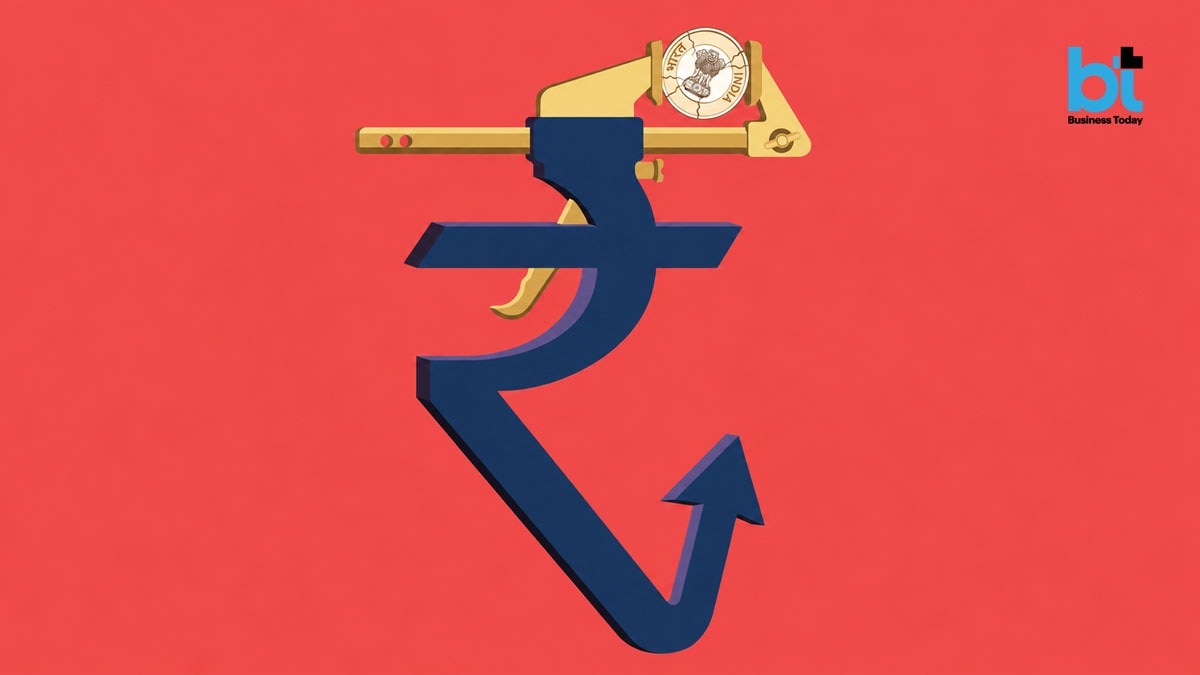
India’s growth faces pressure from rising inflation and a weak rupee. While the finance ministry expects 7.3% growth in FY27, experts warn that global conditions and oil prices could slow momentum. Krishna Srinivasan said, “The confluence of risks could be the biggest impediment to the outlook.” Challenges remain ahead.
But worries have emerged in the finance ministry and the Reserve Bank of India. This was evident in the Monthly Economic Review of the Finance Ministry for October, which pointed out that even though India’s growth has been resilient so far and could be 7.3% in FY27, ‘uncertainties remain considerable’.
A recent report by UBS says while India’s economic growth likely remained resilient at 7.5% year-on-year in the first half of FY27, it expects momentum to moderate in the second half, taking full-year real GDP growth to 7.2%. “A gradual fading of the tax impulse, tighter global financial conditions, oil price volatility and drag from a weak monsoon are likely to weigh on activity,” it says.
The International Monetary Fund recently upgraded its forecast and pegged GDP growth for FY27 and FY28 at 7%. Krishna Srinivasan, Director of the Asia and Pacific Department, IMF, says the agency remains bullish about India’s growth outlook but lists several risks, including the continuing energy price shock, tighter monetary policy that could dampen growth, adjustment in the AI cycle, as well as the effects of El Niño. “The confluence of risks could be the biggest impediment to the outlook,” he says.
At present, policymakers and the central bank are grappling with two sets of challenges emanating from external pressures that are proving to be a double whammy for the economy. There has been some reprieve for now as oil prices have cooled and investor interest in India has renewed, giving some comfort to the rupee. But how long this calm will last remains to be seen.
Price pressures
First, rapidly rising inflation is a concern, as it could squeeze household spending and weaken domestic private demand. Price pressures are being exacerbated by risks from El Niño and uncertain outlook for the kharif crop.
Since the breakout of the West Asia war, just days after the presentation of the Union Budget 2026-27, the government rolled out several measures to contain the impact of rising prices. These included cutting excise duty on petrol and diesel by Rs 10 per litre and scrapping import duty on more than 40 critical petrochemicals, polymers and chemical raw materials.
The government also kept retail petrol and diesel prices unchanged for 78 days after the war began, before eventually raising them. The delay resulted in under-recoveries of Rs 1.23 lakh crore for fuel marketing companies. On the food supply front, it has taken several supply-side measures to contain inflation, including running special Kanda Express trains to transport onions and reducing the basic customs duty on crude sunflower oil from 10% to nil, and on crude soybean and palm oils from 10% to 5%.
Despite these measures, households have felt the heat of the war from costlier LPG cylinders and secondary impact of the fuel price hike. Retail inflation rose to a two-year high of 6.09% in October with inflation in food and beverages much higher at 8.94%. It is expected to remain elevated in the coming months due to adverse base effect and deficient monsoon.
Anubhuti Sahay, Head of India Economics Research, Standard Chartered Bank, says while retail inflation is headed higher and is likely to overshoot the RBI’s upper threshold of 6% for a few months, it should start easing after that. “We expect retail inflation to average close to 5% in FY27 and 4.5% in FY28,” she says, adding that they don’t expect inflation above 6% for a sustained period.
D. K. Srivastava, Chief Policy Advisor, EY India, expects CPI inflation to average at 5.5-6% and says wholesale price inflation will be much higher.
Another factor to watch out for is global crude oil prices. However, with Democrats winning the US mid-term election, hopes have emerged for peace talks with Iran. That may improve supplies and stabilise crude prices. Brent crude prices have remained well above $110 per barrel for a large part of the year, compared to $72.8 on February 27 before the war began. The Indian crude basket averaged close to $120 before the recent fall. The price of the Indian basket is now close to $90 per barrel.
Pranjal Ghate, Economist at credit ratings agency Brickwork Ratings, says hopes of diplomatic progress in West Asia and Russia-Ukraine conflicts have raised expectations of improved global oil supplies. “While these developments offer some relief to India, a sustained easing in crude prices remains difficult to foresee without a meaningful resolution to these conflicts,” he says. The agency expects Brent to remain volatile within the $90–105 per barrel range through March 2027.
On the other hand, Bank of Baroda economists assume a 10% decline in international oil prices under the current scenario. Based on this assumption, they expect a $9-10 billion saving in the oil import bill, which is expected to be around 0.2% of nominal GDP and will support the current account deficit. They also expect the subsidy outgo to increase the fiscal deficit by 0.2-0.3% of GDP.
The government has taken measures to diversify oil imports and is now sourcing crude oil from several countries, including Russia, the US and the UAE. But continued supply shocks and higher freight have not guaranteed lower prices for now.
A falling rupee
This is not all. Adding fuel to the fire are AI investments and elevated US treasury yields that led to the second big challenge—an outflow of capital and a fast-falling rupee. Foreign investors withdrew Rs2.95 lakh crore from Indian equities between January and October 2026. The RBI took a number of measures to support the currency. These included the FCNR(B) deposit mobilisation scheme, which has attracted over $144 billion but has had limited success in stemming the rupee’s slide. Analysts believe the RBI has actively intervened in the foreign exchange market to shore up the currency, pointing to the decline in its forex reserves as evidence of such intervention.
Sahay says the pressure on the rupee amid strong external headwinds is a bigger economic challenge than rising inflation. Recent RBI measures to manage excessive hedging demand and boost forex reserves via FCNR deposits are good moves.
“However, the fundamental issues around weak capital inflows, high oil prices and AI upcycle imply these measures can manage risk but not eliminate it,” she says, adding that they expect the rupee to end the current year 2026 at about 96 against the dollar. The rupee will face pressure in 2027 as well and may end at 99 by December 2027, she says.
While domestic measures have had limited success, the rupee’s performance will depend on a variety of factors. Prime Minister Narendra Modi’s appeal to citizens to conserve foreign exchange, contain the current account deficit and support the rupee by curbing gold purchases, foreign travel and fuel consumption has also had limited effect.
Measures by the RBI and the government to boost investments in government bonds and shore up the rupee have also been only partially successful. Now, the government is looking at proposals to reduce the long-term capital gains tax on foreign investments in equities as another way to attract capital. The RBI data shows its foreign currency assets were down to $591.84 billion by the week ended October 16 from a high of $648.16 billion in the week ended September 4 as it most likely sold dollars to save the rupee. Total reserves fell to $721 billion from a high of $785.7 billion in the same period but have since then somewhat stabilised.
Srinivasan of IMF points out that many countries in the Asia and Pacific region have tried to intervene in foreign exchange
markets but that’s had a limited impact on exchange rates.
However, the tide seems to be turning. There is a change in sentiment; FIIs have bought Indian equities worth over Rs 84,000 crore in the first two weeks of November. The rupee, which fell by 4.9% in 2025 to end the year at 89.87 against the US dollar, fell further by over 6% this fiscal, touching a record low of 96.85 against the US dollar on October 7. But of late, the rupee recouped some of the losses and recovered to a seven-month high of 93.5 on November 17.
Radhika Rao, Senior Economist and Executive Director, DBS Bank sums up these recent trends and says India’s asset markets caught a break this month, supported by resilient fundamentals, global oil benchmarks (down nearly 20% below record highs), return of foreign investor interest, and diversification away from the AI-trade. “Defying a firmer dollar, the rupee has demonstrated relative resilience, benefiting from stronger portfolio flows and exporters’ tipping back into the market. Year-to-date INR depreciation has narrowed to about 4% against the USD, with the near-term bias towards FX stability while the RBI’s curbs remain in place,” she says.
However, an escalation in the West Asia conflict that could drive oil prices higher, and a deeper and broader shakeout in the AI trade would pose the key downside risks to this more supportive market backdrop, Rao warns.
A cloudy outlook
Policymakers in New Delhi remain confident about the fundamentals of the economy but concur that there are several external and domestic risks. With work on the Union Budget 2027-28 underway, they are working with several scenarios as there is no clear outlook on the immediate or even short-term situation.
Srivastava of EY India says inflation and exchange rate pressures may persist in the near term. “Inflation is driven by cost-push forces, mostly crude oil and the related global uncertainty. For at least one more quarter, the impact of the deficit rainfall will also be felt,” he says.
The pressure on the exchange rate is probably due to our inflation being higher than that in other economies, especially the US, Srivastava explains, adding that the interest rate differential is coming down. “Capital flows are also being pulled into countries with AI investments like the US and other economies. Any correction would happen only when returns from AI start coming later and the situation in West Asia and crude oil prices stabilise,” he believes.
While GDP growth in FY27 is expected to remain robust, inflation will continue to remain high this quarter before starting to ease marginally on the back of a base effect.
The economy grew 7.8% in the first quarter of FY27. The finance ministry’s monthly economic outlook has pegged second quarter GDP growth at 7.35% and for the full fiscal at 7.3%. A number of updated forecasts by international agencies also expect India to grow at over 7% this fiscal year. Official data on the second quarter GDP estimates will be released on November 30.
For FY27, Srivastava pegs real GDP growth in FY27 and FY28 at about 7% and nominal GDP growth at about 11.5% in FY27.
Sahay says GDP growth in the first half of FY27 was likely 7.5% and expects it to slow down to 6.7% in the second half. In FY28, they expect 6.5%-7% GDP growth, but risks on either side would be contingent on the external situation.
Experts point out that if oil prices continue to rise, there will be more pressure on the rupee, inflation as well as the current account deficit. If the war continues and crude oil prices remain above $100 per barrel, fiscal buffers with the government will be limited.
For FY27, the fiscal deficit target of 4.2% of the GDP for FY27 will likely be met with higher non-tax revenues from the RBI of Rs 2.87 lakh crore and sale of IDBI Bank that will bring a little over Rs 26,400 crore to the Centre as well as a possible compression in expenditure. The Centre’s fiscal deficit in the first half of FY27 rose to Rs 7.1 lakh crore, or 42.1%, of the BE from Rs 5.7 lakh crore, or 37.7%, a year ago.
DO READ: BT BIG STORY: The Rupee bounces back, but the ₹100 threat isn't gone yet
But fiscal consolidation in FY28 may be less aggressive. For one, tax revenues may not be as buoyant given slower wage growth and lower consumer spending. Higher oil prices will weigh on subsidy spending; the fertiliser subsidy is already seen at least 33% higher next year. In FY27, it will likely exceed the Rs 1.71 lakh crore in the Budget estimate. The Cabinet recently approved Rs 62,370 crore subsidy on phosphatic and potassic fertilisers for the rabi season 2026-27 in view of the recent trends in international prices.
The Eighth Pay Commission report could give a boost to private consumption in FY28. However, it would still have an impact on the fiscal deficit with an estimated bill of at least Rs 2 -2.5 lakh crore.
More rate hikes are expected by the RBI this fiscal to control inflation. This could further dampen growth with analysts expecting at least two 25 basis points hike by end of the fiscal following the 25 basis points repo rate hike on October 7.
For now, the worst fears may have eased, with softer crude prices and renewed foreign investor interest offering some respite to the rupee. But the underlying vulnerabilities remain.