
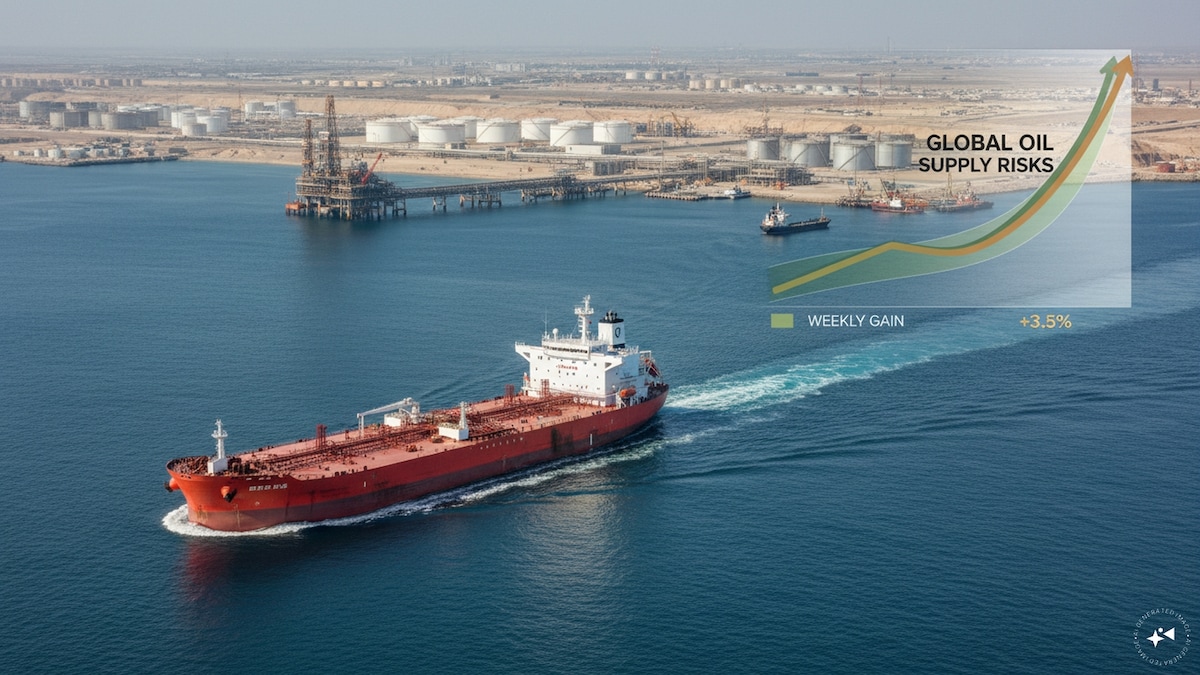
Oil prices headed for a second consecutive weekly gain on Friday October 16, as supply threats in West Asia outweighed the prospect of emergency stockpile releases. Brent crude hovered near $106 a barrel. Traders got worried after a ship sank in the Strait of Hormuz, even as oil flows continued.
Oil prices head for a second consecutive weekly gain near $106 a barrel as supply threats in West Asia, including a shipping attack in the Strait of Hormuz, outweigh potential emergency stockpile releases.
Oil prices headed for a second consecutive weekly gain on Friday October 16, as fresh supply threats in West Asia outweighed the prospect of another release of emergency stockpiles.
Brent crude hovered near $106 a barrel in early Asian trade, changing hands at $105.7, and gained almost 1% over the week. West Texas Intermediate (WTI) traded around $97, with the November contract slipping 0.6% to $97.43.
WTI outpaced Brent this week and narrowed the gap between the two benchmarks.
Cheaper freight lifted demand for American barrels as data from the Baltic Exchange in London showed that the cost of shipping a typical cargo of US crude from the Gulf of Mexico Coast to Rotterdam fell about 12% in a week.
Traders seemed to be concerned primarily about the Arabian Gulf, where doubts about a recovery in physical flows deepened after a fresh attack on shipping. US Central Command said on Thursday that an Iranian projectile struck a container ship that later sank in the Strait of Hormuz.
The Trump administration on Thursday announced fresh Iran-related sanctions targeting 16 individuals and 10 entities, according to a notice published on the US Department of the Treasury's website.
The Singapore-flagged GFS Pride went down while under tow to shore, and the Central Command blamed the Islamic Revolutionary Guard Corps (IRGC) for the strike. Even so, more than 40 vessels crossed the strait in the previous 24 hours, which suggested that flows continued, a Bloomberg report said.
The Energy Information Administration reported that crude inventories dropped by 8.6 million barrels last week, their steepest fall since February. Shut-ins caused by Hurricane Isaias, strong refinery runs and exports all contributed to the draw.
Meanwhile, International Energy Agency (IEA) members agreed to release the remaining 100 million barrels from a March intervention designed to cool fuel prices.
After its governing board met on Thursday, the agency said governments would speed up the remaining volumes, including 20 million barrels of diesel, "as soon as possible". Members had tapped 330 million barrels of the 400 million they originally pledged.
US officials had lobbied informally for an additional release to ease diesel prices, as per an earlier Bloomberg report, but they tabled no formal proposal at Thursday's meeting. European officials, according to the same report, doubted that now was the right time to free up extra barrels.
The US Energy Department said further steps "with a focus on diesel are under review and in progress".
The department also criticised European governments. It said the Trump administration "continues to hold European nations accountable for failing to fulfill their previous commitments", and added that, after President Donald Trump's G7 announcement, all European IEA members had promised to complete their March commitments immediately and release additional barrels.