
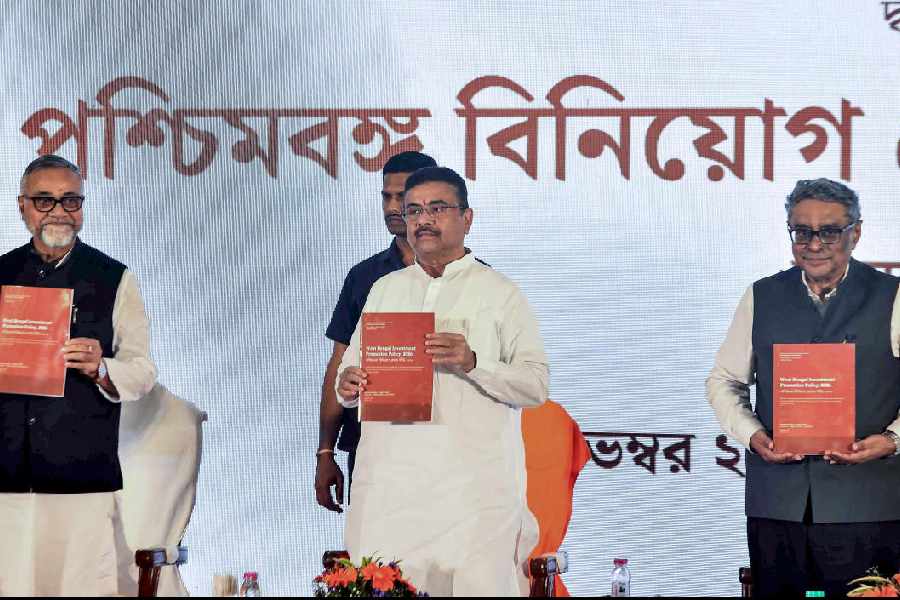
Bengal CM Suvendu Adhikari promised a new approach for Singur while unveiling the state’s investment policy on Thursday. Adhikari said, "We will not use police to forcibly acquire land." The government now plans to purchase land directly for industries, moving away from the hands-off policy followed by his predecessor.
"We will not use police to forcibly acquire land, we will not allow bullets to be fired (like during the Left Front government)," says the chief minister
Bengal chief minister Suvendu Adhikari on Thursday hinted at redrawing the landscape of Singur, the seat of the anti-land-acquisition movement two decades ago that went onto crush the state's dreams of an industrial revival.
"We will do something about Singur. Talks are on with Ashok Leyland," Adhikari said in reply to a question at the unveiling of the Bengal government's new investment promotion policy.
"We are very clear on two things. We will not use police to forcibly acquire land, we will not allow bullets to be fired (like during the Left Front government). We also won't say we are the government and we will not get involved in procuring land for industry," Adhikari said, referring to his predecessor Mamata Banerjee's hands-off land policy.
"We will purchase lands ourselves. Talks are on with HUDCO, NABARD, ADB for funds to purchase lands. We have handed over land to companies in Panagarh and Haringhata," said Adhikari.
The 34-page investment promotion policy document in three languages makes no mention of land, a traditional stumbling block in Bengal's industrial push.
What role the government should play in acquiring land for industries has always been contentious in Bengal.
The Left Front went for forcible acquisition.
Mamata, who unseated the Left riding on the angst against it, advocated a strictly hands-off land policy.
The episodes in Singur and later Nandigram not only marked the undoing of the then-ruling Left Front but also raised investor concerns about land availability in Bengal in the years that followed.
Despite Mamata's business summits held with much fanfare during her 15-year rule, converting investment proposals into industrial projects remained a challenge.
Mamata Banerjee came to power in 2011 riding high on the political dividends of the anti-land-acquisition movement, which also catapulted Adhikari to Bengal's political stage in a big way when he was a Trinamool Congress leader.
While in power, Mamata and her administration largely left the purchase of land for industrial projects to private companies.
He said the government had, over the past six months, handed over land to 33 business groups, including Amul, Vedanta Group, Campa Cola and Reliance, to set up new plants or expand existing operations.
"In the next few months we can facilitate investments of around Rs 1 lakh crore in Bengal," he said.
The chief minister said the cash-strapped Bengal government was not in a position to clear industrial incentive dues totalling Rs 50,000 crore.
"The previous government had cheated industrialists. Had they cleared Rs 7,000 crore to Rs 8,000 crore every year we would not have reached this situation.
"Only when Bengal becomes a financially surplus state we can look at clearing the dues."
Sidharth Pansari, managing director of Primarc and former president of CREDAI Bengal, said the new policy was a positive move for Bengal.
"More industries mean more jobs, and more jobs naturally create demand for homes, offices, retail spaces and supporting infrastructure. This can open up opportunities for real estate beyond Kolkata, particularly in emerging growth centres across the state," said Pansari.
"The focus on easier land availability and faster clearances is encouraging and can give fresh momentum to investment, urban development and the state's real estate sector."
Ajay Jain, chairman of the IIM Calcutta Innovation Park board, said the new policy could create opportunities for start-ups in Bengal.
"The policy's specific provisions for R&D are particularly significant, as they can help strengthen the link between academic research, technological innovation and industrial applications," said Jain.
"Encouraging industry-led research and creating pathways for startups to commercialise innovative solutions could help West Bengal develop a stronger pipeline of technology-driven enterprises."