
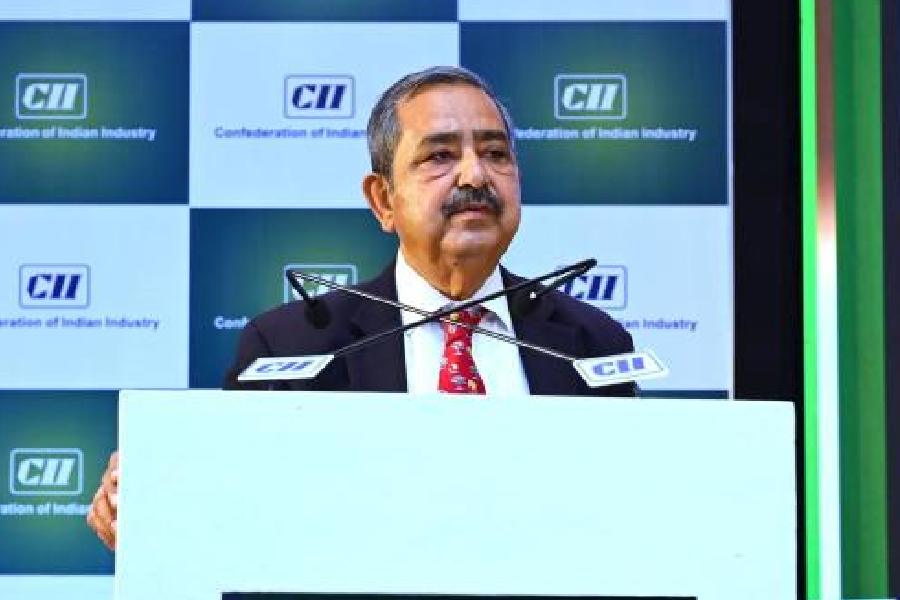
Niti Aayog vice-chairman Ashok Lahiri said Bengal needs large projects to boost its economy. He suggested a deep-sea port and a modern industrial park in Singur to help. "Such projects would serve as a wake-up call for investors," he said at a Calcutta event on Friday. Bengal’s credit-deposit ratio remains low.
The Niti Ayog vice-chairman has identified a proposed deep-sea port and a modern industrial park in Singur as potential catalysts for a turnaround
Niti Aayog vice-chairman Ashok Lahiri has argued that Bengal needs a decisive shift in its industrial strategy, proposing large marquee projects and fresh investments in manufacturing to reverse the years of economic stagnation and lift the sluggish credit-deposit ratio.
Lahiri has identified a proposed deep-sea port and a modern industrial park in Singur as potential catalysts for a turnaround, alongside the establishment of some large manufacturing units and a stable, predictable industrial policy.
According to Reserve Bank of India data, Bengal's CD ratio stood at 51.6 per cent in 2025, significantly below the all-India average of 80.1 per cent. The ratio, which measures the proportion of bank deposits deployed as loans, was 151.1 per cent in Andhra Pradesh, 115.4 per cent in Tamil Nadu and 111.6 per cent in Telangana.
The CD ratio is a measure of how much local savings get recycled into local investment, and reflects the credit demand in a state. The higher the number of industries, the greater the demand for credit, which leads to a higher CD ratio.
"There are two important, interrelated steps to increase the CD ratio. First, the state has to unleash high investment and growth by launching a couple of marquee projects to announce the start of a new epoch of growth. Setting up a state-of-the-art deep-sea port and launching a modern industrial park in Singur could be good examples," Lahiri said at a CII-organised event in Calcutta on Friday.
"In a state where aspirations have collapsed, such projects would serve as a wake-up call for investors, businessmen, bankers as well as the general public."
The Suvendu Adhikari government has proposed a deep-sea port at Dadanpatrabar in East Midnapore and is looking to revive Singur as an industrial destination. State BJP president Samik Bhattacharya has reportedly urged the government to consider setting up a chemical park at Singur.
Lahiri said the second step should be to attract a few large manufacturing units, whose investment requirements and demand for bank credit could be equivalent to those of hundreds of micro, small and medium enterprises (MSMEs).
"Banks find it cheaper and administratively more convenient to lend to one large unit than to many MSMEs. Large units already have an available credit history and credit appraisal is more convenient," he said.
Lahiri also pointed to Bengal's relatively low industrial base. India has around 2.6 lakh registered factories, or an average of 18 factories per lakh population. The corresponding density is around 10 in Bengal, reflecting the scope for expanding the state's manufacturing footprint.
Industry policy
Policy certainty, Lahiri said, would be equally important in attracting investors. He noted that the previous Bengal government had introduced an industrial incentive policy and then withdrawn it, creating uncertainty for businesses.
"One of the most essential things for industrial development is certainty. Businessmen do not like uncertainty. I hope the new policy of the current state government is framed in such a way that it continues for a long time. Businesses also go and invest in places where they can make money," Lahiri told The Telegraph.
The Bengal government is expected to unveil a new industrial policy soon, with Suvendu indicating that the announcement could come as early as next week.
The policy may include exemptions for specified periods on power costs, electricity duty and state GST; interest subvention on industrial credit; and the government shouldering the employer's share of provident fund contributions to promote employment.
Lahiri told this newspaper that the policy should also provide clarity on the incentives and establish a transparent framework for land acquisition, including adequate rehabilitation and compensation for the land-losers.
He argued that Bengal's high population density and dependence on agriculture made the balancing of industrial growth and land use particularly important. He, however, cautioned against allowing land-related concerns to become an impediment to industrial development.
"Lakhs of acres of land may not be needed for industry. Industry will not go and locate near Kanchenjunga or in deep jungles. They will look for strategic positions. So, a few thousand acres that are close to rail or port should be the obvious choice," he said.
Lahiri advised a rational approach to land acquisition, backed by a corruption-free, smooth and legally sound process with proper compensation for the land-losers.
Bengal, he said, needed to recognise that industry was key to providing gainful employment to its large population, even as it protected the interests of those dependent on agriculture.
Industries minister Tapas Roy said at an event organised by the Bengal Chamber of Commerce later on Friday evening that the state's industrial policy was in its final stages.
"We will provide transparent land allotment, simpler and time-bound approvals for building plans, land conversion, mutation and trade licences. Incentives will reward employment generation, not merely the size of investment," Roy said.